EKIP– Expert Club for Economics and Politics A Different Opinion
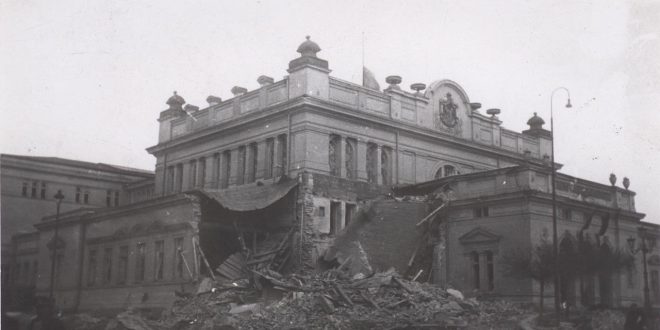
The number of Bulgarian victims and victims of World War II (1939-1945) was relatively small. After its beginning, the authorities sincerely tried to maintain neutrality, but on March 1, 1941, they joined as allies of Hitler's Germany, and at the end of the same year they declared a "symbolic war" on the USA and England. The communists began resistance to the regime not when Bulgaria became part of the Rome-Berlin-Tokyo axis, but when the Wehrmacht attacked the Soviet Union on June 22, 1941. People died in the resistance on both sides. There were victims and victims from the Anglo-American bombings in 1943-1944 and from the Bulgarian participation in the military operations against Germany in the final stage of the war in 1944-1945.
A little-known category of victims and sufferers of the war are those convicted of violations of countless state economic regulations.
State control over the Bulgarian economy during World War II
The wartime organization of the economy is characterized by increased state intervention and strict regulation of all aspects of economic life. Standard policies include measures to eliminate market mechanisms, limit consumption, including through the so-called distribution cards (coupons), price controls, etc. Typical of the state machine during the war is the creation of organizations with similar and often overlapping functions, which leads to a lack of coordination and a clash of interests between them. Among the established administrative structures is the Food Export Directorate, which has the monopoly right to purchase basic agricultural products. The Main Commissariat for Supply also has important functions.
In March and April 1940, two bills were voted in the National Assembly, which became the legal basis for wartime economic organization. The first was for civilian mobilization, the second for ensuring supply and price regulation.
The Civil Mobilization Act established the Civil Mobilization Directorate within the Ministry of War as the main state instrument for managing the economy. Article 22 of the Act gave the Council of Ministers the right to prohibit the export of any products, to regulate and limit trade, to regulate and direct agricultural and industrial production, and to determine prices, wages, and profits.
The bill on ensuring supply and regulating prices further develops the above trends. In the explanatory memorandum to it, the Minister of Trade, Industry and Labor, Sl. Zagorov, noted that after the start of the war, conditions had been created in Bulgaria for “reprehensible and dangerous speculation for the order in the country”. It was expressed in “unjustified” price increases, concealment of available goods and refusal to sell them, purchase of more goods than necessary, etc. By virtue of the proposed and adopted bill, the Minister of Trade, Industry and Transport received the right to determine wholesale and retail prices, to determine the amount of profits in trade, transport and production. Chapter 8 of the law includes penal provisions – fines and various terms of imprisonment for speculation. Compared to the laws in force until then, the sanctions have been strengthened and more criminal groups have been provided for. Not only sellers of goods with unregulated prices are punished, but also buyers who knowingly purchase such goods. In July 1942. The penalties are excessive, with the death penalty being provided for speculation on particularly large scales.
It is striking that under the two laws, adopted at approximately the same time, prices in Bulgaria are set differently. The Civil Mobilization Act stipulates that prices are set by the Council of Ministers, while under the Supply Assurance and Price Regulation Act, they are set by the Minister of Trade, Industry and Transport.
To overcome the lack of coordination between the various administrative units, the Supreme Commissariat for Wartime Economy was established in 1943. Its main task was to coordinate the activities through which the wartime economy was managed. The creation of new and the reorganization of old structures did not eliminate commodity shortages, but increased bureaucratic chaos.
The other dimensions of the state's grip on the economy
Even a cursory review of the victims and victims of the persecutions against the so-called black market traders reveals a picture that is startling in its banality and pettiness. The cases presented here have been randomly selected from among the many administrative decisions and court sentences under the Law on Ensuring Supply and Price Regulation. The mass of violations of the law has also been noted by the periodical press. A letter published in the newspaper "Utro" on January 6, 1943 from Vratsa stated that there were many agents of the "black market" in the area who bought food products from the rural population and resold them in Sofia. The black market traders used BDZ subscription cards to get to the capital faster and cheaper.
In January 1943, eight people were sent to "hammer stones", i.e. to forced labor in the Atia quarry near Burgas because of "speculation". Among them was Solomon Mercado Cohen, who "stocked up on a large quantity of cheese", bought at an excessively high price, and also Boris H. Nikolov, who sold the cheese to Solomon Mercado. In February 1943, the housewife from Sofia, Tsvetana Modeva, was sentenced to one year in prison for illegally acquiring a distribution card. At the same time, K. Pakovski from the village of Staroseltsi (Pleven region) was sentenced to 6 months in prison and a fine of 20,000 leva for not handing over a quarter of a requisitioned pig to the state representatives. In the summer of the same year, the Haskovo Regional Court sentenced two bakers: P. Valchev Hubenov to 6 months in prison and a fine of 20,000 leva for unaccounted 2,310 kg. of flour and Vashan S. Kochiyan to 3 months in prison and a fine of 10,000 leva for unaccounted 1,344 kg. flour. In Targovishte, Bilyal Ibryamov was arrested while carrying 100 meters of fabric, which he purchased at prices above the norm. In the village of Enina (Kazanlashko), the local merchant Dyanko Gerdanov was detained because he purchased 100 pairs of rubber soles and several dozen pairs of rubber boots at prices above the norm. He intended to sell them at a premium to his fellow villagers. In Plovdiv, a resident of the village of Bogdanitsa was sentenced to 1 year in prison because he sold 16-17 kg. flour at a price higher than the norm. Three people were forcibly evicted from Stara Zagora for smuggling hides and slaughtering livestock without a permit.
The chronicle of the arrested and convicted speculators also includes larger-scale transactions. In every major city in the country, various cases of illegal sales of flour, fodder, wood, iron, turpentine, etc. were registered. In these cases, the sentences were much stricter. In January 1943, Sofia merchant Solomon Samo was sentenced to death by hanging for speculating with rubber tservuli, gyon, barchet and hase. In the same case, Georgi Stoimenov received a life sentence. In the spring of 1943, the Sofia Regional Court considered a case of a sewing thread affair. Sofia merchant T. D. Stoyanov imported 10,000 cones of cotton thread from Switzerland for his factory. Instead of using them in production, he sold them on the black market for a profit of over 1.1 million leva. The merchants to whom he sold the threads also made huge profits. A total of 11 people were brought as defendants in the case. The court issued 3 death sentences, 2 life sentences, and the remaining defendants received various terms of imprisonment and fines. Sliven manufacturer Asen Sarivanov also received a life sentence for selling cloth at a price higher than the norm.
In some cases, the state took advantage of the existence of various scandals and, in addition to convictions, carried out the nationalization of private enterprises. Thus, the Minister of Trade N. Zahariev issued a punitive decree, which nationalized the mill of the Piskyulevi brothers from Kazanlak, because they produced flour mixed with waste and sold it as high-quality to the bakers of the city. For a similar reason, the mill of the Mutafovi brothers from the village of Devetak, Karnobatsko, etc. was also nationalized. Obviously, the forcible seizure of private property did not begin with the imposition of a socialist regime.
So what of it?
The other victims and victims of World War II are not heroes, they have no monuments and are not celebrated on national or party holidays. However, it cannot be denied that their lives and freedoms were severely affected by events for which they were not at all to blame. They did not steal or kill, they did not create the shortages and increased demand for all kinds of goods. Many of them satisfy the needs of people who are also not to blame for the war, for the restrictions and for the state control over the economy.
The Bulgarian state is also not to blame for the war, but it must be borne in mind that the measures it took after its beginning were not an expression of a new policy. The Second World War accelerated trends that had a decades-long tradition. Through nationalizations, restrictions and propaganda against profit, the backbone of the Bulgarian bourgeoisie was finally broken. The state machine systematically treated the pursuit of market profit as a criminal activity. In this situation, after September 9, 1944, there was no one to defend capitalism.
Pencho D. Penchev