EKIP– Expert Club for Economics and Politics A Different Opinion
Let us not be fooled. The European economy is on the brink of recession. In the past few months, industrial production in Germany has fallen to its highest levels since 2013 (during the Euro crisis). This has dragged down the industry of a number of other European countries, such as Bulgaria, which rely on Germany as a major export market for manufactured goods. Meanwhile, another of our key trading partners – Italy – is already in a technical recession – on an annual basis, GDP continues to grow weakly, but falls quarter-on-quarter in the second half of 2018. The peak of the current business cycle has definitely passed. From now on, in the short term, we will not see an improvement in economic growth in Europe, but only a deterioration.
The reasons for this are complex. The process of slowing growth is natural from the point of view of the fact that the global economy as a whole began to slow down after the huge monetary stimuli that central banks poured in for years were, if not completely stopped, then at least temporarily paused. Growth in China has also slowed down significantly and this is actually one of the factors that weakened Germany's industrial exports and Europe's exports in general. In the future, however, the key external market for the European Union to which we should turn our attention is the United States. Because this year, negotiations are most likely to take place between the Donald Trump administration and the European Commission on the terms of trade relations between the United States and Europe.
What is the state of the EU economy?
The short-term fate of the EU economy is in Trump's hands. With a snap of his fingers, the American president could send the European economy into recession. All he has to do is raise tariffs on European cars imported into the American market. If that happens, exports from countries like Germany and Italy will collapse. The former has fragile industrial production, while the latter is already in a near-total recession.
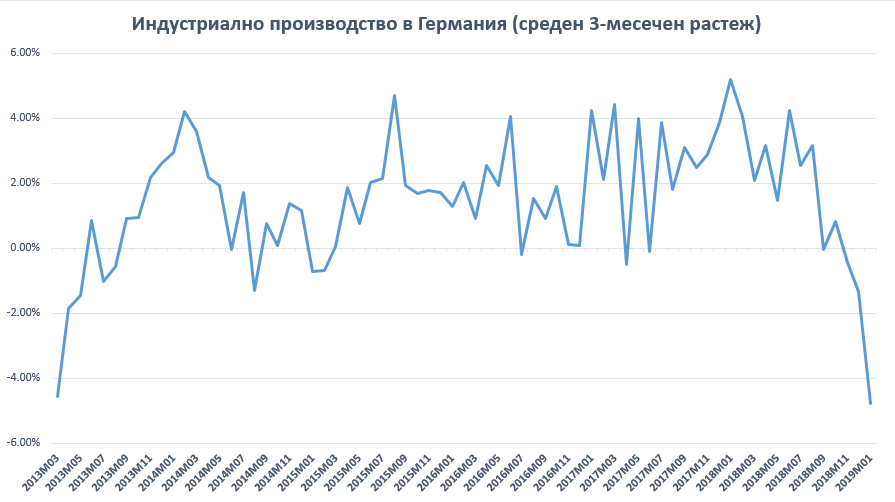
The chart below shows the quarterly average growth rate of industrial production in Germany for the past 6 years. As can be clearly seen, in late 2018 and early 2019, German industrial production not only stopped growing, but began to fall precipitously, reaching and even surpassing the levels of decline recorded in early 2013. Note that in 2013, the Eurozone was still in crisis, mainly related to the economic and fiscal problems experienced by countries such as Greece, Italy, Portugal and Ireland, which caught up with and plunged the entire Eurozone into recession. The fact that industrial production in Germany is currently in a worse state than it was then is indicative of the weakness of the German economy.
Source: Eurostat
And if Germany's economy is weak, then the economy of the entire European Union is weak. This is because Germany is the engine of the Union's economic growth. It is the economic tiger that absorbs a huge amount of resources from the periphery of the EU, uses them to produce products with very high added value and exports them to the world market. Yes, other large economies such as Italy are also of great importance and the fact that the latter is currently almost in recession has a negative impact on economic activity throughout Europe. But no member state is as key to the economic state of the entire union as Germany.
Why does the entire EU depend on Germany?
For many small member states, such as Bulgaria, Germany is the largest trading partner. Of the small economies in the EU, the only ones that do not rely on Germany as a major export market are the Baltic states, Portugal and Greece. All the others, from the Netherlands and Belgium, to Denmark, the Czech Republic and Slovakia, to Bulgaria and Romania, rely on Germany as a major export market. And what are these exports? The largest export categories in these countries are almost always cars, car parts and other materials used in the automotive industry.
That is, these countries rely to a very large extent on stable and strong demand from the automotive industry in Germany in order to realize high exports, which in turn would contribute to higher GDP growth. This means that they rely on car production in Germany to go ahead and do well. And when instead the industry there shrinks, this leads to poor GDP growth not only in Germany, but also in at least half of Europe. That is why, in parallel with the decline in industrial production in Germany at the end of 2018/beginning of 2019, difficult growth or a direct decline was reported in industrial production and exports of all of the above-listed countries. In Bulgaria, this influence was also felt very clearly.
The complex web of intra-European trade relations and economic dependencies should have become largely clear to you by now. In short, the good performance of the German economy (and the industrial sector in particular) is a necessity for the good performance of all other economies in the EU. Now imagine what would happen if US President Donald Trump declared a trade war with the EU and decided to impose heavier tariffs specifically on imported cars from the Old Continent, at a time when the state of the German car industry is already quite bad. It is precisely the import of cars from the EU that is the most frequent target of Trump's trade rhetoric, because the US president regularly expresses the opinion that the US car industry needs protection from external and "unfair" competition, as he sees the EU's trade policy. If, in addition to being the subject of his rhetoric, European cars also become the subject of his trade policy, this would put Germany and the entire European Union into an almost immediate recession.
How can Trump put Germany into recession?
This is no exaggeration. The US is Germany's largest trading partner and one of the three largest for Italy and France. And Germany's main export is cars. A hit to 1) Germany's largest export, 2) its largest foreign market, 3) in the context of already stifling economic growth means a guaranteed recession. And if Germany falls into recession, all other member states, especially the smaller ones, will also experience serious economic difficulties.
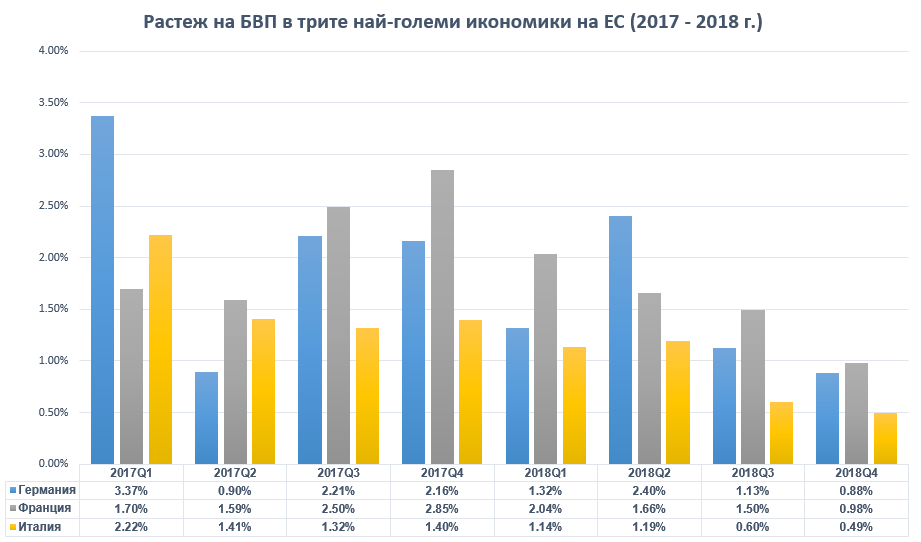
A potential trade war might not have pushed the EU into recession in 2017 and even the first half of 2018, when economic growth in the union was reaching peak levels for the last decade. However, in the current situation, in which German industry is suffocating and Italy is in a technical recession, declaring a trade war would completely bury economic activity in the EU. In the graph below, you can see how GDP growth rates (on an annual basis) in the three largest economies of the EU have moved over the past 2 years.
Source: Eurostat
As it turns out, economic activity growth slowed down significantly in the second half of 2018, falling below 1% in Italy, Germany and even France. In this situation of suffocating European growth, Donald Trump holds all the trump cards in trade negotiations with the EU. With a snap of his fingers, he could put the whole of Europe into recession, and the European Commission is probably already aware of this fact. Yes, a trade war would also hurt the US economy (as we saw in the case of China), but in the current economic situation it would not suffer to the same extent as the European one. Simply because the largest economies in the EU are already reporting almost no growth even without a trade war, while US GDP continues to grow at a significantly higher rate.
For whom is a potential trade war more dangerous?
In the last quarter of 2018, US GDP even exceeded analysts' expectations (while Germany's disappointed them) and reached 3.1% on an annual basis. This is three times higher than the growth of any of the largest European economies! It should be noted, of course, that the US is also already seeing the first signs of an impending recession, most obviously in the dynamics of interest rates on government debt (short-term interest rates exceed long-term ones, which is an indication of a credit shortage and an impending recession). It is no coincidence that the Federal Reserve Board (the central bank) announced at its last meeting that it will most likely not raise interest rates in 2019. This is a clear sign that the Fed believes there is a serious risk of recession if US debt continues to rise in price, which will certainly be interpreted in an appropriately pessimistic light by financial markets and businesses.
But even in this context, it can be said that the American economy has a much larger “buffer” than Europe, which can withstand the blow of being drawn into a trade war. After all, growth in the United States is over 3%, while in Germany it is below 1%. It is obvious that at the moment the European economy is much closer to recession than the American one. It is precisely this time window in which the recession in the United States is further on the horizon than that in the EU that Trump will most likely take advantage of to pressure Brussels to accept his terms in the renegotiation of trade relations. There will be no nuances in the choice that the EC will be faced with – either accept Trump’s terms, or the EU enters a recession.
After China, it's Europe's turn...
This is the most likely development of events, unless the American president for some reason misses this opportunity to pressure Brussels precisely when the European economy is weak. Of course, before turning his attention back to Europe, Trump must first complete negotiations with China. Some progress seemed to be reported in February in this regard, but the dialogue between the two countries is ongoing and much remains to be clarified.
For Brussels, the best course of events at the moment would be for the negotiations between China and the US to continue to drag on at least until the European elections are over and, ideally, at least until the end of the year, when the US economy will be in a weaker state than it is now and, accordingly, the effects of a potential trade war on it will be more dangerous. Beyond that, European politicians have few options. They can hope that the European Central Bank's decision to continue providing cheap financing to the banking sector will have some positive effect on growth in the Union, but it is unlikely to be significant. The current business is at an end. The EU economy is on the brink and a slight push with trade barriers from the US is enough to throw it into the abyss of recession.