EKIP– Expert Club for Economics and Politics A Different Opinion
At a special counter-briefing on Sunday, Prime Minister Borissov, provoked by President Radev's statements and veto on the state of emergency law, commented on a range of topics of key importance beyond the pandemic that has hit the world. He made a mockery of opponents of joining the eurozone and defenders of the currency board, asking us why we no longer write against the single currency, after watching how the European Central Bank (ECB) and other EU institutions are trying to deal with the crisis.
The short answer is that with its actions the ECB is only demonstrating why it is better to keep the lev and the board. With its behavior, the eurozone's central bank is not undermining, but rather strengthening the anti-euro position.
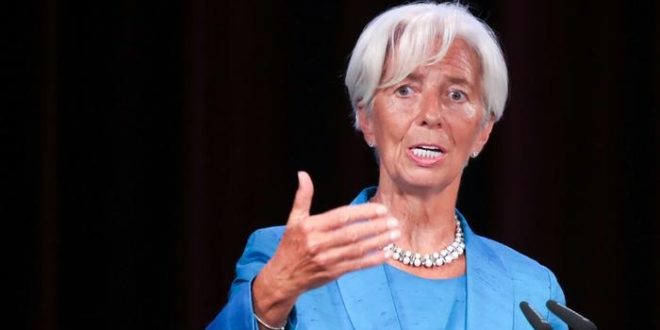
Let's start with the latest blunder by the bank's president, Christine Lagarde, who just ten days ago, with an inconsiderate comment, almost "missed" Italian government bonds jumping to the point of panicking the markets and bankrupting the Apennine government. The risk spreads of Italian sovereign debt exploded by 263 basis points and began to drag the other southern countries into the double-digit trap. Lagarde herself had to repeat Mario Draghi's line from the previous collapse of the eurozone, promising once again to save the single currency in any way possible.
The saddest thing is that comment u was right – it is not the job of central banks to narrow the spreads between countries like Germany and Italy. That is, to artificially push down interest rates on loans to governments that have been pursuing unreasonable and wasteful fiscal policies for decades. Unfortunately, however, thanks to the actions of the same central banks and especially the ECB, this is exactly what is happening in many places around the world, especially in risky countries in the eurozone. The loans continue to pile up. Today, Italy has a government debt of 137% of GDP, Portugal has 121%, Belgium has 102%, France has 101%, and Greece is chasing a record 178%. Values that for most countries were growing even after the European debt crisis of 2009.
In his speech, the Prime Minister rightly emphasized that there is a difference between countries that save and have a sensible approach to fiscal policy and those that live on credit. This difference is especially evident in a crisis, when reserves no longer seem like a deferred luxury or a missed populist program, but a lifeline for the entire economy.
Ms. Lagarde, however, disagrees. Only a few months ago, she was leading a serious public campaign against the budget surpluses of Germany and the Netherlands. All countries with “chronic surpluses” should loosen their purse strings to correct the “imbalances” in the eurozone. In other words, an attempt to break the discipline of the Nordic countries with the argument that additional economic prosperity should be stimulated for the lagging and indebted. Let us recall that even before the arrival of the coronavirus, growth in the eurozone was stagnating to 0.1% for the last quarter of 2019. Obviously, this had to be “fixed” with more spending, whether a crisis like the one with the virus could come… it doesn’t matter to the ECB.
There is a strange excitement surrounding the ECB’s announced €750 billion asset purchase program. The manual from the previous crisis has been removed and expanded, the central bank will buy a wider range of assets and will in fact be able to pour newly created money into the entire eurozone, with special attention to Italy. Almost a Jean-Vidéo approach, except that instead of idle and looted state-owned enterprises, governments and corporations overwhelmed by debt and leverage will be “rescued”. This time, however, due to the shock to the supply, inflation may not hide in various bubbles on the financial markets, but slide into the real economy and combine with the blow to growth in the so-called stagflation. Many people forget that reserves and discipline in good times are the real buffers against the crisis. White money for rainy days cannot be printed every time there is a shock.
When we lick our lips over the prepared 750 billion euros, let's not forget that the debts of the seven most troubled countries in the eurozone at the end of 2019 (i.e. before the corona crisis) were already 7.2 trillion euros, while the European Stability Mechanism only has 80 billion euros. Looking also at Germany's announced 756 billion euros of its own domestic package, we see how only the troubled countries rely on help from the ECB, those with sound fiscal policies act on their own lines.
In any case, the money from Frankfurt would hardly have reached Bulgaria; on the contrary, the Prime Minister rightly emphasized on Sunday that the EU currently does not even have a voted budget, and European solidarity is in short supply. Moreover, if our country were a member of the banking union, the 9.3 billion leva announced in the BNB program would not be here, and together with about another 10 billion leva, they would have powered the central offices of troubled European banks.
The terrible truth that no one wants to admit is that the ECB is reaching its political, legal and technical limits. Even before the current dramatic situation, the bank had already introduced a 0.5% negative interest rate. Since 2016, the government debt of individual member states purchased through the ECB programs remained in their national banks, Italian in Italy, German in Germany, etc. - an obvious preparation for the possible need to split the zone and monetize liabilities. Borisov himself rightly doubted that the ECB might not last.
Bulgaria enters the crisis with good indicators
Fortunately, Bulgaria, thanks to many years of discipline, is entering this crisis with good fiscal performance, especially compared to the countries in the eurozone. The board is optimal in today's situation of uncertainty and remains attached to the German mark in case of a possible collapse. Now is not the time to participate in the chaos of the eurozone, but to make sure that the blow of the crisis is as bearable as possible for everyone at home.