EKIP– Expert Club for Economics and Politics A Different Opinion

I recently spoke to a friend. Like every other conversation in the past few weeks, this one came down to discussing the protests. Even though I knew that with her profession and workplace (which is why I can't mention her by name), I asked her for her opinion on the topic. Her answer was short and clear: "I'm not going to protest. It was much worse ten years ago."
This is, of course, true, but only in one aspect – average salary and purchasing power, or the most important and most visible for citizens. Without in any way belittling how important these two indicators are, they also work as an illusion that we have been moving forward over the past ten years. This is not exactly the case – we have simply benefited from the general prosperity of the world. Everything less visible or intangible in the country is at best at the same level. More often, however, it is far worse than at the beginning of the last decade.
Bulgaria has spent the ten years since the end of the last crisis not preparing for the eventual end of the good days that followed, but for the complete destruction of everything that could possibly bring any stability to the country: institutions, the separation of powers, public trust in the government, the rule of law, the protection of private property, the trust of foreign investors, and the hope for any kind of reform. Here is the catch: each of the above was destroyed for – and replaced by – EU money. The short stick that Bulgaria has long been willingly drawing will only get shorter.
Bulgaria had no choice or opportunity but to grow after the financial crisis of 2008-09. Whoever was in power over the past decade would have had the opportunity to boast that they raised the average standard of living in the country. This is the biggest argument of Boyko Borisov, as well as of people who are not his fans but still prefer him to be in power rather than someone else – the “what if” mindset.
But this argument has many flaws. When economic times are bad, it is no one's fault. When they are good, the government is responsible. The second, of course, is not true: whether they want it or not, politicians in Bulgaria do not have much power over the economic cycle. The currency board prevents any more aggressive intervention in the economy through expansionary monetary and fiscal policy. At the same time, Bulgaria is a small and open country, relying on exports, and accordingly, economic processes within it depend mostly on what is happening in the rest of the world and especially in the EU. At best, domestic politicians can provide the opportunity for stronger growth in the upturn and a smoother exit from the downturn.
A lost ten years
If you want to hear something really disturbing, try this sentence: the last ten years were the good part. As of this week, the European economy is officially in recession. In the US, the word “recession” is a gross understatement of reality, after the coronavirus wiped out a third of the country’s entire economy in one quarter. Bulgaria, even without a real quarantine or health catastrophe, is riding the same train. And now, on the verge of an economic crisis that, whether we like it or not, will drag us down, for the simple reason that we are already a country well integrated into the global economy, it is time to take stock.
It looks like this: Bulgaria lost ten years, in which it either did nothing or harmed itself. Three GERB governments and one BSP government not only failed to take advantage of the ten-year economic honeymoon to make structural reforms and, generally speaking, any optimizations, but also did everything in their power to nip any changes in the bud. Dyankov's "Lean Pizza" was a good start to a series that never made it to the second episode, and was instead replaced by another program - indiscriminately throwing money at every problem and every dissatisfied voice. Until it stops being dissatisfied.
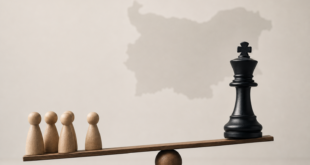
The great illusion is that Bulgaria is better off today than it was ten years ago. Yes, people have much higher incomes today. An indisputable fact, but one that throws dust in the eyes: Bulgaria could have been much richer if it had taken advantage of the honeymoon, which instead turned into scandals, ruin, and not a single government with a full mandate. The good days, on the other hand, were full of inaction, in which to take a break from everything else. It is significant that in none of the last ten years has the Bulgarian economy reached even 4% annual growth, while Romania, Poland, Hungary, Latvia, Lithuania, and Estonia – comparable countries – regularly reached and exceeded 5% growth.
Romania is a particularly telling example. When Bulgaria joined the EU, it was undoubtedly the more developed and faster-growing country. This is changing rapidly: in every year of the last decade, Romania has grown faster than Bulgaria. So 12 years later, the places have been reversed, and Bulgaria is now the undisputed champion in the "poorest" category - as well as in several other categories, which are, however, more subjective.
There is an explanation for all this – or, to be more precise, many explanations. The damage over the past ten years has led to many negative effects, most of which we have yet to see. However, one of them has become visible in real time: while ten years ago we were waiting for American and German companies, we are now also enjoying Czech billionaires as foreign investors. The reason for this is not that the entire region is unattractive, quite the opposite. It is simply that while Google continues to develop its office in Romania as a regional hub and Microsoft pours billions into Poland, we have done everything possible to remain in the old economic reality.
And the argument "it was much worse ten years ago" will likely have a very short shelf life.