EKIP– Expert Club for Economics and Politics A Different Opinion

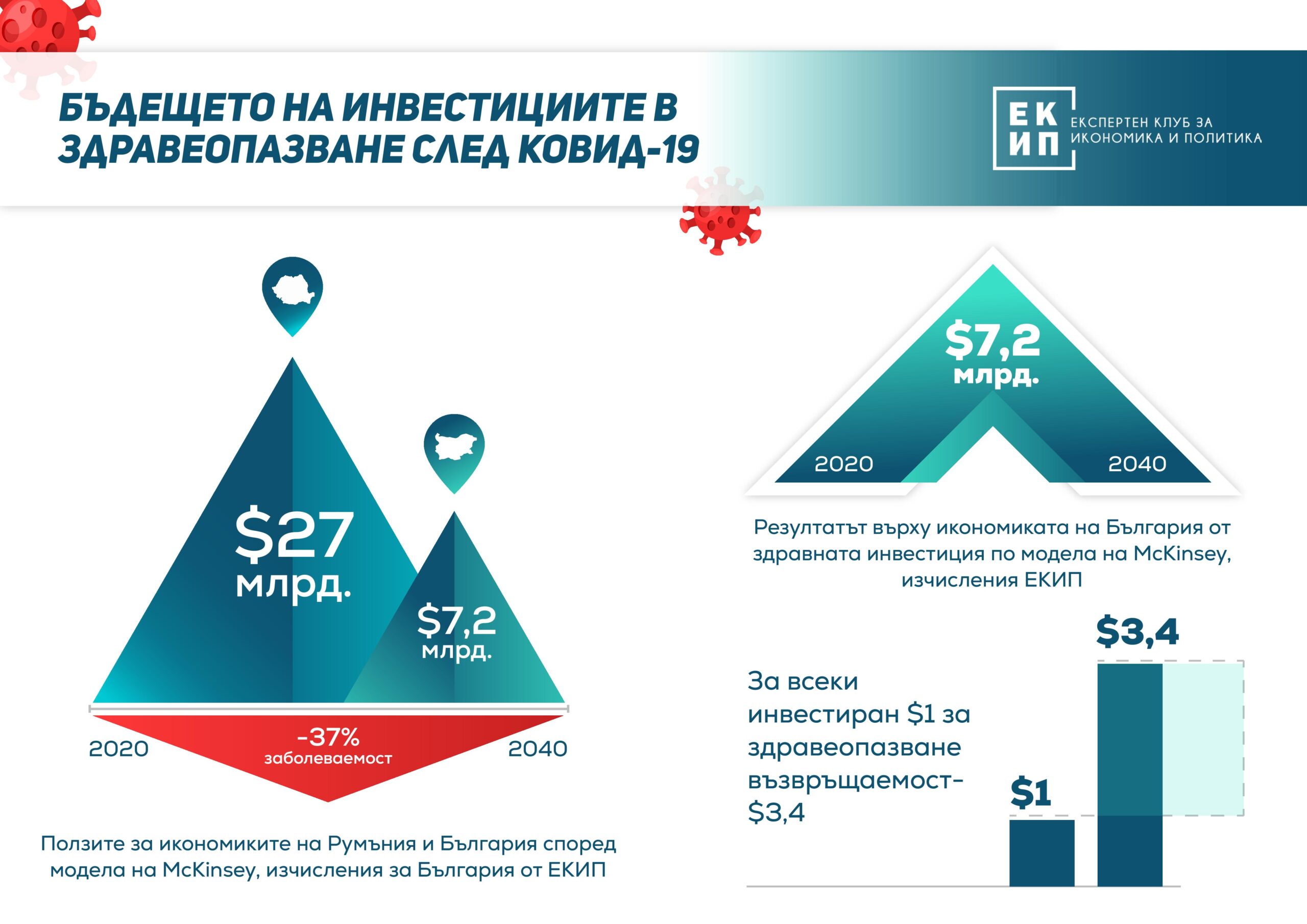
- Every "smartly" invested additional dollar in Bulgarian healthcare can bring a return of $3.4 through a larger and healthier workforce, less need for care for the elderly, and increased productivity of people who are now approaching retirement age.
- Such an investment could bring a 37% drop in the overall morbidity rate in Bulgaria, which translates into an additional 9% GDP in 2040 or 7.2 billion US dollars over a twenty-year period.
- By 2040, globally, 86% of intestinal and 67% of respiratory diseases, 75% of sexually transmitted diseases, 61% of reproductive problems, and 57% of eating disorders can be eliminated.
- The health sector should be seen as one in which investment is made and, accordingly, economic benefit is derived, instead of being treated as a social system
The Covid-19 pandemic has drawn attention to serious questions about the preparedness of the health sector and public systems to deal with the imminent threat to the lives of a significant portion of the world’s population. The topic that has crept past the concerns about the specific virus and the extraordinary measures is that of planning, not only for future deadly infections, but also for the overall appearance of the mechanisms used to treat and prevent diseases. In other words, what would healthcare look like two or three decades into the future?
Some of the main concerns for our part of the world are well known to experts. According to a 2019 European Commission report, “all EU member states face strong and increasing fiscal pressures on their healthcare and long-term care systems, driven by already high levels of debt and public spending, demographic challenges and technological advances.” [1] In other words, an aging and already heavily indebted Europe will struggle to pay for more patients who need access to the latest treatments. European countries face the dual challenge of bringing their public healthcare systems to some form of fiscal sustainability, through efficiency and effectiveness reforms, while at the same time maintaining (and in our case, expanding) access to quality care.
Neither an ultra-liberal immigration regime nor a purely arithmetical jump in government spending can be the solution to such a case. The days of demographic, cost-coverage comfort from the last century, when it was easy for politicians to simply promise more, are over. Nowadays, additional spending must go hand in hand with changes in the system, so as to ensure at least the two goals of budget balance and access to quality.
Moreover, the agenda is increasingly addressing the problem posed by the so-called "Baumol's cost disease", which is particularly clearly visible in healthcare costs. It consists in the fact that in most industries that offer services, in the last twenty years, relative prices have increased, in contrast to capital-intensive industries, where prices have fallen. Healthcare and education are becoming increasingly expensive, at the expense of televisions and mobile phones, for example. There are ways to reduce the cost of labor needed to manufacture a car compared to 1950, it is much more difficult to do the same for performing heart surgery or for developing and introducing an innovative therapeutic method. Although healthcare remains a sector whose productivity cannot be (easily) increased, the salaries of doctors and nurses and investments in new technologies cannot lag behind the rest of the economy, and these increases in costs arise accordingly. Investment and, above all, innovation are the only way to deal with Baumol's spending disease.
A new study by the McKinsey Global Institute from July 2020 [2] dives into the deep waters of modeling the future of global healthcare over the next 20 years. McKinsey’s approach is distinguished by its economic focus – looking at the healthcare sector as one in which investment is made and, accordingly, derives economic benefit, rather than treating it as a social system. The analysis in the publication starts from the basic position, according to which 15% of global GDP is lost every year due to disease. Accordingly, if this problem can be addressed, what will be the direct and indirect economic benefits for global growth.
McKinsey experts analyzed nearly 200 countries and made a forecast until 2040. They concluded that with the interventions already available, the global morbidity rate could be reduced by 40%, with another 6-10% drop coming from the implementation of medical innovations that are still in development today. This improvement in health can be expressed with examples such as a 65% drop in infant mortality, or a change in the quality of life of 65-year-olds so that it corresponds to a person ten years younger.
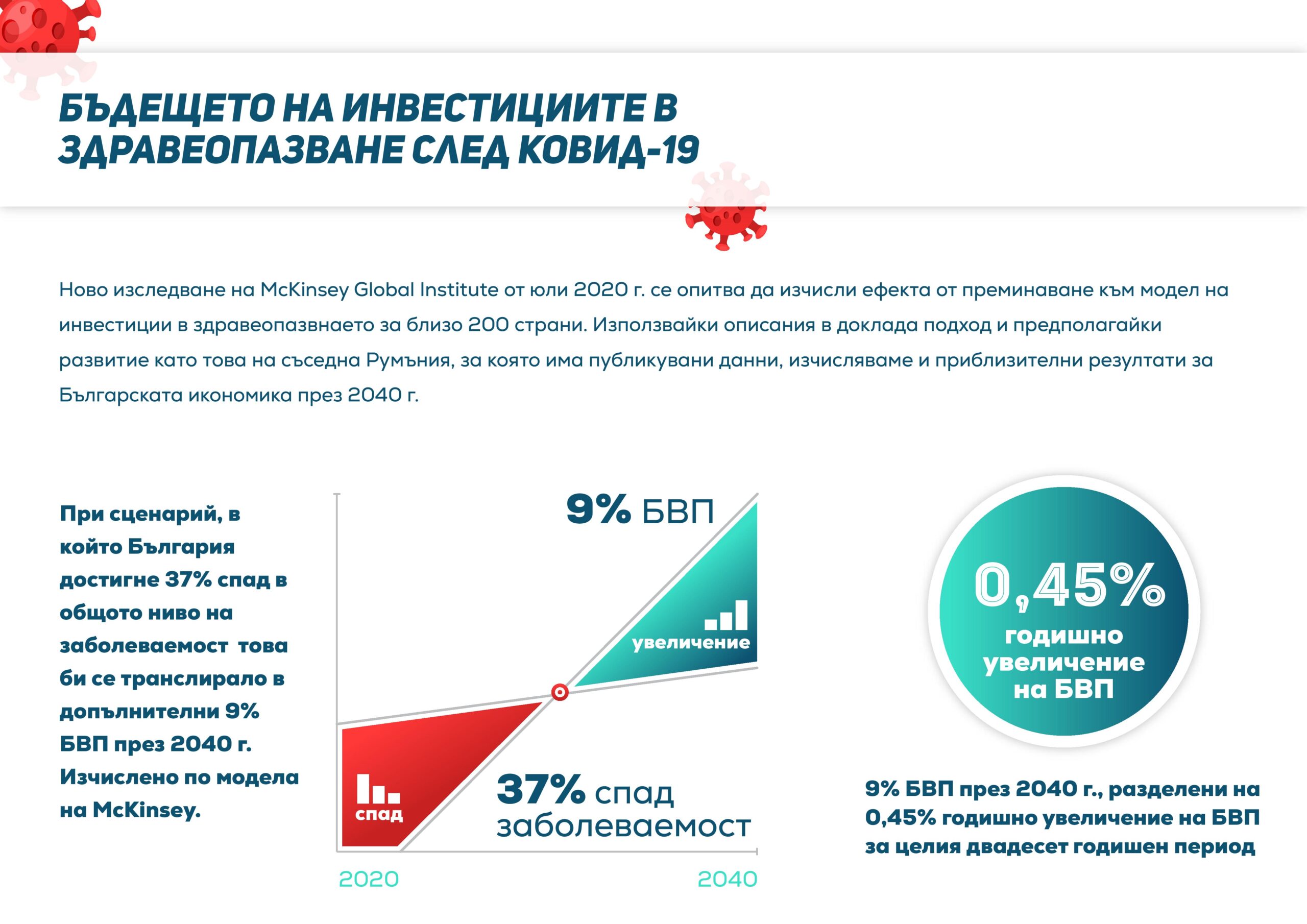
The economic impact of these positive changes is an additional $12 trillion in global GDP by 2040, an 8% increase, which translates into an additional 0.4% growth rate for each year of the period. About half of this growth is expected to come from a larger and healthier workforce, while the other half is expected to come from reduced care needs for the elderly and increased productivity among people now approaching retirement age. Returning to the idea of a new approach to health as an investment, the institute calculates a return of 2-4 times in their model of health system reform.
These successes can be realized under the so-called "healthy growth scenario", defined by the authors of the study. We can say that especially from the bell tower of the Bulgarian healthcare and the dominant hygiene and health habits in society, such a scenario will require, in addition to investments and serious reforms, above all changes at the level of overall thinking. For example, goals related to a 25% reduction in the use of alcohol and other similar substances in the next 10 years are included. We have planned improvements in the quality of the environment, air, general security and (especially important in our case) protection from road accidents by 50%. In order to achieve successes, serious improvements are needed in terms of physical culture, nutrition and success in the implementation of ongoing therapies. In other aspects, Bulgaria may already sufficiently fulfill the necessary conditions - the level of vaccination and the decline in smoking, which actually results mainly from the transition to new heated products.
A comprehensive review of the scientific medical literature has been conducted, and it has been estimated that by 2040, as a result of the healthy growth scenario, 86% of intestinal and 67% of respiratory diseases, 75% of sexually transmitted diseases, 61% of reproductive problems, and 57% of eating disorders could be eliminated globally. The majority (70%) of the interventions needed for this are related to preventive medicine, which is significantly cheaper. Accordingly, according to the model in the report, the additional costs are relatively low and even with certain optimizations can be fully paid off.
The issue of costs has always been key and continues to be a problem for all health systems around the world. To a large extent, at the policy level, it stems from the fact that health-related costs are perceived as part of the social system and are therefore subject to many of the same political dynamics as poverty, maternity or pension benefits. All of this stems from the larger issue of the fact that, for the last hundred years or so, health care has been positioned among the state's commitments and treated as a public good. In a system of private goods, the question of the boundary between consumption and investment is less debated because it is mainly the result of many individual decisions, while in the case of public goods we are talking about a complex system of political and policy debates leading to some form of compromise, tempered or not by the real financial capabilities of the fiscal authorities at a given historical moment.
The McKinsey study is based on projections of the state of health care in 184 countries published in 2017 in The Lancet by a team under the auspices of the Global Burden of Disease Health Financing Collaborator Network. [3] By tracking trends since 1980, the total level of health spending in 2040 is estimated, including all forms of spending – direct government spending, international aid, private health insurance, various funds and direct patient payment. The calculations of this team of authors show that global health spending will increase from about 9 trillion dollars in 2014 to 24 trillion in 2040. For Bulgaria specifically, the projections are that health spending will increase from 8.4% of GDP in 2014 to 10.7% in 2040.
On top of this 10.7% of GDP, the McKinsey model adds another percentage point for upper-middle income countries. The investment needs to achieve the improvements in the healthy growth scenario are greatest in the most developed countries and least in the third world countries, which already have at least some hospital infrastructure. In other words, the most developed countries need the most expensive investments in the most innovative medicines or in the treatment of new types of diseases that are still difficult to address – the relatively easier problems have already been solved.
When talking about new spending in healthcare, even when it is done in the form of, or at least with the strategic vision of, investment, two important questions should be addressed. One is addressed, albeit briefly, in the McKinsey consultants’ study – namely, what is the efficiency of the funds invested. It is particularly relevant in all types of healthcare systems, regardless of their philosophy, the efficiency rate can vary widely from 50% (in Africa) to over 80% (in Switzerland), and it is not excluded that in the least developed and most corrupt regions of the world it can even fall below 30% [4]. According to the authors, with certain changes related to the wider use of telemedicine, the transfer of some simpler manipulations to specialists without full medical education, improvements in the general organization of the systems, etc., productivity improvements of the order of 22% can be achieved, practically eliminating the additional cost of 1% of GDP. Such and others are certainly possible for the Bulgarian NHIF, as we at EKIP have already published several of them in recent years. [5]
The second question, which is no longer addressed in the McKinsey study, is who and how makes investments in healthcare. Ever since Ludwig von Mises’s Economic Calculation in the Socialist Commonwealth [6] and the subsequent debate between Friedrich von Hayek on the one hand and Oskar Lange and Abba Lerner on the other, we know about the problems of the planned economy and the limited possibilities of the state to invest successfully. In this sense, special efforts should be made, if not to privatize the system, as something politically distant and difficult to achieve, then at least to implement the maximum amount of market mechanisms and competition. In other words, investments should be driven to the maximum extent by the personal choices of patients, doctors and pharmaceutical companies, less by politicians and administrators. More innovation, less paralysis around outdated models of functioning.
It is precisely the latest approaches emerging in the poorest but also the most dynamically developing parts of the world that we can learn from Dr. Nima Sanandaj’s new book, The Henry Fords of Healthcare, published this year in London by the Institute of Economic Affairs. [7] He tells us that today’s systems, particularly Western ones, are too focused on controlling health costs in the short term, rather than improving quality and creating the conditions for innovation. In contrast, Eastern systems, in countries like China and India, give more space to entrepreneurs to invest and create new models of work.
The main characteristic of the described successful new approaches is hyper-specialization and an "assembly line" approach, this allows for large economies of scale and, accordingly, high quality to be offered at a lower price. Usually, the patient comes into contact directly with the place where the service is performed, avoids bureaucracy and manages to receive the health service without waiting, which is a huge problem of many Western health systems. Of particular interest to the Bulgarian reader are the opportunities for the development of health tourism, something that is already being taken advantage of in neighboring Turkey. And it is currently a huge untapped niche in our country, which also requires investments that could bring even greater returns than the one demonstrated by the McKinsey model.
One of the publicly presented countries for which the McKinsey authors have made calculations is neighboring Romania. Since there is no information about Bulgaria, neither in the report nor in the press releases surrounding its publication, we can try to calculate the effects on our economy by collecting data from our economy and our health system and assuming that the transformation from expenditure to investment healthcare will have similar results as in our neighbors. Romania is a Balkan country, an EU member with a similar political and economic history. The big difference is in the population, but this is a factor that can be relatively easily isolated in this particular case.
In a situation where Bulgaria, like Romania, achieves a 37% drop in the overall morbidity rate and this translates into an additional 9% GDP in 2040, divided by a 0.45% annual increase in GDP for the entire twenty-year period, the direct effect on our economy from health investment, according to the McKinsey model, is 7.2 billion constant US dollars from 2015 [8]. If we use the fact that the size of the investment in the model for countries like ours is an additional 1% of GDP in 2040 (without optimization reforms of 22%), then the return is in the upper half of the predicted, as for every dollar invested we can get 3.4 back.
The big lessons we can draw for the future from McKinsey’s ambitious study and the recent literature are related to the increasingly necessary transformations of health systems. The technically easy and politically convenient models of the twentieth century cannot work with the demographic pressures and expected innovations of the new century. Indeed, the mindset must shift from simple spending to “smart” investing, from pure macro consumption to personal interest and responsibility.
[1] European Commission, “Joint Report on Health Care and Long-Term Care Systems & Fiscal Sustainability, country reports”(2019)
[2] Jaana Remes et al., “Prioritazing health: A prescription for prosperity”, McKinsey Global Institute, 2020
[3] Joseph L. Dieleman et al., “Future and potential spending on health
2015–40: Development assistance for health, and government, prepaid private, and out-of-pocket health spending in 184 countries,” The Lancet, Volume 389, Issue 10083, 2017.
[4] http://digicollection.org/hss/documents/s18304en/s18304en.pdf
[5] For example: https://ekipbg.com/biopodobni-lekarstva/
[6] https://mises.org/library/economic-calculation-socialist-commonwealth
[7] Nima Sanandaji, The Henry Fords of Healtchare, Lessons the West can learn from the East (London:Institute of Economic Affairs, 2020)
[8] Own calculations