EKIP– Expert Club for Economics and Politics A Different Opinion
About a month ago, the Bulgarian online media outlet “Factcheck.bg” published an article with the following title: “ Bulgaria in the Eurozone: Between Misconceptions and Facts.” Under the guise of combating disinformation, the author of the article, Yordan Barzakov, claims to be debunking “myths” about the “negatives of eurozone membership.” The introductory paragraph of the text is eloquent:
" The closer Bulgaria gets to joining the so-called "Club of the Rich in Europe", the more contradictory opinions about the adoption of the euro are heard. Some of them contain well-argued theses, reasonable questions or criticisms related to the processes taking place in the eurozone itself and their impact on Bulgaria. Others, however, repeat already known and repeatedly refuted "myths" related to the negatives of membership in the eurozone. In the following lines, we will distinguish between the two groups, weeding out legitimate doubts from false statements. "
In itself, this paragraph seems like a promising start to a reasonable and balanced article. Alas, as becomes clear upon reading the following text, there is much to be desired in the “debunking” of myths undertaken by Mr. Barzakov. And what is worse, the very article, which aims to dispel misconceptions, directly creates them by ignoring or distorting completely objective and legitimate concerns and criticisms related to Bulgaria’s possible accession to the eurozone.
In this article, I take on the somewhat strange task of “refuting the refuter” and “busting the myths” of the “mythbuster”. In short – to protect the truth from its self-appointed “guardians” these days. To this end, in the following lines I will analyze the Factcheck.bg article paragraph by paragraph, argument by argument and, as an economic expert who has been dealing with the eurozone case since 2017, I will share my critical assessment of the quality of Mr. Barzakov’s text.
1. Will Bulgaria lose sovereignty if it adopts the euro?
The first critical argument against joining the eurozone, which is addressed in the article, is the loss of sovereignty. According to the author, although this argument is based on national pride and sentimentality, it is ultimately not based on good logic and lacks quality factual justification. It is argued that in a currency board regime that maintains a fixed exchange rate to the euro, Bulgaria has in any case surrendered its monetary sovereignty.
"Since the national currency is pegged to the euro, in practice this means that Bulgaria operates with euro money at the macro level, but without physically exchanging it between citizens and businesses. Instead, we use levs, and so the lev is in fact an "avatar" of the euro and is nothing more than a receipt for euros."
This is true to a very significant extent. But what is missed here is the fact that there is a difference between the currency board as a structure – the framework for the functioning of the monetary system – and the specific currency/commodity/basket of goods or currencies to which the national currency is pegged, through the currency board structure. In other words, no distinction is made between a system and the specific way in which that system is used.
Yes, through the currency board we are in a certain sense "tied" to the euro, but far from the same extent to which we would be "tied" in the eurozone itself. The currency board is far more flexible - in the event of a monetary cataclysm in the eurozone, which it has already come close to once in its history, Bulgaria has the opportunity to change the reserve currency to another without being drawn into a severe and prolonged economic crisis. On the other hand, if it is part of the eurozone, catastrophic consequences for the Bulgarian economy are inevitable when such a cataclysm occurs, because the integration into the eurozone financial system is far deeper.
It is strange why this obvious advantage of the currency board over the adoption of the euro is not taken into account at all by the Factcheck.bg article, even though the very structure of the eurozone to this day is full of holes that push it in exactly this direction. The difference in the levels of integration in the eurozone financial system under a currency board and under the adoption of the euro is a common argument for the advantage of the latter, but the corresponding additional risk that comes with this “advantage” is conveniently overlooked.
In this sense, the statement of the author Yordan Barzakov that “Bulgaria will not give the ECB additional sovereignty in excess of what it currently has” is an obvious logical equivocation. To top it all off, EU law itself does not provide for a mechanism for a possible exit from the eurozone, which makes binding extremely difficult from a legal point of view – a completely different situation compared to the currency board, whose reserve currency is the prerogative entirely of the Bulgarian parliament and, if necessary, it has complete freedom to change it. But if we accept the eurozone, the Bulgarian parliament cannot simply decide at one point to abandon the euro and return the leva. Such a right literally does not exist within the framework of the EU treaties. This is an obvious difference in the levels of sovereignty of the Bulgarian state under the currency board monetary system and that of the euro.
After the fallacy about sovereignty, the article also quotes economist Rumen Avramov, with his thesis that entering the ERM II exchange rate mechanism, which is happening in 2020, does not pose any risks for Bulgaria in terms of exchange rate volatility. The exact quote is as follows:
" An important reminder, made by one of our most authoritative economists, Rumen Avramov, is that with the efforts of the BNB and other central banks of member states with a currency board regime, the ECB was convinced to change the rules for entering the eurozone so that a temporary "untying" of the exchange rate within the framework of ERM II would not be necessary. That is, all concerns that entering the "waiting room" will eliminate the board and make us vulnerable are unfounded. "
If this is indeed the case, we cannot help but wonder why a change to the BNB law in this regard, pushed through by GERB quietly, between two readings in committee, is necessary? Menda Stoyanova's infamous amendment caused a media furor in January 2020, thanks in large part to our efforts at the EKIP to warn citizens about this extremely risky amendment to the BNB Law. Here is what this amendment says:
"As of the date of Bulgaria's participation in the Exchange Rate Mechanism II, the official exchange rate of the lev against the euro shall be equal to the central rate between the euro and the lev, agreed in accordance with paragraph 2.3 of the Resolution of the European Council establishing an exchange rate mechanism in stage three of Economic and Monetary Union Amsterdam, 16 June 1997 and Articles 1.1 and 17.1 of the Agreement of 16 March 2006 between the European Central Bank and the central banks of the Member States outside the euro area laying down the procedures for the operation of the exchange rate mechanism in stage three of Economic and Monetary Union."
Rumen Avramov, quoted by Yordan Barzakov in the article, claims that an exception has been made for countries with a currency board regime, such as Bulgaria, so that the introduction of a floating exchange rate is not necessary. Specifically, we are allowed, if we decide, for the BNB to continue to maintain a fixed exchange rate to the euro, as it was before entering ERM II. The existence of such an agreement with the ECB is a fact, but the devil, as usual, is in the details. First of all, this is just an agreement. The fact is that after the amendment to the BNB Law, in black and white, the fixing of 1.95583 leva for 1 euro no longer appears. And this is an indisputable fact.
What appears is that the lev to euro exchange rate is determined by reference to the resolutions and agreements mentioned in the quoted text above. The quoted EU resolutions explicitly state that the exchange rate within ERM II is subject to negotiations (specifically between the ECB and the national central bank). That is, there is no way to talk about such a “hard” fixed exchange rate as we had before. Everyone can check for themselves what is written in the relevant documents. In this sense, it should be clear that since Bulgaria joined ERM II, the situation surrounding the exchange rate of the lev to the euro has fundamentally changed and it is no longer fixed in the way it was before.
2. Fears of price shock – justified or not?
From here the article continues to the most exciting question for the average Bulgarian related to the euro – what will happen to the prices of goods and services. There is indeed a lot of speculation on this issue, on both sides. Alas, the article itself in Factcheck.bg, although it should debunk misconceptions, falls into such when it says:
" The second most common myth is that the exchange of the lev for the euro will lead to a drastic increase in prices, almost all the prices that we currently see in lev will remain the same numbers, but in euros. This fear has its explanations, especially in the countries of the former Eastern Bloc, but there is no evidence for its validity. On the contrary - official data from the countries that have already gone through the process show exactly the opposite trends in the long term. "
The fears of a spike in inflation, specifically in the short term after adopting the euro are definitely not unfounded. The Factcheck.bg article itself notes that such a spike in inflation levels after joining the eurozone was observed in countries such as Slovenia. But the comforting thing is that this spike was not particularly significant – only 2-3 percentage points to over 5% annual inflation within the first 2 years after adopting the common currency. And in the long term, inflation falls to much lower levels and even deflation.
The big problem here is that the analysis presented is extremely superficial. First, a number of studies have shown that after the adoption of the euro there is a huge discrepancy between the inflation rates reported by official indices and the perceptions of citizens themselves about the inflation rates. This is largely due to the problem of excessive aggregation and averaging of very heterogeneous data, as occurs when compiling a general price index of all consumer goods and services.
The official studies of European institutions on the subject themselves indicate that in the first years after the adoption of the euro, a significant acceleration of price inflation was observed almost everywhere in essential goods, especially food, as well as prices in restaurants and other establishments. Since these are the types of goods and services that are consumed with the greatest frequency, compared to non-food goods (white and black appliances, clothes, etc., which are not purchased daily or even weekly and monthly), a jump in their level of price inflation has a much more tangible effect on the daily lives of consumers.
There is evidence that the initial price shock can be particularly severe. This is the case in Italy, as described by Nikolay Bogatsky in his academic paper, recently translated and published in EKIP. In the period immediately following the adoption of the euro, Italy experienced large discrepancies between the price data reported by the national statistical institute and various business and industry organizations that monitor prices in certain sectors. I cannot reproduce all the specifics of the data here, so I recommend that you pay attention to Bogatsky's material. In short, in his analysis, Bogatsky calculates that the real inflation rate in 2002 in Italy (the year immediately following the adoption of the euro) was 93.96%.
Note that this percentage represents an almost twofold increase in prices – precisely what Bulgarian citizens fear. This should not be read as a prediction that the same will happen in Bulgaria. This was the situation in Italy, and as far as we know in many other countries there has not been such a sharp jump in prices (or at least there is no research yet indicating such a thing). But Italy’s experience in this regard shows that the risk of a very large jump in prices after the adoption of the euro is certainly real and the concerns of Bulgarian citizens in this regard should certainly not be underestimated.
3. Getting richer or poorer after adopting the euro?
Continuing with the example of Slovenia, Mr. Barzakov uses data on the trajectory of its economic data in the period 2006-2015 to show why the fears that Bulgaria may become poorer due to membership in the eurozone are unfounded. Alas, the presentation of the data is extremely biased and misleading. Because if he is going to argue in this way, Mr. Barzakov must take into account the objective fact that GDP per capita in Slovenia did not increase in the period 2008-2019. On the contrary, between 2008 and 2015 there was a consistent decline, year after year. A rise back almost to the levels of 2008 occurs from 2015 to 2019. But even so, by the end of 2019, the level of GDP per capita in Slovenia is lower than in 2008.
On the other hand, GDP per capita in Bulgaria rose from $7,265 in 2008 to $9,828 in 2019. The picture is similar when comparing with other Eastern European countries that adopted the euro, such as Slovakia. Of course, there are also the opposite examples – economies outside the eurozone, such as Serbia, which have experienced a decline or stagnation in GDP after 2008, and those inside the eurozone, such as Estonia, which continue to grow at an enviable pace. The period between 2008 and 2015 was a crisis for all of Europe, but it was especially difficult for the eurozone due to the difficult situation with the public debt in countries such as Greece, Italy, Spain, Ireland and Portugal. In fact, 4 of the listed countries (excluding Ireland) are still unable to restore the GDP levels of 2008.
This shows that economic data certainly cannot be used to argue that the eurozone leads to faster economic growth. There are simply too many cases of countries that have adopted the euro, where for at least the last 12 years there has been either stagnation or even a decline in GDP per capita. Moreover, even if after joining the eurozone we observe an increase in economic standards everywhere, this is not proof that the euro in itself leads to an increase in economic standards. Such an argument is a well-known logical fallacy of the type “because B happens after A, then B must have happened because of A”, known as “ Post hoc, ergo propter hoc”. Mr. Barzakov himself notes this in his article, writing:
" However, this does not mean that Bulgarians' incomes will immediately rise to the average European level. The euro is simply a means of payment that opens up more opportunities for the domestic economy, but getting rich is a process that is driven by both national policy and the citizens themselves. The above data for Slovenia show that if a country uses the advantages of the eurozone wisely, its well-being can increase within a period of several years. "
He is absolutely right that getting rich is a process driven mostly by national politics and the citizens themselves. But it is unclear what is meant by the “opportunities” that the euro opens up for the domestic economy. Mr. Barzakov mentions “price stability”, as well as “easier and cheaper access to a larger market” and “cheaper loans for everyone”. The latter is certainly not true if we simply look at the dynamics of interest rates on loans in Eastern European countries such as Slovenia and Slovakia, as well as Latvia, Lithuania and Estonia. After adopting the euro, the decline in interest rates on loans in these countries has been negligible and it is not at all certain that even this negligible decline has anything to do with the new currency.
The argument for “price stability” is strange, although Bulgaria is not a country where there is “price instability”. The increase in inflation in recent months in our country is part of a global trend from which the countries in the eurozone are certainly not isolated – according to the latest data, inflation in Bulgaria in July was 3%, and in Germany it was 3.8%. Inflation in our country in the last 10 years has never managed to jump over 4% even, and the deepest level of deflation was around 2%. This is certainly not “instability” in prices and the price dynamics in our country are no different from that of any country with the euro for the last decade.
It is unclear what is meant by “easier and cheaper access to a larger market”. The only thing that can seriously be meant is deeper financial integration into the euro area financial system and the elimination of overvaluation costs. This is true, but this integration also carries significant risks. The EIB will soon publish an in-depth report on the risks of deeper integration into the euro area banking market, which we have already undertaken with our accession to the Banking Union.
Beyond that, if we accept the euro itself as a currency, we are fully integrated into a financial system that suffers from chronic instability due to the poor asset quality of financial institutions in specific countries such as Italy, Spain and Greece. We are also integrated into a “common fiscal market”, so to speak, in which our money would be used to bail out fiscally undisciplined countries facing bankruptcy. This is exactly what happened with Greece, but also with Ireland, Portugal, Spain and even Cyprus during the euro crisis. Not to mention that the fiscal crises themselves in countries like Greece are to a very significant extent a consequence of the problematic structure of the euro itself, as the German economist Philipp Bagus explains in his book “The Tragedy of the Euro” (it is available in Bulgarian in bookstores, you can find it in English at this link ).
4. Is there a risk of a debt crisis in the eurozone?
As if in anticipation of this argument, the Factcheck.bg article continues with an attempt to refute the thesis of the so-called "Greek scenario". Mr. Barzakov says that this is a thesis mainly promoted by Steve Hanke, without "providing any serious evidence to support his thesis". And a little further on he writes that " There are absolutely no reasons to believe that Bulgaria is doomed to such a scenario . ", because it was after the crisis that changes were adopted in the eurozone and in Bulgarian and European legislation to ensure that countries would pursue sustainable and reliable economic and fiscal policies.
These are absolutely false statements. First, the changes in European legislation in question are clearly insufficient at this stage given the ongoing chronic fiscal problems in countries like Italy. Not to mention the fact that the so-called "Maastricht criteria", the notorious fiscal rules that on paper must be respected by every member state of the eurozone, are in practice not respected by anyone. Writing rules is one thing, implementing them is another. The eurozone has always had a serious problem with the latter. You can learn more about the absolute impotence of the eurozone in implementing its own fiscal rules and the comparison of fiscal results between the euro system and the currency board in Bulgaria in this article by Stoyan Panchev.
Second, in terms of evidence – Bulgaria and Greece share many similarities such as political mentality, quality of public institutions, and levels of corruption. Also, in 1997 (the year we introduced the currency board system) Bulgaria and Greece had very similar fiscal indicators – for example, practically the same level of government debt. After that, the two countries adopted two very different monetary systems – Greece adopted the euro, while Bulgaria retained a currency board. The difference in the trajectory of their government debt is more than eloquent.
Chart: Government debt ratio as % of GDP
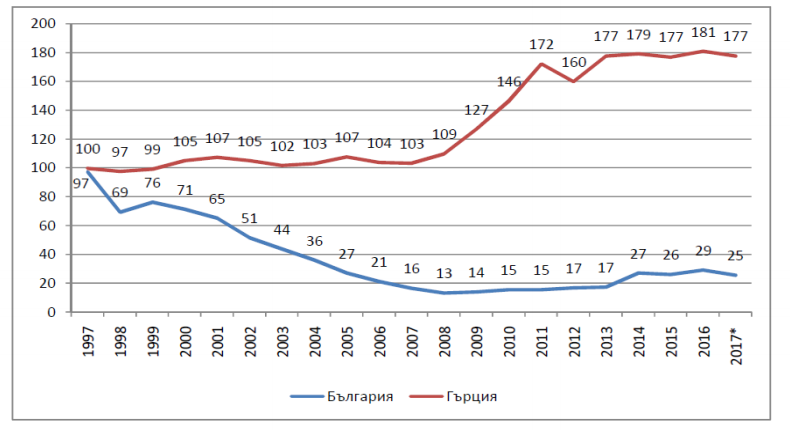
I have written in detail about the similarities between Bulgaria and Greece in their fiscal and economic history, and the risk of similar developments and a similar debt crisis in Bulgaria upon joining the eurozone, in the report “Bulgaria’s Accession to the Eurozone – The Economic View”. Within the framework of this article, which is already very long anyway, there is not enough space to reproduce the full argument in depth, so I recommend that you pay attention to the first chapter of the report. In his article, Yordan Barzakov does not actually address the theory at all about how the structure of the eurozone stimulates fiscal deficits in countries like Greece and Italy, which subsequently develop into debt crises. He does not pay attention to either my materials on the topic, or to more famous and academically renowned economists such as Philip Bagus or Ashoka Modi. In fact, from his text it seems as if he has not read any of the EKIP materials on the topic, nor any other outside of Steve Hanke’s interviews. This is particularly disappointing, and surprising, given that the EKIP is certainly the most prominent economist critic of joining the eurozone for at least the last 3 years. Our arguments are well known, our reports and articles are freely available, but they are in no way addressed by the Factcheck.bg article.
5. Is a referendum on currency legitimate?
Coming to the issue of holding a referendum on the adoption of the euro, Mr. Barzakov's article falls into blatant manipulation. The first such manipulation is the following statement - "Behind the idea of a referendum are the MMA fighter and political activist Stanislav Nedkov - Stucky and the journalist, publisher of the website PIK.BG, Nedyalko Nedyalkov." Again, the journalist from Factcheck.bg clearly did not do his homework. In fact, the first initiative to hold a referendum on the topic was by the PP "Vazrazhdane", which collected over 100 thousand signatures in support back in 2018.
Later, in January 2020, we published an analysis of a sociological survey (prepared by the Trend sociological agency), which showed that more than half of Bulgarian citizens support a referendum on Bulgaria's accession to the eurozone. Subsequently, we have repeatedly emphasized, in a number of our opinions on the topic, that such a fundamental decision on the currency should be made only after a national referendum. That is, the topic of a referendum on the euro was raised first by the Vazrazhdane Party and then by the EKIP years before Nedyalko Nedyalkov and Stanislav Nedkov even thought of it.
Regarding this case, the Factcheck.bg article contains another fallacy. This is the claim that our legislation prohibits such a referendum because the “Law on the Direct Participation of Citizens in State Power and Local Self-Government” does not allow for a referendum on commitments undertaken by Bulgaria through international treaties ratified by the parliament. We are talking about the commitment that appears in the EU Accession Treaty – each member state agrees at some point to adopt the euro. Again, the devil is in the details, because the treaty does not specify when this should happen. And so to this day we have countries like Poland, Hungary, the Czech Republic and Sweden, which postpone joining the eurozone until an unspecified future date.
There is no obstacle to holding a referendum on this specific issue – whether to postpone the adoption of the euro until an indefinite date in the future. In 2003, Sweden held just such a referendum. As of the date of its holding on September 14, 2003, Sweden planned to adopt the euro on January 1, 2006, just as Bulgaria currently plans to do so on January 1, 2024. There is no obstacle to organizing a referendum in our country that asks “Do you support the adoption of the euro on January 1, 2024?” or “Do you support postponing the adoption of the euro?” until an indefinite future date. Neither question would contradict current legislation, because the “obligation” to adopt the euro according to the EU Treaty has an indefinite time horizon. And even if there were an obstacle – the “Law on the Direct Participation of Citizens in State Power and Local Self-Government” in question can always be changed.
Towards the end, Yordan Barzakov’s article concludes with a summary of the structure, some of the known problems of the eurozone, as well as a brief summary of its development from its inception to the present day. The claim that Bulgaria could derive “political benefits” from adopting the euro, because this would make it part of the “core” of the EU, is speculative at best, because a number of countries that are inside the eurozone clearly have less political influence in the EU than some that are outside. For example, if we compare a country like Slovenia with a country like Denmark, Sweden or Poland – Slovenia has adopted the euro, but does anyone seriously believe that it has more influence within the EU than the three listed EU member states outside the eurozone?
6. Why is serious expert criticism ignored?
The article ends with a summary of who has an interest in spreading “disinformation” on the topic (which, as we have already seen, is actually not as “disinformation” as it is presented to us), and a very fleeting mention of our position on the topic. Mr. Barzakov writes that the Bulgarian Libertarian Society (apparently including EKIP as an affiliated organization) represents the “principled position” on the topic. I thank you for mentioning our organization, but even here the author seems to be either insufficiently informed or is deliberately trying to mislead readers, because he writes that our opposition to the adoption of the euro is based entirely on the “libertarian ideology of refusing to centralize power in one place.”
This is undoubtedly true, but only partially. In addition to the principled position against the centralization of power, as economists from EKIP we have repeatedly expressed purely expert criticism of joining the eurozone, based on clear economic arguments. You can find such expert criticism in hundreds of our media appearances and dozens of articles, both on our website and in major national media. Some of them date back to 2017. I strongly doubt that Mr. Barzakov has not come across any of these materials.
Conclusion
The article in Factcheck.bg ends with an eloquent disclaimer – “The publication was created with the support of the European Union”. I think it is appropriate for me to end this text with a similar one. Let it be clear that the article you have just read was not created with anyone’s institutional support except our own . Our campaign to preserve the national currency does not receive targeted funding from any institution or organization, be it private or public. I would only like to thank the donors of the EKIP on Patreon and those contributing with membership fees to the development of the Bulgarian Libertarian Society (BLS). If you would also like to support our campaign to preserve the Bulgarian lev – you can do so directly by donating on Patreon or by joining the BLS membership.