 EKIP– Expert Club for Economics and Politics A Different Opinion
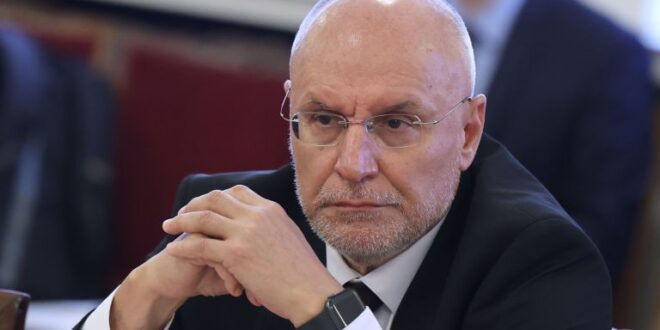
Last week, the economic experts of the Bulgarian National Bank surprisingly joined the Eurosceptic authors of this site. Judging by the draft version of the BNB's part of the "Analysis of the Effects of the Introduction of the Single European Currency in the Republic of Bulgaria", the central bank agrees that adopting the euro would expose Bulgaria to a number of serious economic risks, which the EKIP has been warning about for years. After this analysis, it is now clear why the governor of the central bank, Dimitar Radev, is afraid of an expert debate on the euro.
BNB confirmed the authenticity of the leaked analysis
It should be strongly emphasized that, although not yet approved by the BNB Governing Council, the analysis in question is completely authentic, written by experts from the central bank. This fact was also confirmed in the explanatory position of the central bank itself, which was sent to the media last week. In it, the BNB says that the text is not official because it was not voted on by the Governing Council, but:
" The texts discussed in the public domain - provided for the purpose of transparency and avoiding speculation on the topic - are working versions prepared by BNB experts as part of the activities of the "Macroeconomic Analyses and Public Finances" working group at the Coordination Council for the Preparation of the Republic of Bulgaria for Membership in the Eurozone."
That is, whether stamped by the Board or not, this text came from the BNB. The analysis itself, as well as the document with which it was officially submitted to parliament, can be found at this link. The BNB's position towards the media, from which the above quote comes, is somewhat contradictory, because it begins with a denial of claims that the BNB has prepared a report claiming that Bulgaria is not ready to join the eurozone. However, a few lines below, the BNB confirms that its experts have written a text that on page 50 reads:
“The study of the degree of real convergence of Bulgaria shows that at the current moment the country as a whole is not fully ready for membership in the EMU [Economic and Monetary Union]. ”
Unless we accept some tortured Jesuit-legalistic interpretation of reality, in which only a text voted by the BNB Governing Board can be accepted as a "BNB text", there is no way, based on such a quote, not to conclude that there is an analysis by the BNB that claims that Bulgaria is not ready for the eurozone, at least according to one of the criteria that the central bank itself examines. The EKIP will watch with particular interest how the BNB will try to get out of the controversial position it has gotten itself into. We hope that this will not happen by rewriting such parts of the analysis, which may be "inconvenient" for the bank's governor.
From low convergence to high inflation
But let's get back to the analysis itself. In addition to the above quote, which directly states that in view of the degree of real convergence (especially in the income level and price level), Bulgaria is not ready for the eurozone, the BNB analysis also warns of a number of risks arising from joining the eurozone, which we have also warned about over the years. We warned about the lack of real convergence and the resulting risks from the EKIP in February this year, when we published the analysis of financier Dimitar Chobanov " The Euro: Convergence, Inflation and Indebtedness ". In it, he concludes that permanently accelerated inflation can be expected due to the change in the monetary regime.
Why is the level of convergence between Bulgaria and the eurozone itself important? BNB experts explain on page 80:
"The insufficiently high degree of real and nominal convergence compared to the average levels for the euro area, as well as the more direct and faster transmission of the ECB's monetary policy, create the prerequisites for the common monetary policy in the monetary union to be inappropriate for Bulgaria in most cases. "
This should be the biggest red flag when considering joining a common currency area. The first question that any country considering such a move should ask itself is related to the monetary policy of the central bank that manages the common currency and whether it will be suitable for its own economy. Alas, BNB experts seem to believe that there are prerequisites for this not to be the case “in most cases”. And on the next page (81st) they add that “for many years to come” Bulgaria will be in the process of real and nominal convergence towards the average levels for the eurozone. This is important because:
"This means that in the upward phase of the business cycle, real economic growth and inflation in Bulgaria would be higher than their average level for the euro area. "
Perhaps what worries Bulgarian citizens most about the introduction of the euro is how it will affect inflation. In addition to the lack of a sufficient degree of real convergence and the inadequate policy of the ECB as a risk factor for higher inflation, the BNB also notes the loosening of the minimum bank reserve requirement. This is another risk that Chobanov warned about in his analysis in February. The rate of minimum bank reserve requirements in Bulgaria is currently 10%, imposed by the BNB. In the eurozone, the rate imposed by the ECB is 1% and if we adopt the euro, it will be imposed in Bulgaria as well. According to BNB experts (as well as in our opinion), this is a potential inflation risk (p. 112):
"The released liquidity is a prerequisite for a further decrease in interest rates on deposits and loans in the country compared to their levels before joining the eurozone. In this regard, it could be expected that incentives will be created in the economy to increase lending, promote consumer demand and, accordingly, put pressure on consumer prices. "
The ECB's monetary policy is inappropriate for Bulgaria
Regarding the inadequate monetary policy for our conditions, some might say that this argument is not relevant, because Bulgaria is currently dependent on the decisions of the ECB through the currency board system, which ties the lev to the euro through a fixed exchange rate. This is true, but in its analysis the BNB emphasizes that the transmission of the effects of the ECB's monetary policy would be much more direct and faster than it is currently. In addition, on page 82 the BNB notes that upon joining the eurozone, our central bank will be deprived of any instruments to counteract macroeconomic imbalances that arise due to the ECB's insufficiently restrictive (for us) monetary policy. All this leads to the following:
“The ECB’s insufficiently restrictive monetary policy for conditions in Bulgaria in the upward phase of the business cycle may lead to the accumulation of macroeconomic imbalances, both internal (e.g., excessive lending) and external (deterioration of competitiveness and the accompanying deterioration of the current account). ”
The EEOC has warned many times over the years about the ECB’s excessively loose monetary policy. As we now see, the BNB itself seems to fully agree with us that this policy is inadequate for Bulgaria’s needs and could lead to “accumulation of macroeconomic imbalances” in every respect. But that’s not all. The BNB continues with warnings about risks related to fiscal policy that sound very familiar:
"Due to the relatively lower real interest rate in Bulgaria compared to the average for the euro area, as well as due to the loosening of the government's budget constraint, as a result of the limitation of the disciplinary role of financial markets from the purchases of government securities by the NCB, the ECB's excessively expansionary monetary policy for the conditions in our country could create incentives for an excessive increase in government spending and lending. "
BNB warns of risk of "weakening of fiscal discipline"
This quote from page 83 is supplemented by the explanation that under a currency board arrangement , “pursuing a prudent fiscal policy is conditioned by the statutory restriction on government financing by the BNB and by the disciplining effect of the market reaction.” BNB experts emphasize that upon entering the eurozone, the first of these factors disappears, and the second may weaken. On page 89, the BNB again emphasizes:
" In the case of Bulgaria, it can be argued that the weakening of the disciplining effect of the market response, the removal of the currently effective legal restriction on government financing, as well as the effective loosening of the government's budget constraint under a quantitative easing regime, represent potential factors for weakening the country's fiscal discipline after joining the eurozone. "
The EKIP has been warning about exactly the same risk since 2017 in our earliest materials on the topic. Here, in 2022, the Bulgarian National Bank confirms this risk, which is currently particularly acute due to the inadequate fiscal policy that several successive governments have been implementing in Bulgaria since 2020. It is in the next few years that we will need more fiscal discipline than ever. Next year, a very significant slowdown in economic growth in Europe is expected, and the eurozone itself will almost certainly enter a recession. The risk of recession is not small for Bulgaria, but our fiscal position is particularly vulnerable.
Due to unprecedented irresponsible government spending over the past two years, there is a real risk that in 2023 we will realize the largest budget deficit since the introduction of the currency board. It is the currency board regime that makes politicians fear such a situation, because they know that its “straitjacket” does not allow them to maintain such deep deficits for a long time. The reason why many of them rub their hands at the thought of Bulgaria’s rapid accession to the eurozone in 2024 is the hope that this will “untie their hands” in fiscal terms. BNB experts, just like us over the years, warn that this is a risk to Bulgaria’s fiscal health.
The expert debate must continue
The BNB analysis also warns of other risks associated with euro adoption, including those related to export competitiveness (p. 123). However, we believe that what has been stated so far is sufficient to make it clear that BNB experts warn that joining the eurozone is associated with a number of serious risks, which we at the EKIP have been warning about since 2017. We are glad that there are still experts in the BNB who conscientiously and objectively do their job, even under obvious political pressure, including from the central bank leadership, to present the euro adoption in the most positive light possible.
The key question now is – what is happening with the Ministry of Finance’s analysis? The analysis provided by the BNB is not complete, because the Ministry of Finance has not yet provided its part of the analysis. Every interested citizen should ask themselves why. How long is this ministry delaying, even though its representatives continue to insist that we adopt the euro as soon as possible? We hope to soon see the completed version of this report, including the Ministry of Finance’s part, now with the official approval, signature and seal of the BNB Governing Board. The expert debate must continue to be conducted honestly and objectively. This analysis must not be allowed to be suppressed or in any way censored or manipulated. Rest assured that the TEAM will be closely monitoring this.





The Ministry of Finance's damaging method of operation is a leading cause of current inflation.
The Central Bank is silent that it is not competent to end the current inflation.
The participants in the management of the central bank are destined to be victims of the Ministry of Finance's mistake.