EKIP– Expert Club for Economics and Politics A Different Opinion
“ For they have sown the wind, and they shall reap the whirlwind” (Hosea 8:7)
The year is 2025, a time when technological advances flourish alongside the persistent echoes of past conflicts. From Huxley’s perspective, the world is awash with advances in artificial intelligence, biotechnology, and digital connectivity, while humans struggle with the seductive comforts of modern society that can obscure deeper existential questions. By contrast, Remarque’s lens looks unflinchingly at the enduring scars of war, the haunting uncertainty of future conflicts, and the toll these crises take on the human spirit. Within this tension between seemingly utopian achievements and the harsh realities of political power struggles, five blocs dominate the multipolar scene: the United States, China, the European Union, the BRICS, Africa, and the Gulf states.
Huxley's Dreams and Remarque's Realities
In many of the world’s major urban centers, artificial intelligence and biomedical breakthroughs promise longer, more carefree lives. In these enclaves of prosperity, highly automated factories and quantum computing centers symbolize the era that Aldous Huxley once imagined—a future that seems both exciting and disturbing. But behind these glittering facades lie reminders of Erich Maria Remarque’s introspections on the battlefield, as the weapons of war have also become more sophisticated. Swarms of drones, cyberattacks, and guided missile systems are cementing a fragile peace. Perched on the brink of transformational progress and catastrophic conflict, nations navigate an increasingly complex web of alliances, trade deals, and defense pacts.
1. The United States and China
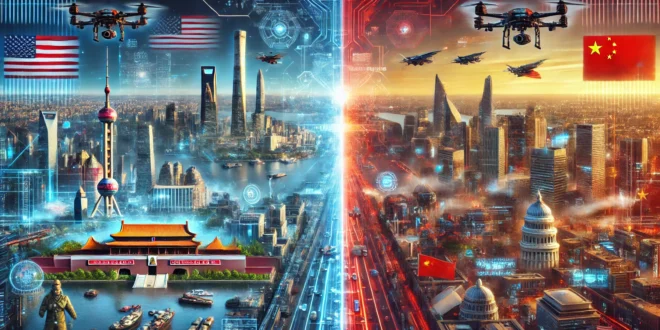
The central rivalry in this multipolar order remains that between Washington and Beijing. From the perspective of an ultramodern consumer society, one can see illusions of endless growth and technological marvels. Yet the undercurrent of potential confrontation persists, recalling Remarque’s warnings about how national competition can turn into tragedy.
Trade relations and economic indicators
Despite diplomatic tensions, trade interdependence remains. World Bank data shows that total trade between the United States and China exceeded $720 billion in 2024 and is expected to reach nearly $750 billion by the end of 2025. Although efforts to partially “decouple” continue, particularly in semiconductors and other high-tech sectors, the consumer markets of the two countries remain deeply intertwined. The IMF notes that by 2025, the United States and China will together account for approximately 34-35% of global GDP, although growth rates in both countries have moderated slightly compared to projections from early 2020.
The United States maintains a nominal GDP estimated at $28 trillion, driven by the growing financial services and advanced technology sectors. China’s nominal GDP is on track to exceed $22 trillion. As its middle class expands, Beijing is trying to balance consumption-led growth with export competitiveness. The new “Digital Silk Road” expands the Belt and Road Initiative (BRI) into big data and cloud computing, increasing global reliance on Chinese-built infrastructure.
Security and alliances
In the Indo-Pacific region, the United States is increasing defense coordination with Australia, Japan, and India, seeking to maintain stability but also to guard against Chinese maritime aggression. China’s expanding navy and the construction of new outposts near strategic sea lanes have fueled concerns in Washington, Tokyo, and New Delhi. However, fears of open conflict that would threaten global markets and advanced technologies have deterred both sides from direct escalation.
Huxleyan and Remarquean undercurrents
A Huxleyan view can be admired as American and Chinese tech giants drive the next wave of AI-powered healthcare, electric mobility and space exploration. At the same time, there is a Remarquean undertone that warns of how fear and mistrust can lead to devastation. The race for quantum supremacy or deadly autonomous weapons systems highlights that behind progress lie tools of war.
2. The European Union
The EU faces the dual challenge of harnessing technological innovation while also grappling with external pressures and internal frictions. Member states remain vigilant against the dystopian drift of an overly automated society, pursuing digital sovereignty and ethical rules for artificial intelligence. Yet, as Remarque would remind us, Europe’s history is fraught with conflict, and concerns about potential hotbeds of tension on the EU’s periphery are still present.
Economic integration and trade
With a total nominal GDP of over USD 21 trillion, the EU remains one of the largest single markets, accounting for approximately 15% of global GDP. Trade with the US exceeded USD 1.3 trillion in goods and services in 2024, with this figure expected to increase slightly in 2025 as supply chains recover from the pandemic. Meanwhile, trade between the EU and China reached USD 830 billion, dominated by exports of European cars and Chinese electronics.
Energy transition
Driven by climate commitments, the EU is significantly reducing its dependence on Russian energy. Renewables now provide over 40% of the Union’s electricity generation – up from 32% in 2020 – and are supported by cross-border transmission projects. While a greener Europe may seem like a Huxleyan ideal, it also struggles with political divisions over funding and migration that remain faint echoes of Europe’s war-torn past.
Security integration
The EU has strengthened its cooperation through initiatives such as Permanent Structured Cooperation (PESCO). Average defence spending in member states is around 2% of GDP, although progress has been uneven. Calls for a more united European army remain controversial. As conflicts simmer in parts of Eastern Europe and the Mediterranean, one is reminded of Remarque’s warning: a bright façade of unity can mask historical feuds and border disputes that could still flare up.
The lack of innovation
Despite ambitious rhetoric to foster a data-driven economy, the EU’s regulatory frameworks often hinder rapid technological breakthroughs. The bloc’s lengthy decision-making processes and strict compliance standards can stifle risk-taking, which is essential for innovative research, and hinder the growth of European start-ups. Many EU-based firms cite overlapping regulations and uneven market integration as obstacles to timely innovation, forcing them to seek out more dynamic, venture-capital-rich environments in the US or Asia. Meanwhile, R&D spending across the bloc, while significant in absolute terms, lags behind the intensity seen in leading tech hubs such as Silicon Valley or Shenzhen.
3. BRICS countries
Originally a loose economic grouping, BRICS (Brazil, Russia, India, China, South Africa) has become a platform for major emerging economies with divergent interests. The group's outward optimism for a shared future hides internal differences and sometimes mistrust.
Trade and economic coordination
According to UNCTAD, intra-BRICS trade will reach nearly US$620 billion in 2024, reflecting steady but modest annual growth. The combined nominal GDP of the five economies amounts to about 26-28% of total world GDP, although this figure varies depending on exchange rates and is higher at purchasing power parity. China remains the main driver, followed by India, whose growth rate is expected to hover around 6% in 2025. Brazil’s raw material exports and Russia’s emphasis on energy sales leave both countries vulnerable to global price fluctuations.
Political upheavals and tensions
- Russia continues to strengthen its ties with China amid ongoing Western sanctions.
- India, which is engaged with BRICS members, is expanding its security and economic partnerships with the US, EU and Australia.
- Brazil is experiencing domestic political changes that sometimes support nationalist rhetoric and other times encourage multilateral cooperation.
- South Africa has struggled with periodic economic slowdowns but remains a gateway to wider African markets.
The dual lens
From Huxley's perspective, the BRICS demonstrate a desire for autonomy in global finance, including the creation of alternative currency payment systems and a framework for digital settlements. However, from Remarque's perspective, tensions are rising - particularly between India and China - raising the possibility that old border disputes could spark larger conflicts.
4. Africa
Africa, home to over 1.5 billion people by 2025, is on the cusp of transformational change. In many ways, the continent embodies both hopeful futurism and the difficulties of conflict resolution.
AfCFTA and growth prospects
The African Continental Free Trade Area (AfCFTA) is a cornerstone of regional integration. The World Bank estimates that AfCFTA has the potential to lift 30 million people out of extreme poverty and increase Africa’s income by US$76 billion. Africa’s total GDP exceeds US$3 trillion, with Nigeria, Egypt and South Africa as economic anchors. Foreign direct investment (FDI) from China and the EU remains strong, particularly in infrastructure, manufacturing and digital services.
Conflicts and human realities
Yet alongside these opportunities, unresolved conflicts also exist. The Sahel region is wracked by rebellions, and civil unrest is erupting in parts of the Horn of Africa. The images of displaced families and destroyed cities are reminiscent of the hardships that Remarque documented in Europe a century earlier. The African Union and regional bodies are coordinating efforts to combat terrorism and negotiate peace, but instability persists.
Technology and demographics
Huxley’s optimism is evident in Africa’s youthful demographics: more than 70 percent of the population in many countries is under 30, fueling a surge in fintech, telemedicine, and mobile agritech solutions. In megacities like Lagos and Nairobi, entrepreneurs are integrating blockchain into cross-border money transfers, bypassing older financial bottlenecks. Yet beneath the promise of transformation lie the shadows of inadequate infrastructure and governance shortcomings—human stories that reflect resilience but also enduring vulnerability.
5. Gulf States
Saudi Arabia, the United Arab Emirates, Qatar, Kuwait, Oman, and Bahrain continue to play important roles in global financial and energy markets. Indeed, as advanced technologies reshape industries, these countries are experimenting with new forms of economic diversification.
Energy, GDP and diversification
Hydrocarbons continue to be central to the region’s economy, with oil prices stabilizing in the $70-80 per barrel range, providing comfortable revenues. The combined GDP of the Gulf Cooperation Council (GCC) is estimated at $2.4-2.5 trillion. Although sovereign wealth funds are pouring billions into tech startups, logistics and tourism, dependence on oil and gas still exceeds 60% of export earnings for several Gulf states. Saudi Arabia’s Vision 2030 is investing in futuristic megacities and cutting-edge research centers, hoping to reduce oil’s share of government revenue to below 50% by the end of the decade.
Regional rivalries and alliances
Improved ties within the GCC follow the resolution of the blockade of Qatar in 2021, but tensions with Iran persist. The Strait of Hormuz remains a critical shipping lane for the world’s oil, and the specter of conflict – however contained – unsettles energy markets. While the Gulf states maintain traditional security arrangements with the US, they are also deepening their technical and trade ties with China, illustrating opportunistic alliances in a multipolar era.
Socio-political prerequisites
The futuristic megaprojects in the Gulf, where AI-driven urban planning meets lavish entertainment hubs, have a Huxleyian feel. Yet a Remarque-esque caution emerges when one considers the numbers of foreign workers struggling with precarious employment protections and the political complexities that could erupt when resources are contested.
Interrelationships and perspectives
These five blocks demonstrate an abstract dance between progress and regress. Huxley’s perspective highlights breakthroughs in technology, healthcare, and governance structures that seem to lift society beyond historical limitations. By contrast, Remarque’s perspective reveals that beneath these promises lie eternal struggles for power, resources, and identity.
- Rivalry between the United States and China anchors global trade and sets the tone for technological competition. Their interdependence does not preclude strategic mistrust.
- The European Union is using soft power in its pursuit of energy transition and data governance, but it is struggling with deep-rooted divisions.
- BRICS demonstrates the shift in the center of economic gravity, although the internal faults are large.
- Africa embodies both dynamic growth potential and the specter of conflict, making it a focal point for investment by outside powers.
- Gulf states are balancing ambitions for a post-oil future with the ever-present vulnerabilities of a region mired in geopolitical tensions.
At this point, the world remains caught between the glittering horizon of technological possibility and the unyielding reality of competition and war. If Huxley’s age of engineering convenience merges with Remarque’s shattering lessons about conflict, leaders must carefully navigate this dual legacy. The next decade depends on whether cooperation on trade, climate action, and conflict resolution can prevail over nationalist fervor and zero-sum games—which will ultimately determine whether 2025 will be a turning point toward sustainable peace or a prelude to deeper global strife.
"Yes, this world is a stage where all men are actors. "
Shakespeare, "As You Like It,"
Act Two, Scene Seven
Sources:
Atlantic Council. (2025). Africa’s trajectory in a multipolar world. Retrieved from https://www.atlanticcouncil.org/
Brookings Institution. (2025). Transatlantic trade in a post-pandemic era. Retrieved from https://www.brookings.edu/
CATO Institute. (n.d.). Research and analysis. Retrieved from https://www.cato.org/
Council on Foreign Relations. (2025). Border disputes in Asia: India-China relations. Retrieved from https://www.cfr.org/
Foreign Policy Magazine. (2023). BRICS and global governance. Retrieved from https://foreignpolicy.com/
Hoover Institution. (n.d.). China’s R&D spending estimates. Retrieved from https://www.hoover.org/
IEA. (n.d.). EU defense funding. Retrieved from https://iea.org.uk/
IMF. (n.d.). Global Economic Outlook 2025. Retrieved from https://www.imf.org/
Mercatus Center. (n.d.). EU digital tax and regulatory impact. Retrieved from https://www.mercatus.org/
OECD. (n.d.). GDP and economic outlook data. Retrieved from https://www.oecd.org/
RAND Corporation. (2025). Naval competition and risk assessment in the Indo-Pacific. Retrieved from https://www.rand.org/
RUSI. (n.d.). Security and defense analysis. Retrieved from https://rusi.org/
UNCTAD. (n.d.). BRICS intra-trade statistics. Retrieved from https://unctad.org/
World Bank. (n.d.). International trade data and AfCFTA projections. Retrieved from https://www.worldbank.org/
Bruegel. (2024). Europe’s innovation performance: Challenges and opportunities. Retrieved from https://www.bruegel.org/
OECD. (n.d.). GDP and economic outlook data. Retrieved from https://www.oecd.org/