EKIP– Expert Club for Economics and Politics A Different Opinion
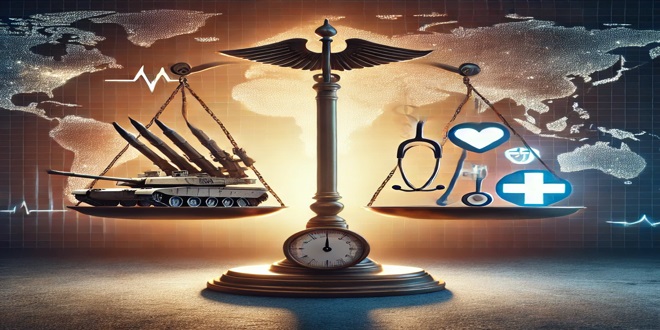
In the realm of public finances, the classic “guns versus oil” dilemma – choosing between military might and social well-being – has long been at the heart of budget debates. Over the past 80 years, governments around the world have spent trillions on both defense and health, but not always to the same extent. In the decades since World War II, trends in military and medical spending have shifted with geopolitical tensions and economic conditions. From the arms race of the Cold War to the post-war welfare states. And from the build-up of defense facilities during 9/11 to the sharp increase in health spending in the wake of COVID-19, the data reveals how countries juggle the imperative of keeping their citizens both safe and healthy. Analyzing these spending patterns, especially in NATO and European Union countries, makes it possible to understand whether higher defense spending is at the expense of health care, or whether smart politicians have found a way to have both guns and oil.
The Cold War: Heavy Weaponry and Modest Aid
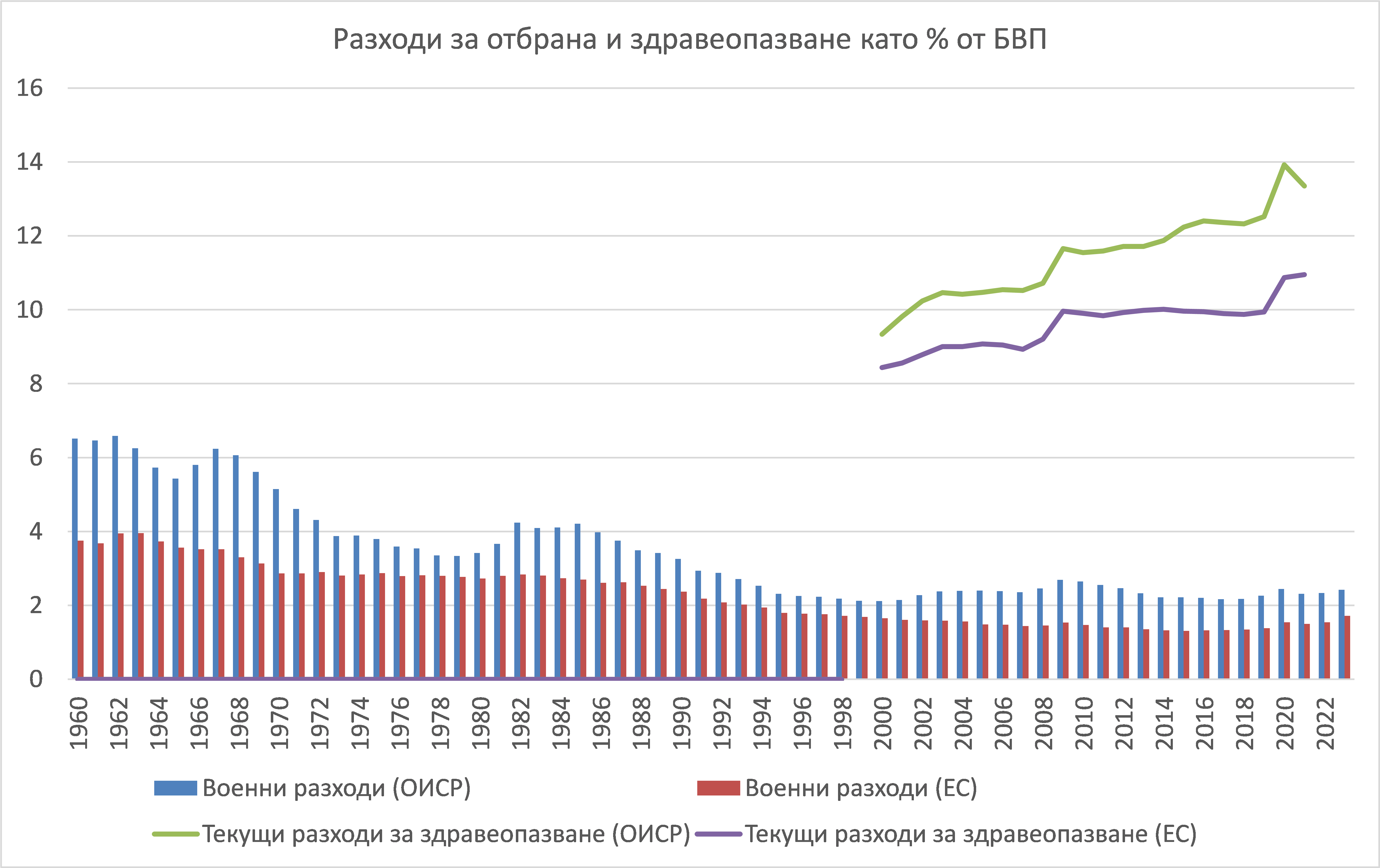
In the early decades of the Cold War, defense budgets were enormous. After 1945, the United States and the Soviet Union invested heavily in their militaries, each with security as a top priority. In the 1960s, global military spending peaked at over 6% of global GDP, reflecting superpower rivalry and conflicts such as Korea and Vietnam. NATO allies in Western Europe also maintained significant arsenals: in the 1970s and 1980s, major NATO members regularly spent over 3% of GDP on defense (the United Kingdom around 5%, the United States around 6%). Military spending accounts for a large proportion of national output—for example, America's defense spending reached around 10% of GDP at the height of the Cold War in the 1950s, before settling at 5–6% in the 1980s.
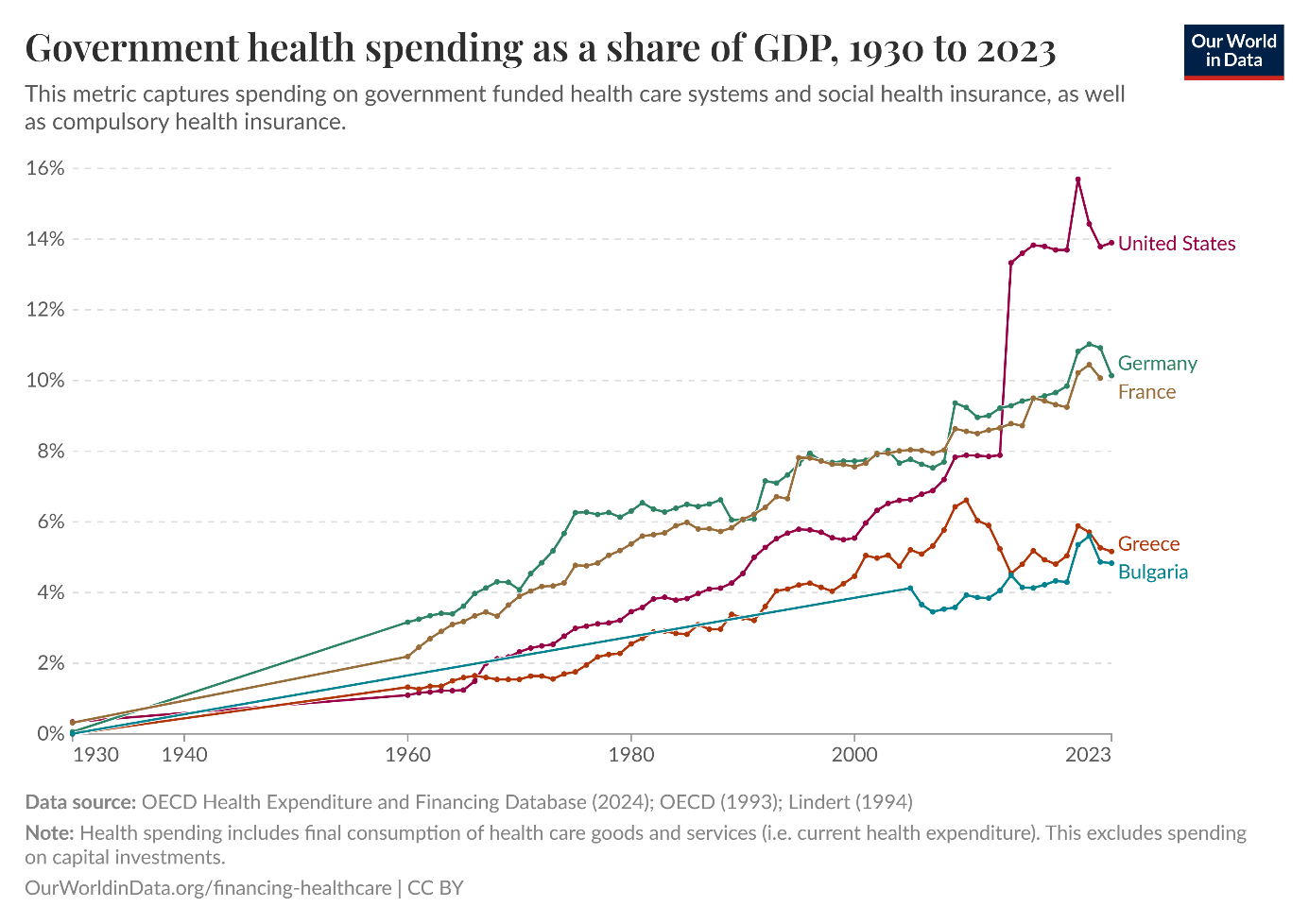
At the same time, health care was a lower priority in budget terms during these years. Spending in most countries in 1960 was modest - the average health care expenditure in OECD economies was approximately 3.8% of GDP. However, as wealth increased in the post-war period, public health systems gradually expanded. In the 1970s, many Western countries established universal health care (for example, the British National Health Service was established in 1948), which increased health care budgets. However, the growth of health care was limited by large commitments to defense and other needs. In the Soviet bloc and other authoritarian regimes, military and heavy industry were often given priority over consumer welfare, meaning that public health services, while universal, were insufficiently well-funded. Thus the Cold War era directed spending toward weapons, not oil—security first, welfare later. Social programs expanded (especially in Western democracies), but in the shadow of large defense bills.
The Peace Dividend: Welfare States Rise
The fall of the Berlin Wall in 1989 and the collapse of the Soviet Union in 1991 changed the West’s budgetary priorities. With the existential threat of nuclear conflict between the superpowers gone, many NATO countries cut defense spending and received a “peace dividend.” Western European military budgets, which had previously amounted to 3-5% of GDP, fell sharply: in the late 1990s, countries such as Germany, Italy, Spain, and the Netherlands cut defense spending to just 1.1-1.5% of GDP. This freed up fiscal space. In fact, from 1990 onwards, European governments increasingly directed resources to their welfare states—pension, education, and especially health care. As noted in , national governments effectively generated savings every year and "used them primarily to finance and expand their welfare states." In Germany, for example, lower defense needs after reunification saved an average of over 20 billion euros per year, allowing for higher spending in other areas.
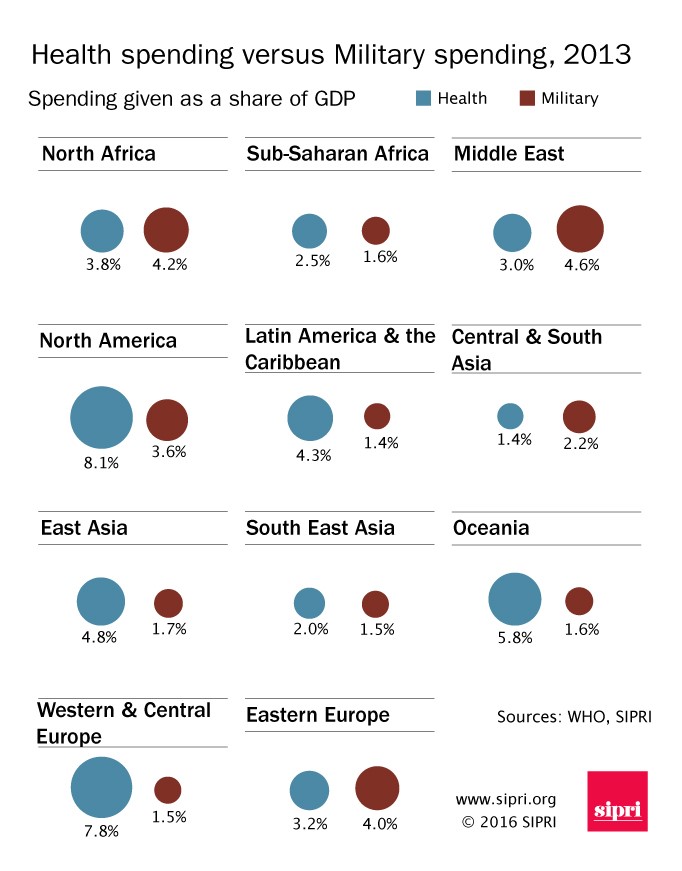
Разходите за здравеопазване нарастват през 90-те години. Средният им размер в страните от ОИСР се удвоява от равнището през 1960 г. до около 7,9 % от БВП през 1990 г. и продължава да нараства. Напредналите икономики насочват ресурси към болници, нови медицински технологии и по-широко застрахователно покритие , подкрепени от икономическия растеж и отдиха от военната конфронтация. Страните от Централна и Източна Европа, които излизат от обсега на съветската сфера, първоначално се сблъскват с икономически сътресения, което свива бюджетите за здравеопазване, но с прехода на икономиките им те също се опитват да увеличат социалните разходи и да реформират здравните системи. Общата световна тенденция през този период е ясна: военните разходи като дял от производството намаляват след Студената война, докато делът на здравеопазването като цяло се увеличава. Към началото на предходното десетилетие правителствата по света харчат средно два и половина пъти повече от своя БВП за обществено здравеопазване, отколкото за отбрана (5,9 % спрямо 2,3 % през 2013 г.) (buy lyrica pills). Регионите, в които цари мир, отделят пари за медицина, а не за ракети, което показва как дивидентите на мира се превръщат в болнични легла и лекарства.
9/11 and New Compromises: The 2000s
The turn of the millennium brought new challenges. The attacks of September 11, 2001, and the ensuing "war on terror" triggered a sharp increase in military spending, especially by the United States and its NATO allies engaged in the wars in Afghanistan and Iraq. U.S. defense spending rose from about 3.5 percent of GDP in 2001 to almost 5 percent in 2008, reaching levels not seen since the end of the Cold War. By the end of the 2000s, the U.S. military budget exceeded $700 billion per year, surpassing all competitors. Some European NATO members also modestly increased their defense budgets between 2000 and 2009—for example, the United Kingdom maintained spending of about 2.5 percent of GDP during its interventions in Afghanistan and Iraq. Yet most of Western Europe remains hesitant to divert much of its domestic priorities; many still hover around or below NATO’s recommended 2% of GDP on defense. The contrast is stark: while the United States took over the bulk of NATO’s military operations after 9/11, continental Europe largely continued to enjoy its prosperity, relying on the American security umbrella.
Source: OECD (2025)
Even as defense budgets in some countries have increased, health care spending has not collapsed—especially in wealthy countries. In the United States, despite wars abroad, health care spending continued to rise in 2000, driven by the expansion of Medicare and rising medical costs. As of 2010, public and private health care spending in the United States amounted to about 17 percent of GDP, the highest level in the world. European countries have also maintained their commitment to health care; in countries such as France, Germany, and the United Kingdom, health care spending increased between 2000 and 2009 (for example, health care spending in France remains above 10 percent of GDP). But there are tradeoffs: the rapid increase in U.S. defense spending has contributed to a growing deficit, which has indirectly led to cuts in other programs. the cost of the Iraq war (about $1-2 trillion) could have "funded Medicare's prescription drug plan for a decade" or covered the needs of the US Social Security for 75 years. In lower-income countries, any redirection of funds to the military is more likely to have a zero-sum effect: governments fighting insurgencies or regional wars often have to postpone investments in health infrastructure. Thus, the 2000s saw a mixed picture - rich countries trying to maintain both weapons and oil (often through debt), while poorer and conflict-torn countries faced more difficult trade-offs.
Savings and rebalancing: 2010
The global financial crisis of 2008-2009 led to budget cuts in many countries, forcing difficult budget choices. Defense spending, already reduced after the peak of the Iraq war, has leveled off or declined in many Western countries since the beginning of the decade as they tighten their belts. Between 2010 and 2019, global military spending as a share of GDP reached a historic low, averaging around 1.9% of GDP – partly as a result of deliberate cuts and partly because of economic recovery (which led to higher GDP while defense budgets remained constrained). In post-crisis Europe, governments from Greece to the United Kingdom have cut defense programs to meet deficit targets. Health spending has often been more politically sensitive to cuts, but it too has come under pressure for austerity. In some hard-hit EU countries, health budgets were stagnant at the start of the 2010s, despite rising demand for services. However, underlying factors – ageing populations, medical innovation and public expectations – maintained a slight upward trend in health spending. By the end of the 2010s, average health spending in OECD countries exceeded 8-9% of GDP, a historic high, while defence spending in most of them had not yet returned to pre-2001 levels.
Years of change
Recently, geopolitical tensions have again raised the level of defense. Russia’s annexation of Crimea in 2014 and renewed tensions between the great powers have led NATO to strengthen its focus on security. NATO members have formally renewed their commitment to allocate 2% of GDP to defense, although few initially met it. Eastern European countries such as Poland and the Baltic states, which feel the threat most strongly, have increased their military spending significantly since 2014. Even traditionally pacifist Germany has begun to increase its defense budget (from ~1.2% of GDP to 1.5%). These increases have been gradual and often occurred alongside economic growth, meaning that the impact on social spending has been small. In fact, between 1995 and 2015 , about 72% of countries in the world managed to reduce the share of GDP spent on defense, while 73% increased the share spent on health. The general trajectory since the end of the Cold War was this: more oil, fewer weapons. As of 2019, the world, on average, spent about two to three times more on health than on defense as a ratio of GDP.
There were exceptions in the 2010s. In the conflict-ridden Middle East (the war in Syria, the fight against ISIS, the wars in Yemen and Libya), the military burden increased - some North African and Middle Eastern countries significantly increased their defense budgets, while investment in health care lagged behind. And Eastern Europe, in the context of the conflict in Ukraine after 2014, broke with the global trend: several countries in this region actually reduced the share of health care in GDP and increased the share of military spending. These cases highlight that when security threats increase, social sectors can feel the pressure. Yet outside these conflict zones, the pattern of defense reductions and welfare increases largely persisted in the 2010s.
Pandemic and war: a double shock
In 2020, an unprecedented blow struck: a global pandemic, followed by a ground war in Europe. The COVID-19 crisis led to a sudden spike in healthcare spending. Governments around the world have pumped huge sums into public health – from emergency hospitals and vaccines to bailouts for health systems – leading to high growth in healthcare spending as a share of GDP (in some cases because GDP has also contracted). In 2020-2021, , which is more than pre-pandemic levels. The urgent need to save lives has put aside any talk of budget cuts; if anything, military spending has been temporarily downgraded this year. Many defense exercises and procurements have been postponed as resources and attention have been diverted to the health emergency.
But in 2022, the world’s lens shifted again, as Russia’s full-scale invasion of Ukraine in February brought war back to Europe, and defense budgets once again came to the fore. NATO countries, shocked by the conflict on their doorsteps, proceeded to dramatically increase military spending. In the years that followed, dozens of countries increased their defense spending by double digits. In 2022, global military spending reached a historic high of $2.24 trillion (and $2.44 trillion in 2023), reversing the relative decline of previous decades. For NATO in Europe, the alliance’s 2% GDP target suddenly became a floor, not a ceiling. Germany announced a massive defense investment plan; France, Poland, the Nordic countries, and others set budgets that are on track to reach or exceed 2% of GDP. This rapid rearmament raises new questions about weapons versus oil. European governments, already burdened by pandemic debts and aging populations, now face the daunting task of financing tanks and missiles as well as hospitals and clinics. , that something will have to change – either higher taxes, or larger deficits, or cuts in other areas – to meet the new defense imperative. Early signs are that many countries are opting for higher borrowing in the short term to finance their military activities, hoping not to cut healthcare spending. In fact, in 2022 and 2023, most European countries kept their healthcare budgets growing (to cope with the backlog of operations and to strengthen systems post-COVID). But as security needs continue to grow, the tension between armored vehicles and MRI machines could intensify if economic growth does not provide additional resources.
Guns vs. Stethoscopes: Is there a trade-off?
Do higher defense budgets lead to lower health spending? Economists have long studied this question of “crowding out,” and the evidence is abundant. On the one hand, rigorous studies across countries show that there is a real trade-off, especially in developing economies with limited financial resources. For example, one global analysis (2000-2013) found that a 1% increase in military spending led to an average 0.62% reduction in health spending. In lower-income countries, the effect was even more pronounced—a 1% increase in military spending was accompanied by an almost 0.96% drop in health investment. These findings confirm the intuitive idea that in a context of limited budgets, more weapons can mean fewer vaccinations or hospital beds, especially where budgets are not bolstered by large revenues. , dedicated to OECD countries, also concludes that defense spending often competes with social spending, which harms health care in less wealthy countries.
On the other hand, over the past few decades, many countries around the world have managed to increase both their health and military spending – usually thanks to economic growth. As the Stockholm International Peace Research Institute (SIPRI) has noted , between 1995 and 2015 there was no “clear link” in which a reduction in military spending always led to an increase in health spending or vice versa. Roughly three-quarters of countries have shifted towards prioritizing health (increasing the share of health in GDP and reducing the share of military spending) over this period. But it is interesting that some countries that have increased their military spending have found ways to spend more on health. These are usually middle- and high-income economies in boom times – China, for example, dramatically increased its defense budget in the 2000s and 2010s, but its spending on health (as a percentage of GDP) also rose as the country became wealthier. Wealth can buy both weapons and oil. In developed countries, the crowding-out effect can be “neutralized” by growth – higher GDP and incomes allow for greater absolute spending on everything. However, the data confirms that poorer countries “suffer the most” from the trade-offs between defense and health, since budgets are a zero-sum game.
Trends and prospects
Since 1945, the global trend has been clear: when geopolitical tensions have eased, defense budgets have shrunk and social care (including health) budgets have increased, and when conflict looms, military spending can increase at the expense of other priorities. NATO and EU countries are examples of this: they enjoyed a generation of low defense spending after the Cold War and redirected resources to public health and social care. Now, with war and great power rivalry once again in Europe, defense spending is rising again. So far, this has not led to a sharp reduction in health spending among wealthy Western countries, but the opportunity cost is drawing attention. High military budgets mean that potential funds that could have gone to new hospitals, medical research, or pandemic preparedness are instead spent on fighter jets and troop deployments. On the other hand, underinvestment in defense can have its own costs if it encourages aggression - a dilemma that is now well known in Europe.
In the future, economic conditions will play a key role. If growth and government revenues increase, countries can manage to maintain both robust health care and stronger defense. If economies stagnate or debt becomes unsustainable, policymakers may face painful trade-offs between the operating room and the war room. Political leadership and public opinion will determine priorities: democratic societies that are accountable to voters generally prioritize health and well-being— in 92 democracies, 93 percent spent more on health than on military spending in recent years. Authoritarian regimes, by contrast, often direct disproportionate resources to security forces at the expense of hospitals. Ultimately, the balance between syringes and swords will continue to shift depending on the international climate. The past eight decades have shown that peace and stability allow oil to trump weapons, while the fear of war tips the scales back. Governments must constantly calibrate this balance. In an ideal world, strong defense and strong health could coexist without one cannibalizing the other—a goal that prosperous societies in peacetime sometimes achieve. The challenge for today’s leaders is to prevent a new era of conflict from undoing hard-won progress in public health. After all, a nation’s strength is measured not only by the might of its military but also by the health and well-being of its people.
Sources: World Bank, OECD, SIPRI, IMF, NATO, etc.