EKIP– Expert Club for Economics and Politics A Different Opinion
Author: N. S. Lyons
America's fight against the deep state is an international conflict in which Britain and Europe have been active proxies. This will no longer be tolerated.
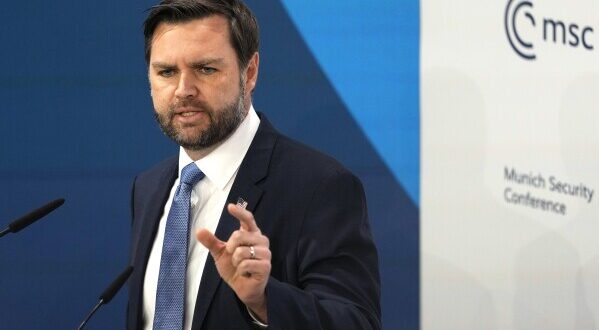
The political elite of Europe and the Anglosphere seemed shocked by J.D. Vance’s extremely frank speech in Munich last month. The US vice president declared that the most serious threat to Washington’s security came from within NATO and reproached the leaders present for their increasingly overt attacks on “democratic values” – including censoring speech, suppressing popular opposition parties and cancelling elections. If this shock is not staged, it is quite telling, because these elites were already effectively at war with the US in their own way. Vance merely named the true nature of this covert conflict.
Vance delivered several important messages in his speech, the most significant of which was that the era of “post-national,” globalist liberalism was over. According to him, the United States was now interested in a strong West built on sovereign and independent states capable of defending their own physical, cultural, and spiritual integrity. His emphasis on freedom of speech and democratic legitimacy was linked to this message and went beyond simple appeals for “shared values” or Washington’s sympathy for nationalist movements. In effect, Vance issued a clear warning: Europe could no longer act as a conduit in the political and ideological conflicts tearing the United States apart. Specifically, he warned that transatlantic institutional, technological, and legal support for the beleaguered American leftist deep state must be ended immediately—or there would be consequences.
After Donald Trump was elected in 2016, panicked American elites sought to build a system of public opinion control by tightly regulating the information environment, especially online. They believed that “the growing support for populism came from voters who were poorly informed and susceptible to disinformation, including from abroad, and that if their access to information on the Internet was controlled, they would start voting “right.” Of course, at the heart of this perception was the elite’s belief that his increasingly radical policies were the only sensible path, and that opposition to them could only come from stupid or easily manipulated people. As Trump’s defeated opponent, Hillary Clinton, later stated, social media had fundamentally changed the environment, and “if we don’t moderate and control the content, we lose control altogether.”
This idea gradually grew into a powerful censorship machine, partially revealed after Elon Musk’s acquisition of Twitter. Initially, the main obstacle facing the American elite was the First Amendment to the Constitution, which guarantees freedom of speech. Although, as John Kerry complained at a forum in Davos, the First Amendment was a “serious obstacle” to “deleting” unwanted content, the Biden administration began to circumvent the Constitution by directly cooperating with technology companies and state-funded fact-checking organizations. This led to what one US federal judge called“the most massive attack on free speech in American history.”
A more subtle and enduring way to circumvent the Constitution was to outsource censorship, using the legal and regulatory frameworks of the EU and other Western countries. Because of the global nature of the Internet, any local market of sufficient size influences the network worldwide through its regulations. Leaders on both sides of the Atlantic quickly realized that with its large unified market, the European Union could pressure Internet companies everywhere—including the United States—to change their behavior in order to maintain access (this regulatory coercion became known as the “Brussels effect,” and became the most remarkable European innovation of the century).
The American “partners” immediately set in motion a series of structures for global “moderation” of internet content as part of an unofficial anti-Trump/anti-populist alliance. It began in 2016, when Brussels forced Facebook, Microsoft, Twitter and YouTube to sign a “ Code of Conduct on Countering Illegal Hate Speech Online,” requiring “the removal of illegal hate speech within 24 hours” and ordering “the removal or suspension of access to such content.” The decision as to what exactly constituted illegal speech would be made by “trusted” reporters – a network of ideologically aligned media outlets, often funded by the state. Other similar frameworks soon emerged, such as Germany’s 2017 NetzDG. (which criminalizes a wide range of “misinformation”) and the UK’s “ Online Safety Act”, which prohibits even relatively vague forms of “hateful conduct”, such as causing “unnecessary anxiety” and “significant psychological or physical harm”.
This regulatory tightening culminated in the adoption of the EU’s Digital Services Act (DSA), which came into effect in 2023 and is now fully in force. “The DSA’s main objective is to prevent illegal and harmful online activities and the spread of disinformation,” by fining any internet platform (from social networks to app stores to accommodation sites) up to 6% of its annual global revenue if it fails to remove “false” or “harmful” content within hours. What constitutes such content is decided by small committees of “experts” selected by the European Commission. Overall, as investigative journalist Matt Taibbi rightly notes, it is “the most far-reaching censorship law ever passed in a Western democracy.”
For a long time, this approach worked. The Twitter Files exposé, conducted by journalists like Taibi, Michael Shellenberger, and others, showed that Twitter teams regularly provided reports on how they were complying with NetzDG requirements in Germany. Twitter’s legal department even noted internally that “half or more” of its time was spent on regulations around the world and enforcing foreign censorship requests by 2022.
The transformation of this anti-populist system into an overt international policy occurred in 2019 with the “Christchurch Call to Action,” initiated by New Zealand Prime Minister Jacinda Ardern. This call resulted in commitments from dozens of governments, online platforms, advertisers, and civil society organizations to “root out terrorist and violent extremist content online.” The commitments themselves were described as “encompassing everything from implementing appropriate laws and regulations to technical measures and working on the root causes of terrorism” (in practice, this often included right-wing populist or anti-government views, and subsequently any “dangerous” opinions about COVID-19 and the management of the pandemic).
What followed was an explosion of hundreds of “non-governmental” organizations, think tanks, “fact-checkers,” and academic “disinformation researchers” that sprang up to coordinate censorship that stretched across borders. They provided “expertise” that governments and platforms could rely on to decide who to silence or sanction. At the same time, as formally independent and “scientific,” they gave the appearance of objectivity. They quickly became a key part of the anti-populist project. Their signature practice was to pressure advertisers to boycott inconvenient sites, platforms, and media outlets by branding them extremist.
The Center for Countering Digital Hate ( CCDH ), an organization closely associated with the British Labor Party, has emerged as particularly effective in this effort, successfully limiting ad revenue for certain sites deemed “right-wing.” Following Elon Musk’s acquisition of Twitter, CCDH helped drive many advertisers away from the platform. Leaked documents from CCDH later revealed that they were explicitly considering a strategy called “Kill Musk’s Twitter.” Moreover, CCDH worked closely with government agencies, providing lists and justifications for censoring political opponents. When CCDH published a report denouncing 12 influential critics of COVID lockdowns as “The Dozen Misinformers,” 12 Democratic attorneys general in the United States sent a letter the same day to the heads of Twitter and Facebook, demanding that the 12 individuals be removed from the platforms. It was later discovered that the CCDH and the Democratic Party regularly exchanged drafts and coordinated joint actions.
In addition, CCDH appears to have acted as a foreign lobbyist, regularly organizing meetings with American lawmakers and reporting that it was making “progress for change in the US and support for STAR” – STAR is the “Global Standard for Social Network Regulation” that CCDH hoped the US would adopt under a Democratic Party in power. This is probably also why European Commission Vice-President Věra Jourová confidently remarked in Davos two years ago that the Americans would soon introduce hate speech laws similar to those in Europe.
The US Department of Justice is now apparently investigating whether CCDH engaged in a coordinated foreign influence campaign without registering as a foreign agent (of the UK). Given the revelation that the Labour Party sent up to 100 staff to the US to help Kamala Harris’ campaign – something the Trump team called“blatant foreign interference” at the time – it seems unlikely that the Trump administration’s Justice Department would look favourably on the organisation’s claims of innocence and independence.
But CCDH is just one of many organizations with a similar role, including Newsguard and the Global Disinformation Index. An investigation by UnHerd shows that these organizations collectively form something like “invisible guards in the vast machine of online advertising” and “fact-checking” aimed at distorting or controlling the information and narratives reaching the public. In other words, they function as political weapons.
It is noteworthy that a significant number of these organizations – such as the Atlantic Council and the Alliance for Securing Democracy (ASD) of the German Marshall Fund – receive partial funding from several governments on both sides of the Atlantic and maintain close ties to intelligence agencies. The founding board of the ASD, for example, included names such as John Podesta (Chairman of Hillary Clinton’s 2016 campaign), Richard Ledgett (Deputy Director of the National Security Agency under Obama), and Michael McFaul (Special Assistant to the President on the National Security Council under Obama).
This is no accident. As journalist Jacob Siegel has well documented, since 2016, American security services have turned the tools of counterterrorism, counterinsurgency, and regime change developed for overseas use back at home. Following the “Christchurch Call,” Western intelligence and security services, particularly in the Five Eyes network, have stepped up their cooperation to combat “disinformation” and have deployed their own propaganda machinery to “win hearts and minds.” In the United Kingdom, the British Army’s 77th Brigade—a “non-lethal psychological warfare” intelligence unit—began monitoring and reporting on the activities of British citizens (despite its stated overseas operations), working with other government agencies, and coordinating with Five Eyes partners on influence operations.
These security services have sewn the perceived threat of populist movements into emerging theories and doctrines of “ fifth-generation warfare”—a view that the digital revolution has transformed geopolitical competition into a global “ubiquitous battlefield,” marked by constant cyberwarfare and the battle over “information and attitudes.” From this perspective, citizens’ minds (or “ cognitive infrastructure,” as governments have come to call them) are terrain to be fought over in constant battle with rivals like Russia. Populists are now branded as foreign enemies, not just domestic political opponents.
This has led to a comprehensive totalitarian approach to the whole of society, representing a total unification of the state, the military, the private sector, the non-governmental sector and international organizations in the name of “protecting democracy”. This fusion of public and private power is the true “deep state”. This is why intelligence agencies so often work side by side with activist NGOs like CCDH or with nominally private companies like Graphika– a social network analysis company that was initially funded by the US Department of Defense to counter terrorist propaganda, but was later repurposed to identify and censor public discourse around COVID-19 and other troubling issues.
In other words, the transatlantic alliance has been waging a hybrid information war against American society (and other nations) for years. Its primary goal was to stop the rise of Donald Trump and the populism he embodies. But that failed; Trump is back, and as Vance warned political and military leaders in Munich, “there’s a new sheriff” in Washington. As well as risking being left holding the hot potato in Ukraine, former President Joe Biden’s European allies now find themselves mired in the digital trenches of America’s Cold Civil War, still fighting on the side that is already clearly losing. Vance politely told them they had better abandon their positions and withdraw from the conflict zone immediately.
Vance repeated this message directly to British Prime Minister Keir Starmer at the White House last week, saying: “Look, I’ve said what I’ve said before, which is that of course we have a special relationship with our friends in the UK and some of our European allies, but we’ve seen a number of violations of free speech that affect not just British people but also American technology companies and ultimately American citizens.” Here he was not just talking about the principled American disagreement with British and European disregard for free speech, but about their active information warfare against the US, its new government, its companies and its citizens. When Starmer hesitantly replied that “of course we don’t want to interfere in American affairs and we don’t…”, this apology rang clearly false and is unlikely to convince the new sheriff.
If European countries and their English-speaking allies do not want to be treated as enemies but as allies of the United States, they must withdraw from the war they have started on behalf of the old regime in Washington and disarm their censorship machines. This means bringing order to their intelligence services, cutting off support for their paramilitary transnational organizations like the CCDH, and abandoning legislation like the DSA or the “Online Safety Act,” which are designed to control information and political discourse across borders. Vance has been emphasizing this since the election campaign, when he threatened to withdraw American support for NATO if Europe continued to “regulate” American policy through the DSA, stating that it was “absurd to maintain a military alliance [NATO] if that same alliance does not respect freedom of speech.”
Washington's message to its supposed allies is simple: stop the information war and get out. If they don't pay attention and continue to meddle in America's internal political affairs, they may soon find that the new sheriff is ready to impose real diplomatic and economic sanctions for their continued aggression.
The publication is a translation from English. You can read the original material at this link.