 EKIP– Expert Club for Economics and Politics A Different Opinion
Oliver Mark Hartwich
For Germans, July 8th was a good day. Not just because it was this author’s birthday or because of Germany’s delightful 7-1 victory over Brazil in the World Cup, but also because this year it is Tax Freedom Day. Theoretically, up to this point, all the income that the average German has earned since the beginning of the year has been collected as taxes by the government. [1] From that point on, Germans can actually start earning money for themselves by the end of the year.
The date of Government Freedom Day is calculated by many think tanks around the world. In Germany, this is done by the Taxpayers' Federation. To celebrate the occasion, the group has released a short study that not only puts this year's Day in historical context, but also presents important international comparisons.
The first thing to say about Germany's tax rate is that it has remained virtually unchanged over the past decades. In 1960, tax revenues amounted to 28.2% of GDP. Today, they are 31.5%, with the percentage changing little over that period.
But actual taxes are only one side of the story – otherwise the government would have celebrated Freedom Day in April. What has changed significantly over this period are payments to social security systems. They are not called “taxes”, but in reality they are exactly that. In Germany, these include compulsory health insurance, home health care insurance, [2] unemployment insurance, pension payments and accident insurance. In 1960, the various taxes paid into the social security system amounted to 12.1% of GDP; since then they have increased to today’s 20%.
Adding the 31.5% paid in taxes and the 20% of GDP paid for social security, the total tax burden in the economy is 51.5%. Sarcastically, we could call this semi-socialism – the government takes more than half of all income. But this is the reality in most other modern “welfare states” as well.
Germany is a very good example. In fact, it is not something strange, considered in a European context.
In most countries in Europe, a similar increase in government redistribution is observed. In practice, the entire expansion of government is caused not by an increase in the number of services it provides, but by an ever-increasing redistribution of income. The result is a colossal gap between net and gross income that is otherwise difficult to imagine.
Using OECD data, the German Taxpayers' Federation calculated the difference between gross and net wages, including the impact of VAT. For a worker earning an average income, the tax burden is 21.9% in New Zealand and 30.4% in Australia. This is a significantly lower tax burden than is typical in Europe. Belgium tops the list of predatory governments with a tax burden of 59.1%, followed by Hungary at 54% and Germany at 53.1%. In most of the major European economies, the burden is well above 40%.
The tax burden for families with two workers and two children is somewhat lower, but still the burden in Europe ranges from 47% of income collected in Greece to 29.4% in the United Kingdom. Again, Australia and New Zealand have much lower tax rates at 23.2% and 15.5% respectively. This comparison shows that Europeans work much harder for the taxman, while Australians and New Zealanders are more free to enjoy the fruits of their labor.
These remarkable differences in tax rates equalize net income, despite the huge differences in labor costs. The report again presents some important calculations. The left side of the table shows how much it costs to employ a middle-income earner and what net income they receive.
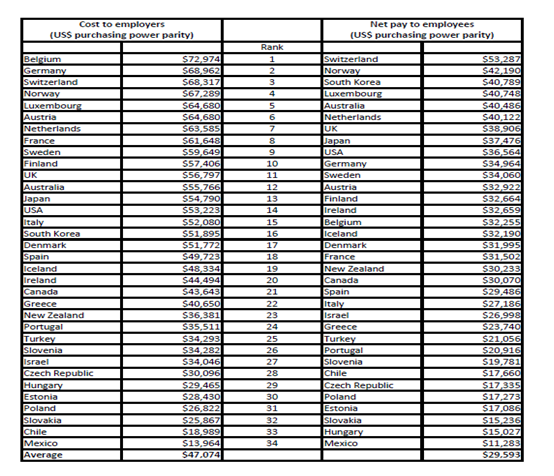
It is perhaps surprising that Belgium is the country where it is most expensive to hire someone at the national average wage, even though it ranks 15th in the ranking of real earnings that workers receive. Similarly, there may seem to be a huge difference between the cost of labor in Germany and New Zealand ($69,000 versus $36,000). But, thanks to New Zealand’s significantly lower taxes, this difference almost disappears when it comes to workers’ net earnings ($35,000 versus $30,000). A similar comparison can be made between Australia and New Zealand, where, despite large differences in gross labor costs, net wages do not differ much, although adjusting for purchasing power parity also helps to bring the two values closer together.
For European taxpayers, the gap between gross and net wages is clearly unpleasant. But it should be an even greater concern. In Europe's aging societies, pension and healthcare payments are likely to increase in the future. At the same time, globalization will make it harder to justify unprecedentedly high labor costs.
This is bad news for future government Freedom Days in Germany and the rest of Europe. Tough decisions will have to be made to keep the day on its current date.
Australians and New Zealanders, however, will look to Europe for comfort. Sure, we sometimes feel like we pay excessively high taxes, but compared to tax levels in Europe, we are in the advantageous position of working mostly for ourselves, not for the government. Let's keep it that way.
You can read the original text here .
Translation: Daniel Vassilev
Editor: Stoyan Panchev
[1] Government Freedom Day is the date by which taxpayers hypothetically produce tax revenues for the year – note trans.
[2] Nursing care insurance is a type of long-term care insurance. It covers the care of people who are not sick in the traditional sense, but who are unable to perform daily activities.






Germany and Belgium are also very bad... guys, let's emigrate to Somalia - the percentage there is close to 0%.
HEE
And what was this extremely profound comment supposed to mean?
According to some people, over the last 20-30-40 years the methodology for calculating GDP has changed significantly and now (for example) as much as 35% of the US GDP is "money" that is NOT the result of actual transactions. Thus, comparing the percentage of taxes to GDP 30 years ago and now seems to be irrelevant. Governments systematically change the methodology for calculating GDP so that it does not appear (as a percentage) that they are spending more and more.
Here is the link explaining how US GDP is calculated (I don't know how it is in the rest of the world, but it can be assumed that it is similar):
http://www.peakprosperity.com/crashcourse/chapter-16-fuzzy-numbers
As for taxes in Bulgaria - they are not low at all. For most workers, for every 100 leva of net disposable income, 47 leva of personal income tax and social security contributions are due. When you add in VAT, excise duties, fees, etc., the percentage becomes almost the same as in Western Europe. Here are the exact calculations:
http://represia.blog.bg/politika/2012/03/08/.916633