 EKIP– Expert Club for Economics and Politics A Different Opinion
For the Christmas and New Year holidays, the government decided to give us a "small" surprise. In just a week, controversial changes to the Social Security Code (SSC) were voted on without any public debate or preliminary assessment of the impact of the adopted regulatory texts. The government tried to hide many questions, disappointments and future economic shocks behind two phrases, the true meaning and significance of which they themselves hardly understand . Here are what they are:
The right to free choice?! Freedom of choice is the right of every individual, regardless of whether he makes a decision related to his daily needs or chooses what to invest in, how to save or in general how to dispose of his property. Is what the government offers free choice, when in essence the payment of social security contributions is an obligation, not a voluntary decision?! When the majority of the social security contribution serves to finance the current needs of the National Social Security Institute? And only 5% of it goes to the individual account of the insured person in the pension funds of the Social Security Institution? If the real goal of those in power is to give their fellow citizens a choice, it is logical to let them decide for themselves where and how much of their income they wish to set aside for old age, and not to artificially create an option for some choice. An option that only provides an opportunity for those who, for some reason, fall into the trap of the state promise and transfer their savings from personal accounts in universal pension funds to the anonymous and bottomless system of the National Social Security Institute. But not for those who want the opposite scenario, namely that their contribution will go only to private pension funds. Or even less for all the others who prefer another form of saving/insurance.
Is the state the better manager?! It is naive to talk about creating competition between the National Social Security Institute and private pension funds. State social security (the first pillar of the pension system) is built on the basis of the cost-covering principle, i.e. in it, pension funds are seized from the personal incomes of people of working age in the form of insurance contributions. They are not subject to saving, are not capitalized, but serve to pay the pensions of current pensioners. In return for these contributions, workers receive only a promise of payment of a state pension when they reach retirement age. The state cannot be a good manager, it does not save or invest the money it receives, but only redistributes it. In fact, it is not even capable of this, after for years the chronic deficits in the state social security system have been covered by transfers from the state budget. And not only do people have no personal savings, but the contribution that is deducted from their monthly salary turns out to be extremely insufficient to patch up the imperfections and wrong incentives created by the way the solidarity pillar functions.
The supplementary mandatory pension insurance (second pillar of the pension system) is built on the basis of the capitalization principle, i.e. insurance contributions are paid into the universal and professional pension funds in a separate individual account for each insured person. They are managed by private pension insurance companies, are capitalized and bring income to the insured persons. The weighted average yield of the universal pension funds for the last two years according to FSC data is 5.96%. With an average annual inflation of 3% for 2012, 0.9% for 2013 and deflation reported since the beginning of 2014[1], insured persons can enjoy relatively good yields as a result of the investment policy pursued by the pension insurance companies.
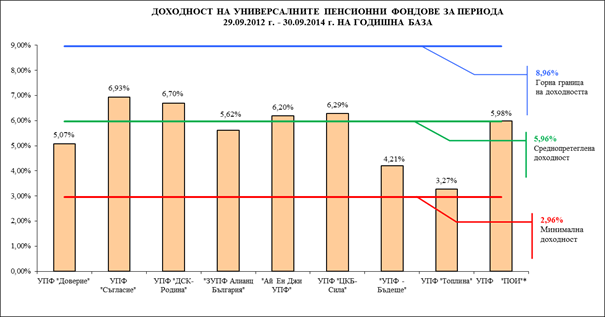
Source: FSC
Lack of memory and economic logic. Some of the factors that necessitated the introduction of the three-pillar pension model in 2000 (negative population growth, upward trend in non-insurance of working people, low collection of social security contributions, etc.) do not seem to have changed to this day. However, if common sense does not prevail and the controversial changes in the Social Security Act are not voted down, instead of a step forward towards a capital-accumulating system, we may take a huge step back, suffering all the subsequent economic and social negatives.
The sharp turn regarding the pension system is another signal that will send a negative message to the investment community. We cannot expect higher incomes, living standards and sustainable economic development without growth in investments, savings, labor productivity and competitiveness. On the other hand, the political class, through its unpredictable actions, does not stop sending negative signals to foreign investors intending to start a business in the country and create new jobs. And looking at local investors, things do not look more optimistic. The transfer of contributions for a second pension from private pension funds to the National Social Security Institute is a particular exercise, which, logically, could lead to the possible sale by pension companies of government securities, corporate bonds, shares or other financial instruments in which they invest (in accordance with the financial instruments and investment limits specified by law, as set out in the provisions of the Social Security Act) the funds of the insured persons. At some point, however, the lack of sufficient resources for investment may freeze the active participation of pension funds in government bond auctions (as key buyers of government-issued debt [3]), which in turn will put public finances to a serious test. I wonder if the government has thought about this, when investors can demand higher yields for the placement of new debt issues? Whatever the answer to this question, let us not forget who will have to pay the price of a debt-ridden economy. And against the background of the general economic picture, there is no shortage of structurally important elements for the establishment of an attractive business environment that have been nurtured over time and have become an insurmountable obstacle – the lack of effective justice, the presence of corrupt practices, administrative and bureaucratic burdens, etc.
How short is human memory? Providing political and financial convenience is both a short-term and an ineffective solution. Reading these amendments as an intention to cover the short-term deficit of the National Social Security Institute for a year, two, or even a little more once again shows the political bias towards postponing the implementation of urgent reforms. But for how long?! According to the annual actuarial report of the National Social Security Institute from 2012, an upward trend in the dependency ratio (the ratio between the number of pensioners and the number of insured persons) is noticeable after 2021 as a result of the aging population, increasing average life expectancy and decreasing number of employed persons. According to the estimates of the National Social Security Institute, it will reach 91.4% in 2060.[3] The subsidy that the state will have to provide over the next few years to cover the deficit in the unreformed pension system is estimated at around 2,000.0 million leva. annually with a long-term growth trend.[4] The demographic problem cannot be ignored, as well as all the other adverse effects of taking the easy, but short and wrong path.
Fortunately, in view of the great public pressure, the unpleasant surprise remained open-ended. GERB announced the possibility of backing down from their position, although continuing to use the “right to choose” as a cover for their political ambitions. But, in fact, the scary thing is not that, but the fact that there are still people who believe that the state is the better alternative and are ready to give up their individual freedom to choose, act and dispose of their property in one fell swoop.
______________________________________________
[1] – NSI data;
[3] - See Fig. 9, page 40 of the Annual Actuarial Report of the National Social Security Institute, 2012;
[3] – See Table 13, page 44 of the Annual Actuarial Report of the National Social Security Institute, 2012.





And does it strike you that a year or two before retirement we feel so tired and powerless that we count the days until our cherished dream, and when we retire we are overcome by such a burst of strength that we start working at two or three more places where our unemployed children and grandchildren would work?!
Before 1989, the Bulgarian economy needed labor (for some - unbelievable, but a fact!), and through economic levers, the participation of retirees in all its areas was stimulated. Now, when the "pancake has turned" and unemployment is over 10%, these "levers" must be eliminated and replaced with others: First of all - WORKING PENSIONERS, IN ADDITION TO THE PENSION, SHOULD RECEIVE FROM 50 TO 70% OF THEIR WORK UNDER A CONTRACTUAL WAGE. THE EMPLOYER MUST CONTRIBUTE THE REMAINING 30 TO 50% TO THE UNEMPLOYMENT FUND. Those who do not "get it" will leave in this way - they will free up jobs for young, promising personnel. The lack of cheap retired labor, according to the law of demand and supply will force employers to increase wages according to the worker's contribution.
In order to introduce such drastic measures (we are calling for reforms, after all!), several events need to be carried out:
1. Through preliminary discussions and agreements, a FULL consensus should be reached between political parties, employers' and other public organizations relevant to the problem, so that they are not used for propaganda and opposition.
2. To conduct a large-scale explanatory campaign to prove that this is beneficial for our children and grandchildren.
3. To guarantee compliance with this new principle by ensuring its widespread implementation through control and harsh sanctions for non-compliance.
I know that with this proposal I have not "discovered hot water" - it has been discussed under the radar for years, but apparently - no one dares to say "The King is naked!", so as not to incur the curse of over a million "suffering" pensioners. I am ready to put on the "head of a woodcutter", I am "Mr. Nobody". It is necessary that this idea be embraced and proposed to the Legislator by an Organization that has the right to do so. Are there any?!