EKIP– Expert Club for Economics and Politics A Different Opinion
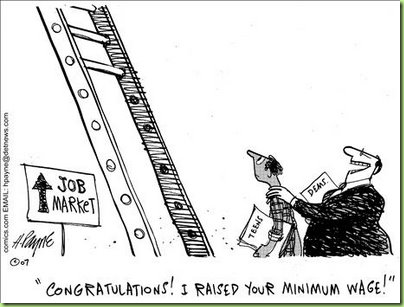
Don't believe raising the minimum wage hurts real people? After March 31, a famous science fiction bookstore on Valencia Street in San Francisco's Mission District will no longer be able to satisfy your fantasy tastes:
“The change in the minimum wage will mean that our labor and compensation costs will increase by approximately 39%. This increase, in turn, will increase our total operating costs by 18%. To offset this cost, we will need to increase our sales by at least 20%. I do not believe that is a realistic option for a bookstore in San Francisco at this point.”
And this speaks for itself:
“ In November, San Francisco voters surprisingly passed a measure that would raise the city’s minimum wage to $15 an hour by 2018. While all of us at Borderlands support the concept of a living wage and believe that the new law could be good for San Francisco, Borderlands Books, as it stands, will not be a financially viable business if it has to comply with this minimum wage. Therefore, we will be closing our doors no later than March 31st. The cafe will remain open through at least the end of this year.”
Early reactions from customers online have been mainly along two lines: 1) anguish that a beloved cultural institution is going down the drain, and 2) reflections that they, fans and customers, also supported the minimum wage increase when it was voted down. (That may limit the rights of businesses, but who cares?) But in this world – as in the alternate worlds of science fiction – the connection between actions and their logical consequences, intended and planned or not, cannot be severed.
That is precisely why American economist David Boaz commented as follows:
Making it more expensive to hire workers and reducing returns on investment do not seem like policies designed to deal with the appalling unemployment [in Spain]. Europe has had higher unemployment than the United States for most of the past two decades. And in 2004, economist William B. Connerly suggested several reasons for this: longer and more generous unemployment benefits, reducing the incentive to find work; inflexible wages; and job protections that make businesses reluctant to hire workers they cannot fire. Economist Mark Perry reports that the unemployment rate in European countries with a minimum wage is twice as high as in countries without a minimum wage. And minimum wage laws certainly seem to reduce youth employment.
Translation and compilation: Maria Neeva
Source: Cato Institute