 EKIP– Expert Club for Economics and Politics A Different Opinion
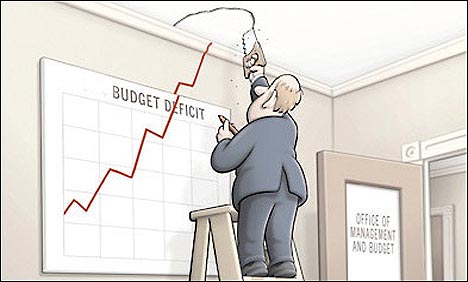
In March, Bulgaria placed three Eurobond issues on international markets for a total value of around EUR 3.1 billion. The issues were considered successful given the good yield achieved compared to the 10-year Eurobonds issued in the summer of 2014 for EUR 1.5 billion. Although the country’s need to enter the international financial markets was not surprising, it generated a strong response on the political and economic scene. Unfortunately, the essence of the problem remained in the background – the policy of the last few governments of accumulating expenses exceeding tax revenues (i.e. budget deficits). With the successful issue in March, the case received the status of temporarily resolved, and the attention of the general public turned to other pressing economic and social issues.
The path of accumulating budget deficits (deficit spiral) and increasing debt levels is the result of political planning, which, however, is far from the aspiration to transform a country into a prosperous and rich economy. All economic development is due to the behavior of individuals who act, choose, cooperate, compete and trade with each other. The people of a society feel economic progress not always when the value of GDP increases, but when their needs are satisfied and the factors of production are used in the most efficient way.
Increased public funding of sectors such as healthcare, education, social and pension insurance, etc., for which we often hear calls, does not solve the fundamental problem. The transfer of more and more responsibility to the state allows a large part of the citizens to naively or even indifferently accept the negative consequences of state governance, while using the justificatory phrase “there is no state in this country”. Here it is worth noting that it is not the absence of the state, but rather state intervention that is at the root of the deteriorated state and the subsequent negative effects of the functioning of a number of systems.
In this sense, what should we have in mind and understand when the emphasis is placed on the need to increase the volume of public spending? To this end, let us consider what government spending is through the eyes of the famous representative of the Austrian School of Economics, Murray Rothbard. We can conditionally divide them into two categories – transfers and “resource-using” spending, classified by Rothbard as a binary intervention, in contrast to the so-called “triangular” intervention. [1] Resource-using spending represents the use of scarce resources by the state to provide goods and services; in other words, it is its attempt to act as an economic entity. Transfers, on the other hand, directly redistribute purchasing power from some individuals to others. There is a great similarity between these two categories of government activities. For example, both represent redistribution because they finance the salaries of the bureaucrats employed in the respective operation. In both, there is the so-called crowding out effect – government spending and investment displace existing private spending. However, there is one major difference – in resource-using spending, factors of production are used to achieve government goals at the will and discretion of the state, while in transfers, the government directly subsidizes certain individuals who decide for themselves how to use the funds provided to them, thus distorting the market.
Transfers or government subsidies prolong the life of inefficient firms at the expense of efficient ones, making it difficult to redirect scarce resources to meet the most pressing human needs. In a free market, if an entrepreneur makes a loss or does not have enough funds to cover his production costs, his alternative is to move to another more profitable industry or to offer a good or service to the market that will be valued more highly by consumers. However, if the government subsidizes it, it will continue to function, but the resources will not be used in the most efficient way, i.e. we will have a waste of funds and wrong investments. When the government bails out loss-making enterprises with taxpayers' money, it not only prevents the production of better quality products and services, but also deprives workers of higher wages, better working conditions, and professional development.
Regarding the second category of government spending – the so-called “investment spending” – Murray Rothbard makes the important clarification that they are consumption spending. The government does not have its own funds that it can invest and risk in order to make a profit. Its inability to act as an entrepreneur is also associated with the impossibility of carrying out economic calculation – a fundamental problem first highlighted by another prominent representative of the Austrian School of Economics, Ludwig von Mises, in “Economic Calculation in the Socialist Commonwealth”. [2] The only adequate method of economic calculation is the one based on prices determined by the market. In a regulated market, the mechanism of free negotiation and the most efficient allocation of public funds does not work, since price formation is either impossible due to centrally lowered prices, or inefficient due to the distortion of the mechanism.
Returning to the effects of increased public financing, let us look at the share of government spending as a percentage of GDP in EU member states. Over the past few years, the state of the European economy has gone through a phase of bloated public finances, accumulating budget deficits and maintaining high debt levels, until at some point this forced governments to implement austerity measures and cut spending. Another question is where and to what extent the so-called “austerity” has become a reality. Total government spending as a % of GDP in 2014 in EU member states reached 48.1% compared to pre-crisis levels of 46.5% in 2008.
Fig. 1: Total government expenditure as % of GDP for EU member states
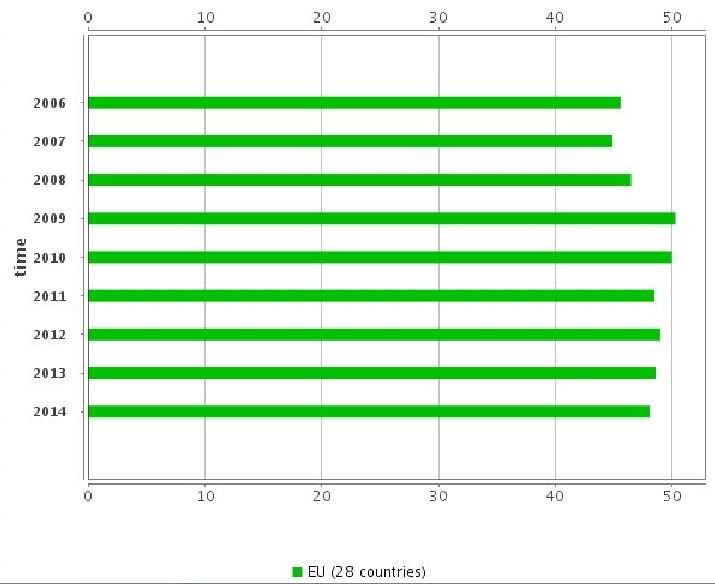
Source: Eurostat
Official Eurostat data for 2014 compared to the previous year show a stable average share of government spending in a number of countries, an increase in others, and, most importantly, a decrease in a relatively small number of them.
Fig. 2: Government spending of EU member states as a percentage of GDP
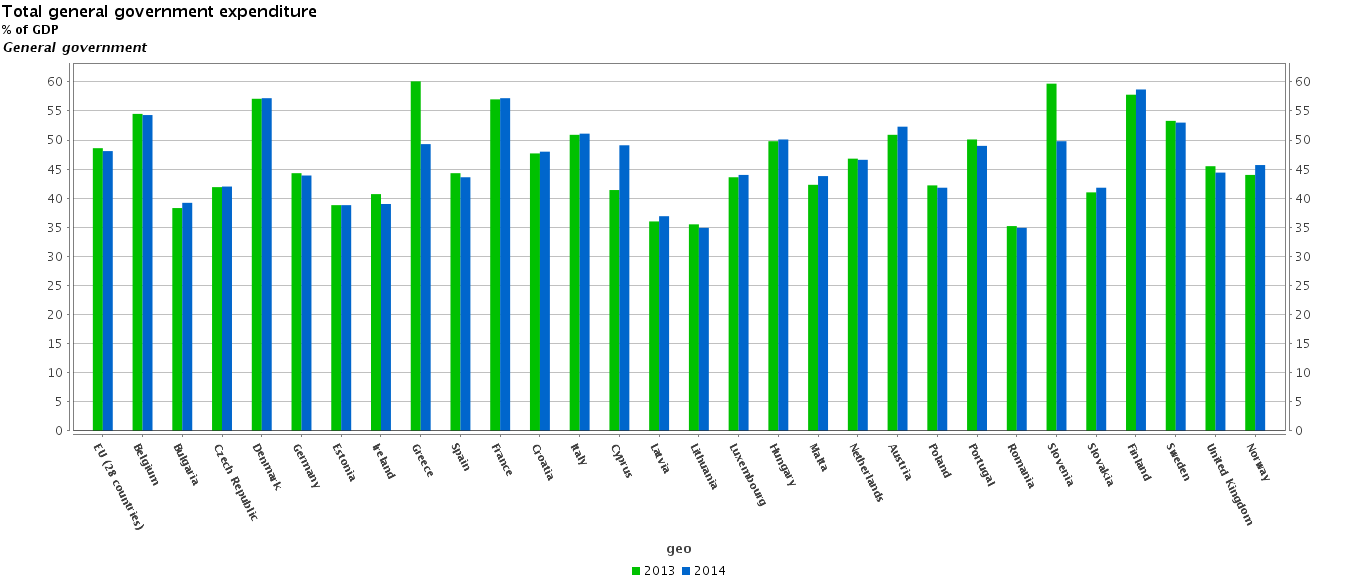
Source: Eurostat
Despite the high level of spending, however, economic growth in the EU remains anemic, demonstrating the inability of the union, as well as of any individual economy (including Bulgaria, which, if the government’s forecasts prove correct, will register its ninth consecutive year of deficits in 2018), to adjust and grow. [3] Therefore, Europe’s slow recovery can only be combated by sharply reducing government spending and implementing the necessary structural reforms. But while state leaders are now officially relying on monetary policy tools with a view to launching an ECB bond-buying program, we are unlikely to witness a genuine recovery and normal economic growth in the next few years.
[1] Виж Murray Rothbard, Power and Market: Government and the Economy (Ludwig von Mises Institute, Alabama, 2006).
[2] The full text of Mises’s essay is available here. Two years later, in 1922, Mises developed the argument further in his landmark work, Socialism.
[3] According to Eurostat data, the EU GDP for the period 2008-2014 moved as follows: 2008: 0.5%; 2009: -4.4%; 2010: 2.1%; 2011: 1.7%; 2012: -0.5%; 2013: 0%; 2014: 1.3%.





There is a little truth because we really need to see where there is unnecessary bureaucracy, but we cannot put all state spending under one denominator because the state can create jobs in socially beneficial activities and some of them (police, firefighters, etc.) cannot be financed from elsewhere.
The topic is very large and I have explained the main points in comment #1 and especially #8 - http://darikfinance.bg/novini/112887?&order=asc#comments
Budget surpluses through transparent public procurement for socially useful things and unemployment up to 2-3% - if necessary, the streets will be swept and washed twice, stones will be taken out of the river and cones will be collected from the forest so that there will be work and not social assistance, and the UN proposal for a 4-day work week to reduce unemployment is for good.
In comments #2 I have given an article by economist Georgi Angelov.
Further in the comments I have also given the wonderful statement of Prof. Dr. Ivan Angelov - The difference in GDP per capita (i.e. in social labor productivity) and in average salary per employed person with those in the EU is huge (45% and 22-23%, respectively) and contradicts any economic logic and elementary justice......... The share of budget expenditures in GDP in 2013 was 38.9%, and the budget for 2015 provides for 39.8%, together with contributions to the EU and with a 3% deficit. The share of budget revenues is about 36% of GDP.
Our market fundamentalists insist on an even lower share of expenses – up to 30% and even up to 25%, "so that more money remains with the private sector, who could dispose of it more rationally."
The EU average in 2013 in terms of spending was 48.5%.
In some of the member states it is as follows: Slovenia – 59.7%, Finland – 57.8%, France – 57.1%, Denmark – 56.7%, Belgium – 54.4%, Sweden – 53.3%, Austria – 50.9%, Italy – 50.5%, Portugal – 50.1%, etc. Behind the low percentages in Bulgaria are hidden distributional relations that severely harm working people and increase social inequality. They are the economic basis of the restrictive policy and are used as a financial justification for its implementation. The state must proceed to a European type of distributional relations, and the unions must increase the pressure for change.
Milton Friedman has industrial capitalism in mind when he talks about the free market, not financial capitalism, meaning that financial capitalism needs strict regulations because that's where the problems come from.
Milton Friedman - The American economic system represents "socialism for the rich and free enterprise for everyone else." If the average person fails to pay his debt, he is forced to live in his car. If a banker fails to pay his debt, he relies on taxpayers to bail him out.
There are much more important things and I have explained them in detail under the posting of Mr. Hitov, doctor of economics and lecturer at the University of National and World Economy - http://krizata.blog.bg/history/2015/04/02/zashto-niakoi-taka-silno-nenavijdat-velikite-bylgari-v-ikono.1351149
There are 3 planetary catastrophes coming and if the right measures are not taken, there will be billions of victims - in short, I know how to avoid them