 EKIP– Expert Club for Economics and Politics A Different Opinion

Nikola Filipov
We would all probably agree that a functioning capital market is of fundamental importance for a developed market economy. A number of economic studies clearly reveal the strong correlation between market capitalization and the level of GDP per capita in an economy. The positives – both at the firm and macroeconomic level – of an efficient capital market are indeed many. From ensuring access to financing for economically efficient investment projects that create employment and gross domestic product, to households saving and investing more.
The capital market in Bulgaria - the boom and the recession
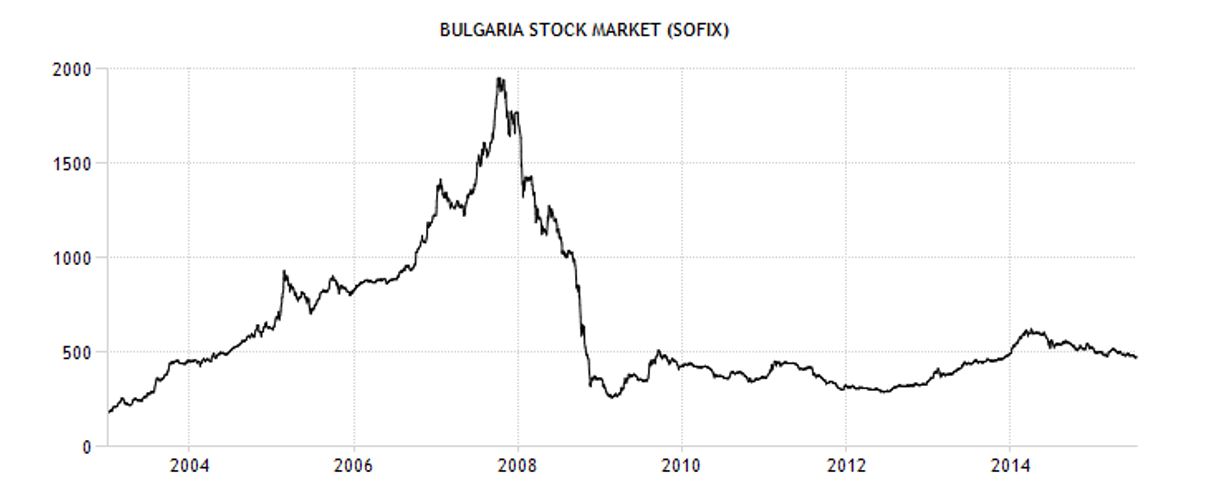
In theory, the Bulgarian Stock Exchange should be the backbone of the market economy, and perhaps for the period 2004-2009 it really was. It was then that we witnessed one of the first clearly expressed cycles of boom followed by recession (see Chart 1). During this period, many public companies managed to raise capital from the stock exchange. Other times they acquired public status in order to optimize their capital structure in order to finance their investment projects in a more efficient way. Still others were delisted from the stock exchange due to their acquisition by strategic investors. In general, by the middle of the boom (2005-2006) on the capital market, the Bulgarian Stock Exchange managed to attract the interest of many foreign and Bulgarian investors. In parallel, over the past decade, we have also witnessed a number of strange events from a legal point of view that damaged the interest of minority investors in public companies. Most of these violations somehow remained under the radar of the Financial Supervision Commission (FSC). As a result of the accumulation of such errors, both individual and institutional investors to some extent lost confidence in the Bulgarian capital market and directed their resources to more developed capital markets.
Chart 1: SOFIX Index of the Bulgarian Stock Exchange in the period 2003-2015.
Source: Bulgarian Stock Exchange
The new regulations of the Bulgarian Stock Exchange
On July 6, 2015, the FSC proposed to eliminate the obligation of securities issuers to publish interim financial statements for each quarter, leaving only the obligation to publish financial statements on an annual and semi-annual basis. The pretext for this financially illogical proposal is that this is done in order to alleviate the financial and administrative burden of issuers. But although in practice the omission of two quarters may not be of any colossal importance, the signal sent to capital market participants is extremely negative, because instead of imposing and encouraging greater transparency of public companies, in practice the regulator does exactly the opposite. This will invariably lead to a significant outflow of investors from the Bulgarian Stock Exchange. For reference: in the period 2011–2015 The number of individual clients of the COBOS online trading platform dropped from 946 to 287, and instead of legislators focusing on bringing these people back into the capital market through legal measures aimed at protecting their interests and strengthening market practices that would develop the capital market and make it more efficient, the FSC unfortunately did the exact opposite.
Every student who has successfully completed his first year at an economics university knows how fundamental access to information and transparency of public companies are for a developed capital market. The more information that is available about a company, the better market participants can assess its real value and thus push share prices towards some logical price, making the capital market more efficient. The entire efficient market hypothesis [1] (EMH) is based on the fact that even in its weakest form (the so-called “weakly efficient form”) [2], asset prices already incorporate all available information and if an investor decides to apply technical and fundamental analysis, he cannot achieve a return that is higher than the market. It is for this reason that the FSC proposal is in direct conflict with perhaps one of the most famous economic theories, because if we assume that capital market participants will have half the available information (two quarters of accounting data, compared to four) to use for fundamental analysis, this directly means that the Bulgarian capital market becomes significantly less efficient.
In order to systematize the negative consequences that will invariably follow from this proposal, I will ask the following questions to the FSC:
- Why would a Western strategic or financial investor invest in a capital market that is not only characterized by extremely low liquidity, but also, on top of that, allows issuers of securities not to provide reports on a quarterly basis?
- What is the logic behind a Bulgarian pension or mutual fund investing in a Bulgarian public company when there is half as much information about the issuer as in developed capital markets in the West? How can one even defend a proposal to enter a credit committee position with such high legal risk and limited information?
- Will this regulatory proposal increase insider trading, one of the main factors degenerating the efficient capital market?
I suspect that the answers are extremely clear to all of us, and unfortunately they lead to only one conclusion: that regulatory changes aim to destroy one of capitalism's most valuable weapons for achieving sustainable economic growth - the capital market.
[1] The Efficient-Market Hypothesis was developed by Professor Eugene Fama in the 1960s. It states that it is not possible for market returns to increase solely through information that is already known, except through luck.
[2] According to the HEP, in the case of “weak-form efficiency”, future market prices of commodities cannot be predicted based on historical data on their movements, and information about their past fluctuations cannot be used for investment strategies that increase their profitability. Incidentally, future prices are determined by information that is not contained in the past price sequence; respectively, technical analysis techniques are unusable.






I am glad that the capital markets specialist and first head of the Bulgarian Stock Exchange, Viktor Papazov, also said it: "According to him, Greece is only the first manifestation of the global crisis of the current financial model" (comment 6 and 7) - http://darikfinance.bg/novini/116413#comments
Everything related to interest rates, etc., profitability is a bubble because economic growth cannot be infinite in order to have a constant return on company shares and interest on government securities.