EKIP– Expert Club for Economics and Politics A Different Opinion
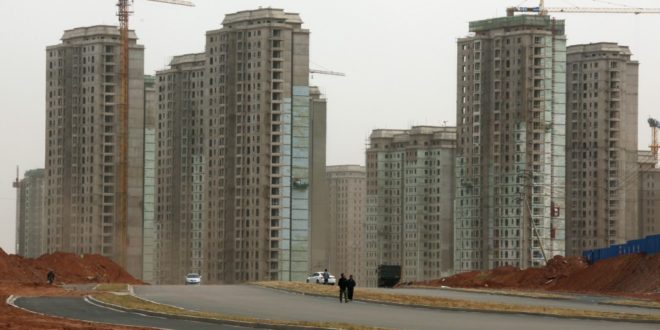
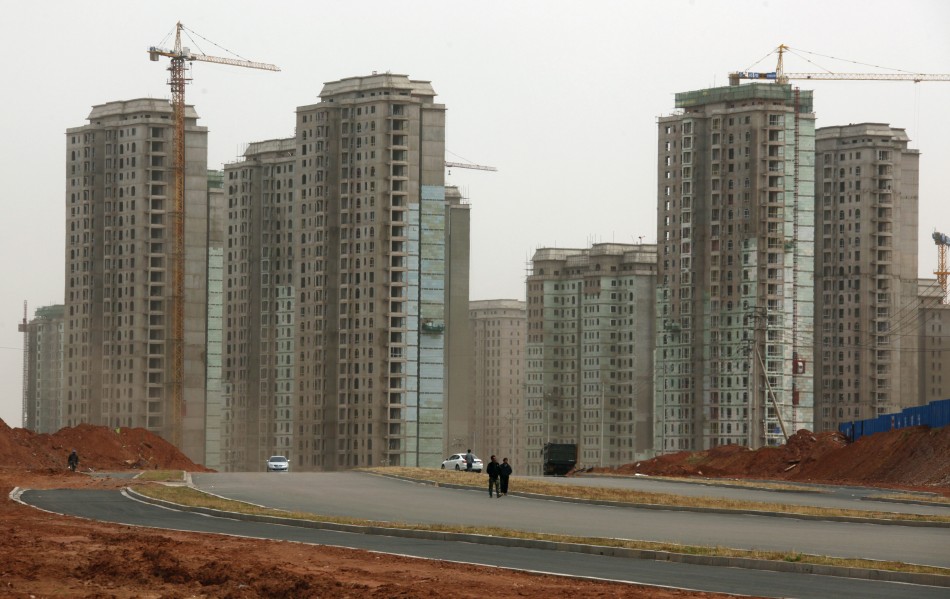 In recent months, the state of the Chinese economy has been one of the most discussed topics in the business media. The bursting of the Chinese stock market bubble was one of the most discussed news stories this year, along with the decision of the Chinese Central Bank to lower interest rates to record lows. It is clear that the Chinese economy is in a period of crisis and its weakness is affecting both financial markets in the rest of the world and natural resource markets. And of course the question that everyone is asking is what is causing this weakness? The Chinese economy is driven primarily by domestic manufacturing, which distinguishes it from the US economy, for example, which has a more consumer focus.
The sector with the greatest importance and the greatest impact on the entire economy of China is construction. For a long time, the state of the real estate market has been one of the most reliable indicators of the state of the Chinese economy (the other indicator is exports). In this article, we will analyze the impact of the fiscal and monetary policies of the Chinese government on the real estate market over the past seven years (since the crisis in 2008) and how this subsequently affects the Chinese economy as a whole.
The beginning of China's business cycle
The current problems of the Chinese economy are rooted in policies undertaken during the crisis of 2008/2009. During the economic boom period, immediately before the crisis of 2008, in China, like in the United States, a very large bubble was formed in the construction industry and the real estate market. When the crisis began, however, the Chinese government decided to do everything possible to prevent the bubble from bursting. In order to maintain at least seemingly high levels of economic growth, the Chinese Central Bank sharply increased the money supply and cut interest rates on loans by about 2% in late 2008 and early 2009, which led to a massive decrease in the cost of credit. In addition to monetary stimulus, the government also tried to “stimulate” the economy through fiscal methods. In November 2008, in parallel with the lowering of interest rates, a huge program of state investment in infrastructure and housing worth 586 billion US dollars was launched, which was equal to 17% of China's GDP at the time.
In a sense, these measures are achieving their goal. In the second half of 2009, the situation in the real estate market began to improve. The same happened with the demand in the capital goods market. The Chinese economy seemed to be on the rise again and in 2010 it even recorded double-digit GDP growth on an annual basis – 10.6%.
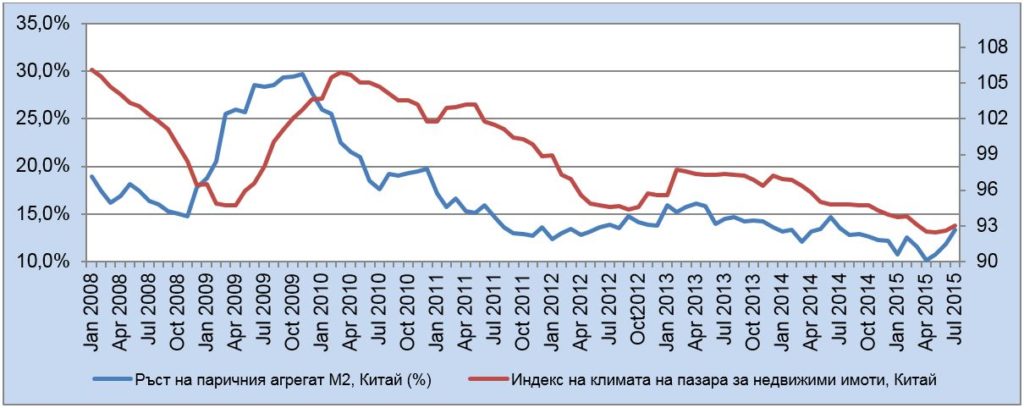
In the table below you can see how the so-called "Real Estate Climate Index", which measures the overall business activity in this market in China (index values above 100 mean positive growth, values below 100 mean the opposite), and the growth rate of the monetary aggregate M2, which measures the supply of both the so-called "narrow money" (currency, current accounts) and the so-called "broad money" (time deposits, savings deposits, etc.).
Chart 1: Business Climate Index of the Real Estate Market and M2 Monetary Aggregate in China.
Source: National Bureau of Statistics of China
One thing that can be seen very clearly in the graph is that with a short lag of usually 3 to 6 months, the real estate market index moves in the direction in which the growth rate of the monetary aggregate M2 moves. That is, when the money supply grows rapidly, business is booming very soon after. However, when the growth of M2 starts to slow down and decline, the same thing happens to the real estate market. From this graph it becomes very clear that the state of the real estate market in China is to a very serious extent dependent on the variations in the growth of the money supply over the years.
The relationship between the real estate market and monetary policy
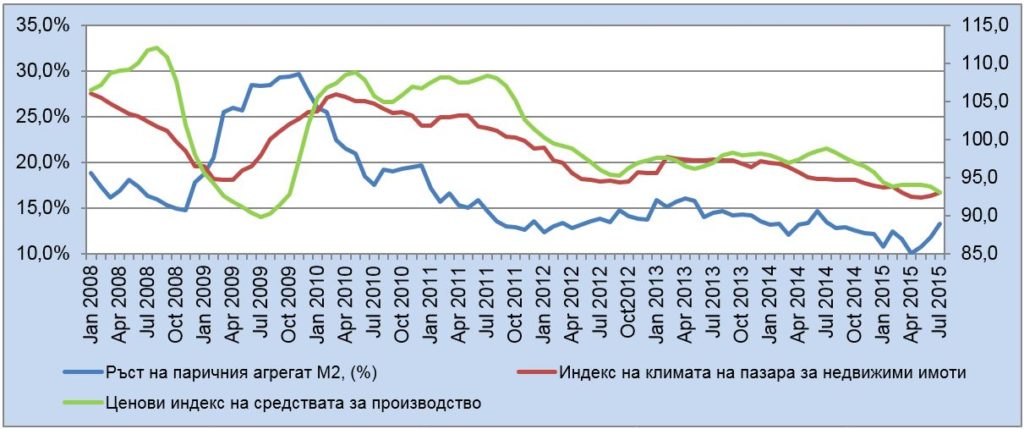
Over the past seven years, the capital goods and natural resources market in China has been going through a cycle very similar to that of the real estate market. This is quite natural given the size of the construction industry (in 2011, construction projects in China accounted for 1/3 of all construction in the world!). Therefore, it absorbs huge amounts of the aforementioned goods and resources. The next chart contains the same data as the first, but this time, in addition to the variations in the growth rate of the money supply and the movements in the business climate index in the real estate market, data on the price index of means of production in China over the past seven years have been added. The category of “means of production” includes all types of capital goods (i.e. goods and resources that are used to produce other goods) with the exception of labor.
Chart 2: Real Estate Market Business Climate Index, M2 Monetary Aggregate and Producer Price Index in China.
Source: National Bureau of Statistics of China
When we compare the movements of the three variables, a certain trend is clearly noticeable. The variations of the price index of means of production follow those of the business climate index of the real estate market, and its in turn follow those of the growth rate of the money supply (the monetary aggregate M2). Thus, it is evident that through the real estate market, the monetary policy of the Chinese Central Bank also influences the rest of the Chinese economy. What is the reason for this pattern?
When the Chinese central bank, together with commercial banks, lowers interest rates by increasing the money supply, this leads to more investment in longer-term projects such as new housing construction. Given the importance that the Chinese government attaches to the construction industry by supporting state-owned and semi-state construction enterprises, it is quite natural that the real estate market is the most dependent on variations in the money supply. Artificially low interest rates stimulate additional investment in the construction sector. This means that the demand for construction space increases, increasing its prices and thus the construction market enters a boom period. And because this is one of the largest and most capital-intensive sectors of the Chinese economy, the growth of investment in the construction industry also seriously affects the demand for capital goods and resources. In other words, it is quite natural to expect a tangible pattern between the state of the real estate market and that of the market for means of production. And of course, if the good state of the real estate market and that of the capital goods market is due primarily to the cheap credit poured into the economy by the Central Bank, this means that the values of these markets are overvalued, i.e., they are bubbles.
The business cycle of the Chinese economy from the 2008 crisis to today
After the 2008 crisis, thanks to fiscal and monetary “stimulation”, the two aforementioned markets entered a boom period – this is clearly visible in the graph. In 2010, however, price inflation began to grow very rapidly and reached 5.1% in November 2010 – the highest level since mid-2008. To deal with this problem, the government tightened its monetary policy and between December 2010 and July 2011 they increased interest rates by about 1% to 6.56%. The graph above shows how the growth rate of the money supply plummeted during the same period from 19.7% in December 2010 to 12.7% in December 2011. Very soon this began to affect the business climate index in the real estate market. It fell from 103.2 to around 94.9 in May 2012. A little later, the same thing happened with the price index of means of production, from 108 in July 2011 to 95.4 in 2012.
Note the period in 2012 when both indices hit their lowest levels since the 2008/2009 recession. This is known as a “growth recession.” At that time, China’s economy was growing at a slower pace than initially expected. The chart clearly shows that every time the growth rate of the M2 monetary aggregate reaches a low, such as in late 2008, late 2011/early 2012, and late 2014/early 2015, both indices also hit a low shortly thereafter (6 to 9 months). Each low in the values of both indices also marks a period of recession in the economy – first in late 2008/early 2009, and then in mid-2012. Once the growth of the monetary aggregate stabilizes and starts to rise again, the same happens with the other two indices. Since the end of 2008, this cycle has repeated itself twice, with an average duration of about three years and includes: a period of growth, a peak of growth, a period of decline (longer than the period of growth), a bottom, new growth.
The country is currently in the period just after the end of one such three-year cycle, which began in the middle and second half of 2012. It is clear that the Chinese economy is currently in a recession. This year, the values of the business climate index in the real estate market and the price index of means of production have reached their lowest values since 2008/2009. At the same time, the rate of GDP growth on a quarterly basis is also the lowest in the last six years. In the second quarter of 2015, it was 7%.
In both cases, the period of growth of the monetary aggregate M2 follows a reduction in interest rates by the Chinese Central Bank. In the case of the first cycle - from the end of 2008, and in the case of the second - in mid -2012. The graph clearly shows that since April of this year, the growth rate of M2 has started to grow again. This happened after a series of interest rate cuts by the Central Bank, which began in late 2014. From November 2014 to August 2015, the interest rate on loans was reduced from 6% to 4.6%, which is the largest reduction since 2008. This is how the Chinese government hoped to cope with the current recession.
However, this does not solve the fundamental problem. The real estate market, the construction industry, and the capital goods market are all too dependent on the monetary policy of the Chinese Central Bank. If the government wants to address the country's economic problems in the long term and get rid of the vicious economic cycle it is in, it must stop pouring cheap credit into the construction industry and thus creating financial bubbles in the real estate market and the market for capital goods and natural resources.