 EKIP– Expert Club for Economics and Politics A Different Opinion
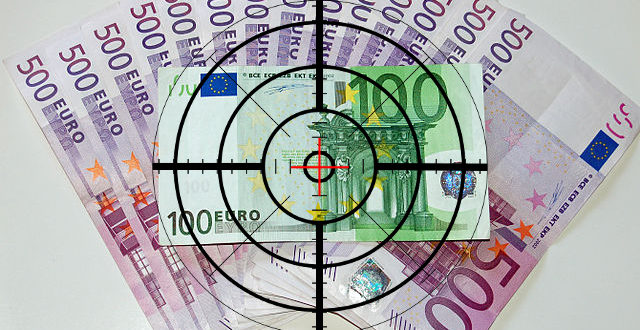
The ECB's Governing Council has decided to abolish the 500-euro note, it was announced on February 15. This is the second most widely used denomination after the 50-euro note. Furthermore, it accounts for 30% of the value of physical euro banknotes in circulation.
Why is this move important and what are the effects?
The reason given by the European monetary authorities was the fight against: terrorism, money laundering, the shadow economy and drugs. “Public opinion” increasingly believed that high-denomination banknotes were used for criminal purposes.
Moreover, the world is undoubtedly entering a new technological era that makes cash transactions seem increasingly obsolete. Are we moving towards a cashless society of electronic payments? Probably. In Sweden, for example, cash transactions are now a rarity. On the bus, in the subway, in cinemas, in shops, in taxis and in banks - electronic payments and text messages seem to eliminate the need for cash.
The economic arguments behind Draghi's decisions
No matter how much he tries to convince us otherwise, Draghi is hardly treating the issue from the perspective of terrorism. The decision has very clear economic dimensions. The ECB is trying to get the money out of the banks, for households to start consuming, for businesses to invest, for inflation to increase and for the wheel to turn.
To this end, Draghi made the interest rate on commercial banks' deposits with the ECB negative. This affected the interest rates on commercial banks' deposits themselves, which became practically zero, and in places like Sweden — also negative.
The act as part of the war on cash
Of course, the biggest losers from such a pro-inflationary policy are savers, who are directly punished with almost zero or negative interest rates on their savings accounts.
Keeping your money in a bank or investing in government securities with negative nominal yields in such a situation would be illogical, because you are effectively losing money, when you could simply shove it under the mattress, for example.
If you sell an apartment in the current situation, it makes economic sense to increase your cash reserves, and the larger the denomination, the more convenient. The smaller the denomination, the more difficult it will be to preserve your savings, respectively, the greater the incentive to enter the financial system.
The possibility of “withdrawing” money from cash circulation by economic entities, however, comes into direct conflict with the Keynesian understanding of central bankers that the problem today is insufficient aggregate demand, which they want to stimulate with their monetary and interest rate policies. That is why the ECB is trying to punish this alternative.
Hidden reasons
The truth is that modern Western governments are outrageously indebted, while at the same time, from a purely political perspective, they cannot afford to cut spending or make reforms by balancing their budgets.
Instead, they are desperately looking for additional sources of revenue. In addition to new taxes and money printing, the tens of billions circulating in the "shadow economy" are a tempting target and must be taxed, therefore "illuminated" and brought into the financial system.
The negative effect: financial repression
Today, banks in Europe are very cautious about credit — they have difficulty lending it, and the 1 trillion euros in non-performing loans for the Eurozone weigh on their balance sheets.
That's why banks and financial intermediaries such as insurance and pension funds invest aggressively in government securities.
By eliminating cash and directing savers to the banking system, the danger is that loanable resources will end up in the hands of corrupt politicians, instead of businesses and consumers for private consumption and private investment. A typical crowd out effect, in English.
The battle against cash also results in people unfamiliar with the financial markets and the banking system being forced to become part of them, costing them additional costs such as fees on accounts and debit and credit card transactions — again due to the lack of an alternative for consumption, investment, and saving in cash.
The ubiquitous and ever-lower cap on cash transactions, the referendum in Switzerland for full and central bank-controlled reserve, and the abolition of the largest euro denomination — the 500 euro note — are happening precisely in the above-described context.
Other hidden financial dimensions
The presence of larger denominations also means greater demand for money as a store of value. When they disappear, the currency becomes less attractive, confidence in it declines, and its purchasing power decreases with it.
And the whole exercise, of course, is part of the central banks' currency war, in which the losers are once again savers and economic agents with fixed incomes, such as pensioners, for example.
Important to note: the money supply today consists of cash and bank deposits, based on the monetary base created by government agencies - central banks. Today, when we withdraw currency from an ATM, we are actually withdrawing system reserves, and hence a natural decrease in bank credit. Conversely, if cash disappears, the central bank will gain complete control over the monetary system and bank credit.
In a word: if cash is removed or reduced, this means that bank credit will grow even faster than it already is, undisturbed, that is, with significant inflationary potential, and hence a credit boom and speculative, misguided investments, recessions.
The freedom of corpses
A problem for citizens may also arise in terms of their financial security and personal privacy. Just as recorded transactions can be used to more easily track down criminals (who will most likely switch to barter and cryptocurrency forms of payment), every transaction will be subject to monitoring by Big Brother.
Where you travel, what gifts you give your mistress, and what strange sexual tastes you have — they will now be just a click or two away from the hands of some official, with new powers and tools for monitoring and surveillance of citizens by those in power. For government, but also for criminal benefit, given the enormous corruption in the atrophied administrative apparatus all over the world.
Are abuses possible? Undoubtedly.
What's coming up?
The next casualty of the war on cash is the $100 bill, along with the 1,000 Swiss franc bill. The stakes are not just our convenience, but also our savings and personal freedom.
You can read the original article on Kuzman Iliev's blog: HERE





The failure of the European Central Bank (ECB) is a fact.
The ECB has no competence to save Europe from escalating a catastrophic economic crisis and is looking for something to declare a malicious factor (in this case, "cash" money) to justify its failure.
For those who are aware that the flawed European monetary system is the leading cause of current economic difficulties, the situation is clear.
The salvation of Europe is possible through an improvement of the European monetary system.