EKIP– Expert Club for Economics and Politics A Different Opinion

As it became clear last week, the banking sector in Italy is in a serious financial crisis and many of the country's largest banks are facing bankruptcy, which is why they need an urgent injection of capital. In the midst of the dispute between Italian Prime Minister Matteo Renzi and statesmen in Berlin and Brussels, it seems that the analysis of the causes of the crisis has been omitted.
This crisis is mainly due to three factors – the high share of non-performing loans, the outflow of capital from the Italian banking system and the policy of negative interest rates on additional reserves of commercial banks, led by the European Central Bank. The results of the referendum in the UK are mentioned as another factor that had a negative effect on the value of Italian bank shares, but its influence is absolutely secondary – the banking crisis in Italy has been brewing for months before Brexit. Italian banks are in an extremely bad state even without the pressure of negative interest rates, but it is the latter that further worsens the situation to such an extent that it creates the need for an urgent injection of capital to avoid a wave of bankruptcies.
The main problems – too many bad loans and a rise in capital outflows
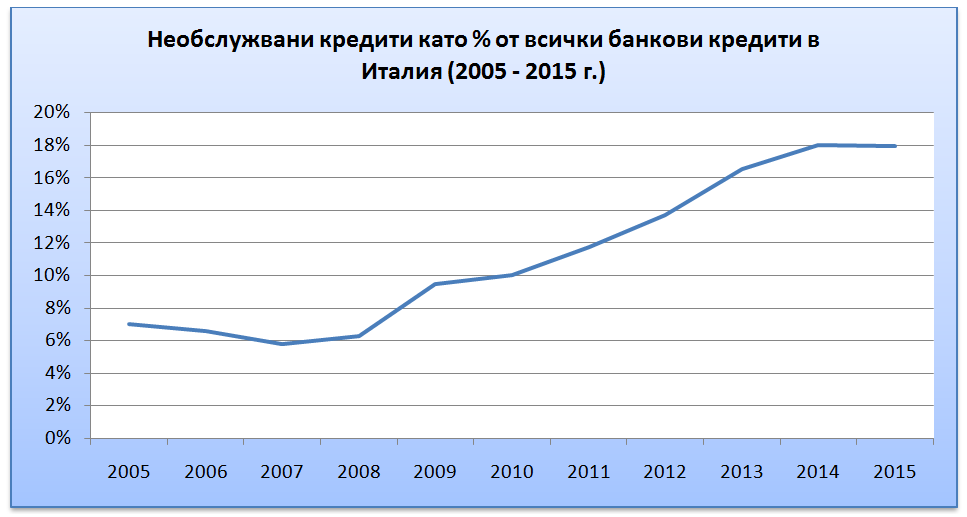
The huge share of non-performing loans [1] is at the heart of the crisis in the Italian banking system. From 2008 to 2014, the share of these loans in all loans granted by Italian banks almost tripled - from 6.3% to 18%. Figure 2 shows the dynamics of non-performing loans as a percentage of the gross value of all loans granted by Italian banks over the past 10 years. According to the latest data, the total amount of bad loans in the Italian banking system amounts to 360 billion euros.
Chart 1: Share of non-performing loans as % of all bank loans in Italy
Source: World Bank
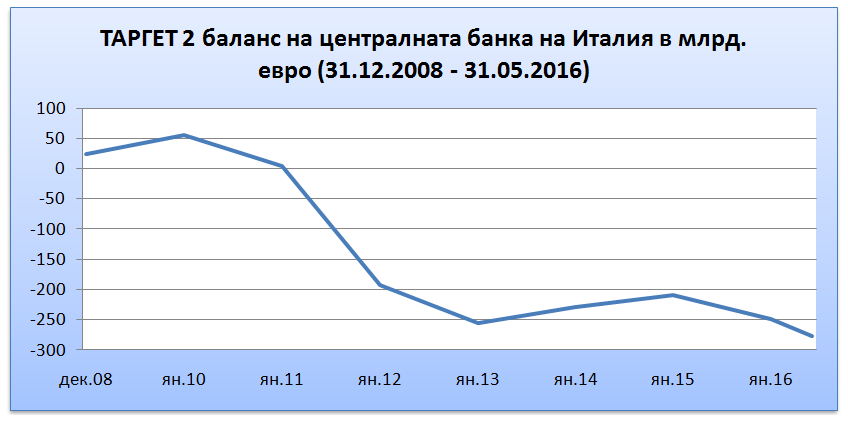
The second major problem of the Italian banking system is the outflow of capital from it to other banking systems in the eurozone. The best way to track the dynamics of the outflow of capital from the banking sector in Italy is to look at how the TARGET 2 balance sheet of the Italian central bank has moved in recent years. Due to the fact that this balance sheet also reflects the monetary injections by the ECB into the banking systems of countries where there is an outflow of deposits to other banks in the eurozone, the TARGET 2 balance sheet of the European central banks very well shows the movement of monetary capital in the eurozone (a detailed explanation of what the TARGET 2 system is and how it works can be found here ).
Chart 2 shows the dynamics of the TARGET2 balance sheet of the Italian central bank for the period December 31, 2008 - May 31, 2016.
Chart 2: TARGET 2 balance sheet of the Bank of Italy
Source: ECB
As we can see, since the beginning of the crisis in 2009, the balance sheet of the Italian central bank has been steadily deteriorating. The only temporary improvement occurred in the period from the beginning of 2013 to the beginning of 2015. According to ECB data, in the third quarter of 2015, the TARGET2 liabilities of the Bank of Italy began to grow rapidly again, reaching their highest level in May 2016. By the end of the third quarter of 2015, the TARGET2 balance sheet of the Italian central bank was -188.6 billion euros, and by May 31, 2016, it was already -276.2 billion euros. That is, from the beginning of October 2015 to the beginning of June 2016, the capital outflow from the Italian banking system amounted to at least 87.6 billion euros.
The main source of profit for any bank is the net margin between the interest it pays on deposits and the interest it receives on the loans it has granted. In the case of Italian banks, over the past seven years, the increase in the share of non-performing loans combined with the outflow of capital have seriously squeezed this net interest margin, which has led to a deterioration in their financial results and returns. These two factors are largely interconnected and mutually influence each other. Fearing a decrease in returns and even bankruptcy and, accordingly, the loss of their deposits and/or the depreciation of their shares, investors begin to withdraw their capital due to the growth of non-performing loans. This outflow of capital, in turn, further worsens the banks' returns, because at the same time as the growth of bad loans, they begin to lose equity and liquidity, as a result of which their profitability is squeezed from both sides.
Negative interest rates – fuel on the fire
In the last two years, a third factor has emerged that is further worsening the state of the Italian banking system: the European Central Bank's negative interest rate policy. On June 11, 2014, the ECB introduced negative interest rates on the additional reserves held by commercial banks in the hope that this would encourage them to lend more. Initially, the level of negative interest rates was -0.1%, but it was gradually increased to -0.4%, which is where it is now.
Chart 1 shows that while capital outflows stopped growing in 2013 and 2014, this trend resumed in 2015. One of the reasons for this is most likely the ECB’s decision. The fact that commercial banks after 2014 have to pay the ECB to “park” their additional reserves there is starting to put additional pressure on bank profitability – a factor that did not exist before. This, combined with the new rules in force since January 1 this year, according to which, in the event of a bank in the eurozone facing bankruptcy, capital to stabilize its financial condition must first be obtained from its shareholders and creditors before seeking state aid (i.e. financing from taxpayers), is sure to lead to an additional flight of investors from the Italian banking sector.
In the face of negative interest rates on their deposits at the central bank, European banks have several options. They can 1) reduce the interest rates on their deposits and bonds to their customers and creditors, 2) start granting more credit (the effect desired by the ECB), 3) raise the interest rates on their loans, or 4) bear the losses from negative interest rates. The problem for Italian banks in particular is that their financial situation will worsen, whichever option they choose. Option 1 would have the most unimaginable and dangerous consequences and is avoided even by banks in countries like Germany due to fears of a mass withdrawal of deposits and a huge loss of liquidity. Option 2 poses serious risks because, due to the anemic economic growth in Italy, it could lead to an even higher share of non-performing loans. Option 3 is perhaps the relatively safest, but its effect is exactly the opposite of that sought by the ECB. Option 4 means a further loss of profitability for banks, which, against the backdrop of high levels of indebtedness and low returns (as is the situation in Italy), could lead to bankruptcy in the long term.
In other words, regardless of the reaction of Italian banks to the ECB's policy, their financial situation is in any case doomed to deterioration from the very beginning. Even if they choose the option that is relatively safest for their financial situation, the economic effects of this are exactly the opposite of those sought by the ECB. It should be noted that all this applies not only to Italian banks, but also to banks throughout the eurozone and especially those in less competitive member states. Given the fact that so far negative interest rates have not achieved the desired effect and have led to the destabilization of banking systems in countries like Italy, it is high time for the ECB to rethink its policy for the future.
[1] Loans, payments on which are overdue by more than 90 days
The article is from the weekly newsletter of the Institute for Market Economics - you can see it in the original HERE