EKIP– Expert Club for Economics and Politics A Different Opinion

In 2016, industrial robots won the presidential election of the world's largest economy for Donald Trump. No, artificial intelligence has not yet reached a level where it can consciously make decisions on its own (including in the realm of politics), nor have concerned activists won any civil rights for R2D2[1] or its more primitive modern-day counterparts.
In fact, Trump accomplished something that had been considered impossible for the Republican Party as we know it in recent years: he diverted large numbers of working-class votes from key swing states, which gave him the electoral college support he needed to win the White House. Those blue-collar votes went to the construction magnate thanks to his focused rhetoric, promising to bring back manufacturing jobs, protect against foreign competition, and reindustrialize the American Midwest.
Automation as the main culprit for job losses
And how could they not like such promises, since since the peak in 1979, jobs in American manufacturing have decreased by over 7 million, with more than half disappearing after 2000. This newly created unemployment is a serious blow and it is understandable how many communities of voters succumb to an explanation of the type - free trade, the Chinese, the Mexicans took our livelihood and we can simply get it back with Donald Trump.
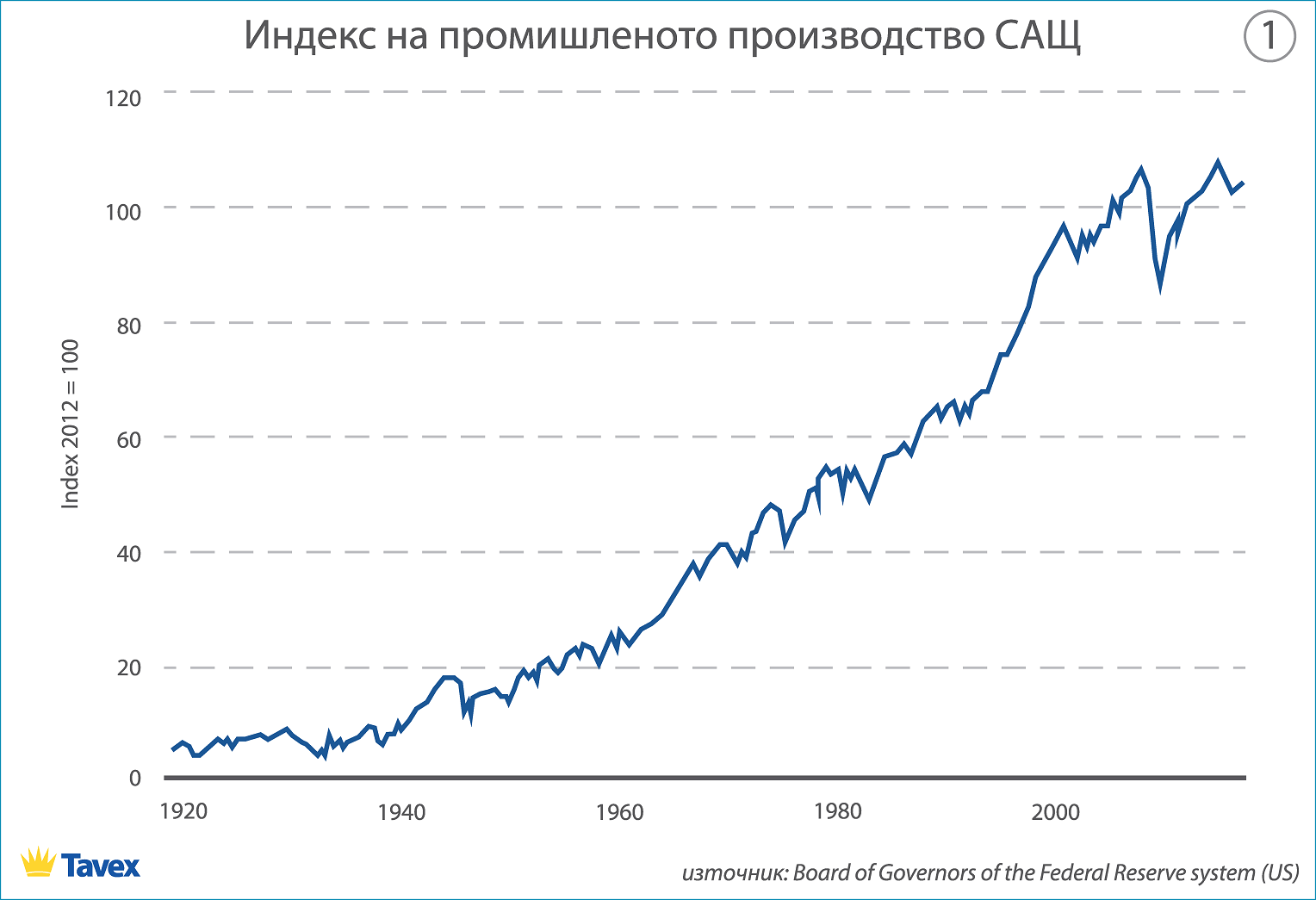
That’s not what economists’ research shows, however. According to a comprehensive study by Ball State University in Indiana, only 13% of job losses in the sector come from foreign competition; the vast majority – 85% – are the result of technological innovation. And despite fewer people working, industrial production in the United States has doubled since the early 1980s, reaching almost $2 trillion. In fact, this is part of a steady upward trend since the early 20th century (Figure 1).
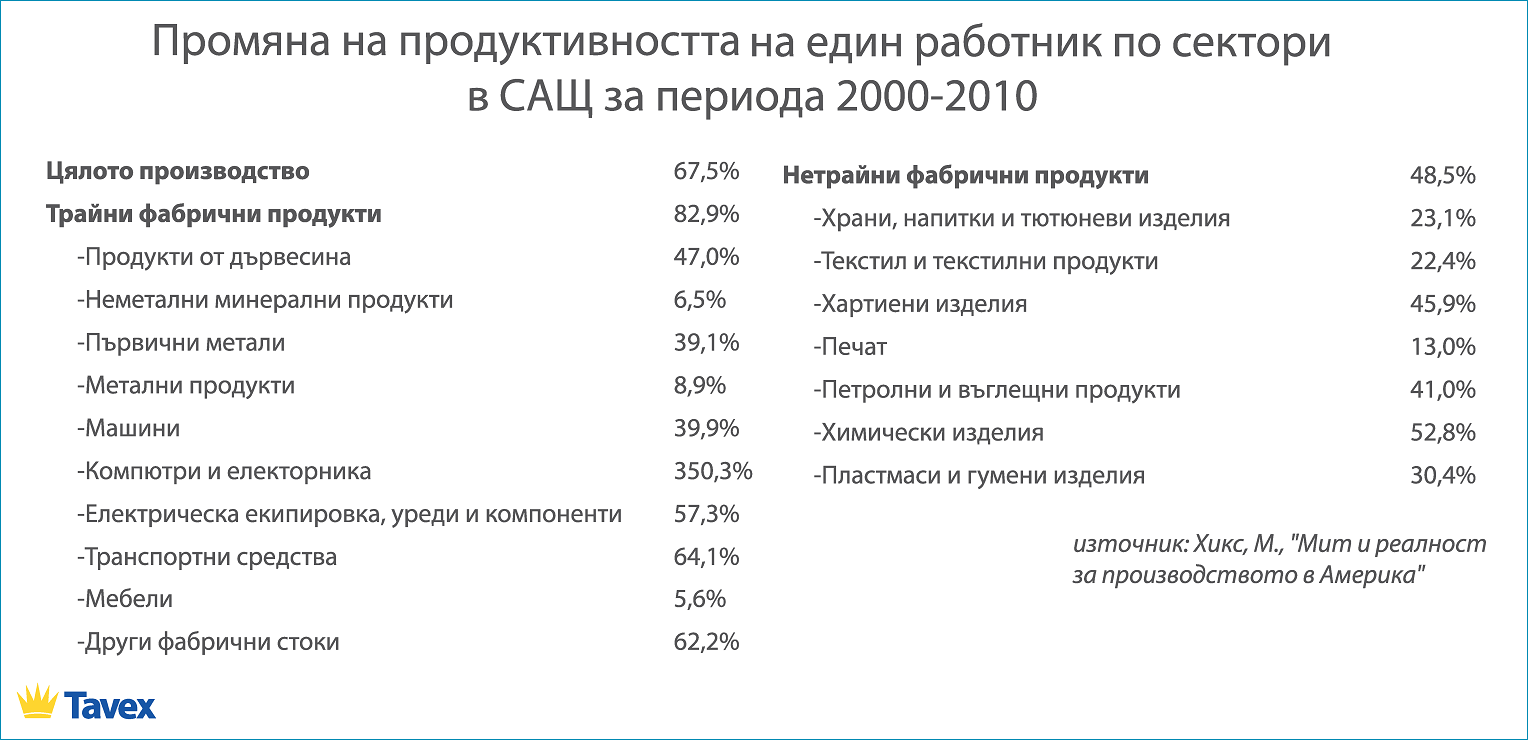
The increase in labor productivity is so great that if the technological level in 2010 had been the same as in 2000, then instead of the 12.1 million industrial workers actually employed, their number should have been 20.9 million. Table 1 shows the increases in productivity per worker in the different subsectors over the period. Yes – no, the Chinese are taking the jobs of American blue-collar workers, the culprit is robots.
Should we be worried about job losses?
And while American voters are lagging behind in understanding these facts, more informed groups are already preparing for the next stages of the development of technologies that replace human labor. The first, as the Economist magazine calls him, “an unexpected Luddite[2]” is one of the kings of computer technology, Bill Gates himself, who at the beginning of the year presented his idea for a “robot tax” with the explicit aim of the tax to slow down technological development and thus avoid a possible social crisis resulting from the loss of jobs.
The problems with Mr. Gates’s proposal are multifaceted, but it’s worth starting with the fact that while automation leads to job losses, it also creates new ones, often in the same industry. Since 2000, the widespread introduction of ATMs and the electronic payment system have resulted in an annual increase in the number of bank clerks in the United States of about 2%. Counterintuitively, ATMs, which are called automated teller machines (ATMs), lead to more employees being hired, rather than laid off. The reason is that it becomes cheaper for banks to open new branches, thanks to the increased productivity of each employee in those branches.
The other mechanism for creating new jobs is known from economic history, which reminds us that for most of human history, over 90% of workers were engaged in agriculture. Thanks to technological leaps, today in the most economically developed countries only 1-3% of the workforce is employed in agriculture, in countries like China the decline is particularly drastic, from 50% in 1994 to 3% in 2010. All these people who are not in the fields in the 21st century are not unemployed, it is just that the newly created wealth has allowed them to engage in other types of activity. Would Bill Gates like to impose a tax on combines or on the automatic needle seeder?
What is the purpose of an economic system?
In fact , the purpose of the economic system is not to create “jobs”, but to produce more and more products for consumption. The story of the visit of the Nobel laureate in economics – Milton Friedman – to China, where he was taken to inspect the construction of a navigation canal, has become legendary. He asks his hosts why the workers are using shovels, since a few excavators would do a much better job. It is explained to him that the idea of the construction, among other things, is to create jobs for the Chinese peasants. To this the American economist replies – “If the goal is simply to have more work and employment, why didn’t you give them spoons instead of shovels”.
Increasing productivity through capital accumulation allows us to produce more with less and opens up additional spaces for specialization of labor and for the use of leisure time. Today, the global entertainment industry is estimated at 1.89 trillion dollars, and is expected to reach 2.14 trillion dollars by 2020. This includes things like television, music, and cinema, but does not include hundreds of other ways to spend leisure time that could not exist if most of humanity were busy harvesting.
But bad ideas don’t just come from software billionaires. The European Union, as usual, is at the forefront of attempts to stifle innovation, not only through taxation, but also through regulations on the use of robots and artificial intelligence, already being discussed in the Commission and Parliament. It is almost tragicomic how governments around the world are trying to find ways to “protect” workers, while at the same time encouraging investment in capital to replace those same “protected” workers. This process is well illustrated by a recent headline in the Wall Street Journal that reads “minimum wage – a law to hire robots.”
The most jobs destroyed by government regulations
Regulations like minimum wages, union contracts, and protections against firing make human workers artificially more expensive for employers. The simple economic principle that no one wants to pay more for something than it actually costs leads to young, unskilled workers being replaced by machines. Major fast-food chains like McDonald's and Wendy's announced in 2016 that they were installing thousands of electronic consoles in their locations, mostly in cities that had implemented the new high minimum wage of $15 an hour.
The reactions to political movements that persistently promote schemes such as unconditional basic income (UBI) to solve social problems, including the supposed unemployment caused by robots, are quite regressive. UBI is already being experimented with on a small scale in some Scandinavian countries, but most economists see major drawbacks to its introduction. Some of these include the huge cost that must be financed through tax increases or new money printing, the incentive to exit the labor market, and the social division into classes (workers and recipients).
With the development of robots, humanity is undergoing yet another technological improvement of the surrounding world. A process that in capitalist economies has never stopped and, as in previous cases in history, there are forces that want to put a spoke in the wheels of this change. What is new is that modern Luddites have a serious ally in the face of disentangled and empowered political-bureaucratic institutions, ready to impose control and, through taxation and regulations, slow down economic and technological progress.
[1] The cute little robot from Star Wars. [2] The Luddites were a 19th-century social movement that protested, often destroying mechanized looms, against the changes brought about by the Industrial Revolution.
Original publication on Tavex.bg.
Image source: Tavex.bg