EKIP– Expert Club for Economics and Politics A Different Opinion
Author: Mihail Krastev
A few months after the Ministry of Finance's planned limitation of cash payments to 5,000 leva failed to pass parliament, the finance ministry is now trying to push through this idea again.
This time, the attempt to limit the financial freedom of citizens has been inserted into a proposal for a change to the Value Added Tax Act, which provides for a reduction in the ceiling for cash payments from the current 10,000 leva to 5,000 leva.
Both at the beginning of the summer and now, the Ministry of Finance and Minister Vladislav Goranov justify the proposal with the aim of reducing the shadow economy and point out that it is in line with practice in other European Union countries, "where the threshold for cash payments is in the range of 2 thousand to 3 thousand euros."
It is high time we directly called these claims lies. We do not need to look for a milder term for them, after they have been repeatedly refuted, but they are nevertheless cited as arguments.
Lie 1 – Limiting cash payments is consistent with practice in other European Union countries
It should be made clear once and for all that such a statement is a lie and anyone who makes it is a liar. There is no other way to describe a person whose job it is to have a financial culture, but who cannot do a basic check in which EU countries there is no ceiling on cash payments. And these are Germany, Austria, Slovenia, Lithuania, Latvia, Cyprus and Malta.
In the UK, there is no limit on cash payments, as long as they are made with banknotes up to £50. In Sweden, there is no limit on banknote payments, and only in certain cases are merchants obliged to inform the responsible authorities, and then for payments over €15,000. In the Netherlands, there are no cash restrictions, and merchants inform the institutions only in case of suspicious transactions. In Hungary, there are no restrictions on payments by customers.
These are not claims or assumptions, these are statistics. There are indeed countries such as Belgium, Denmark, the Czech Republic, France, Greece, Italy, Portugal, Spain and Slovakia where cash limits exist, but it is clearly not a prevailing European practice, much less a consensus among EU countries for its pan-European introduction. On the contrary, in the largest European economy, Germany, over 70% of payments are made in cash, and any attempt to even raise a debate about limiting them is met with a sharp public and media reaction.
Lie 2 – Cash restrictions will reduce the shadow economy
The most commonly used argument by the Ministry of Finance in their attempts to introduce cash restrictions remains, on the one hand, illogical, on the other hand, unproven, and, as we will see from the data below, false.
Not once did the experts from the finance ministry present data on how limiting cash payments would affect the level of the shadow economy. The likely reason for this is that they do not have any that would support their thesis. So let's do the work of the Ministry of Finance.
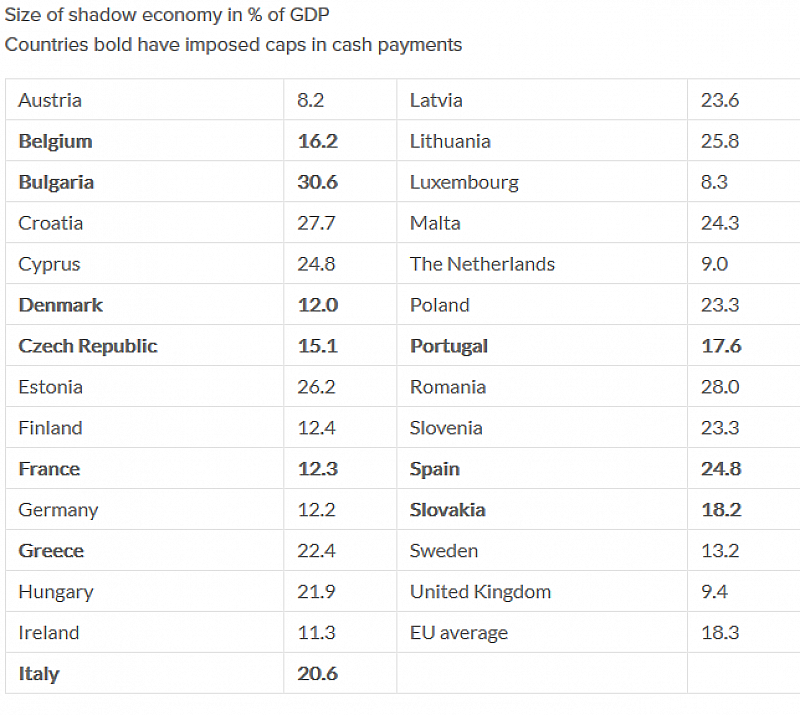
In the graph below you can see the level of the shadow economy compared to GDP. The data is from a study by Johannes Kepler University in Austria, with countries in bold that have a cap on cash payments. It is evident that there is no correlation between the amount of cash payments and the level of the shadow economy, and even the best performers in this regard – Austria, the UK and the Netherlands – have not resorted to restrictive measures against their citizens.
For further confirmation of this data, we can turn to the work of Austrian economics professor Friedrich Schneider. In his study “ Restricting or eliminating cash: an effective tool for combating corruption, the shadow economy, crime and terrorism?” Schneider concludes that although cash payments are a factor in the shadow economy, they are not the driving factor in it, meaning that restricting them will not reduce the shadow economy.
In fact, according to the professor's data, if cash were completely removed from the economy, a contraction of the gray sector by between 10-20% could be expected, which is hardly the desired effect.
The same applies to the justification that cash payments increase corruption. While in countries with low levels of corruption in the public sector, such as Switzerland and Austria, the percentage of cash payments is high, in countries such as Bulgaria and Greece, where restrictions have been introduced, corruption is rampant.
Lie 3 – Cash restrictions will help fight terrorism
Although not fully activated in Bulgaria, this support of the initiators of the cash restrictions is still mentioned in the debate in our country, and most likely this will happen more and more often. The idea is to create a feeling that paying in cash should be invariably associated not only with corruption and criminal activity, but even with terrorism.
Again, there is no convincing data to support this thesis, so we can define their imposition as a lie. To prove that it is a lie, we will again seek help from Prof. Dr. Schneider. In his study, he presents data on the cost of carrying out terrorist acts in Europe over the past 20 years. It turns out that 75% of the attacks cost less than $10,000.
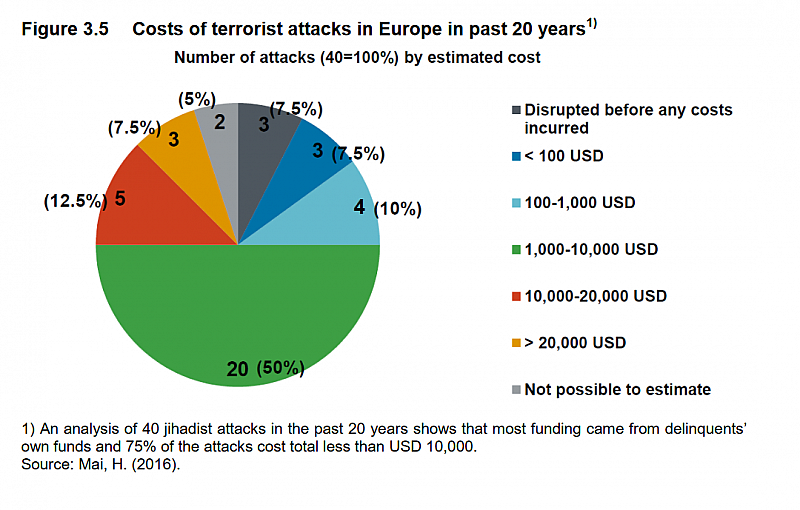
This means that even with extremely strict cash restrictions, this cannot in any way prevent terrorists from organizing attacks. As for the macro picture, the global financing of major terrorist organizations such as the Islamic State and Al Qaeda has little to do with cash payments, as it is carried out through state connections (Turkey) and huge financial institutions (Deutsche Bank).
The false claims or outright lies that the Ministry of Finance is using are hardly accidental. Rather, it is about serving banking and corporate interests under the guise of fighting corruption and the shadow economy.