 EKIP– Expert Club for Economics and Politics A Different Opinion

In recent days, I'm sure you've come across a number of headlines announcing that the profitability of private pension funds has collapsed, disintegrated, collapsed, crashed, etc. You get the idea. Something scary and shocking has happened to the profitability of pension funds. This is neither too far nor too close to the truth. The media furor was caused by the publication of the data of the Financial Supervision Commission on the profitability of private pension funds (in the Second Pillar of the pension system, which, like the First, is mandatory) for the last two years, from 31.12.2016 to 31.12.2018. The data is indeed not particularly pleasant, but there should be no unnecessary panic, and I did not see any in-depth analysis of the data and the possible reasons for the poor profitability in the media space. Let's roll up our sleeves and get to work on this in this article.
Is the stock market crash to blame?
Before we say anything, it should be noted that the last quarter of 2018 was very bad for financial markets. It turned out to be the worst quarter of an already rather unpleasant year in terms of the profitability of basic investment assets such as stocks and bonds (both government and corporate). In October, we witnessed a sharp correction of almost 9% in the S&P 500 index in the US, as well as a correction of over 9% in the German DAX. In December, a second wave of such downward corrections followed with an approximate magnitude.
Chart 1: S&P 500 Index Movement (08.2018 – 01.2019)
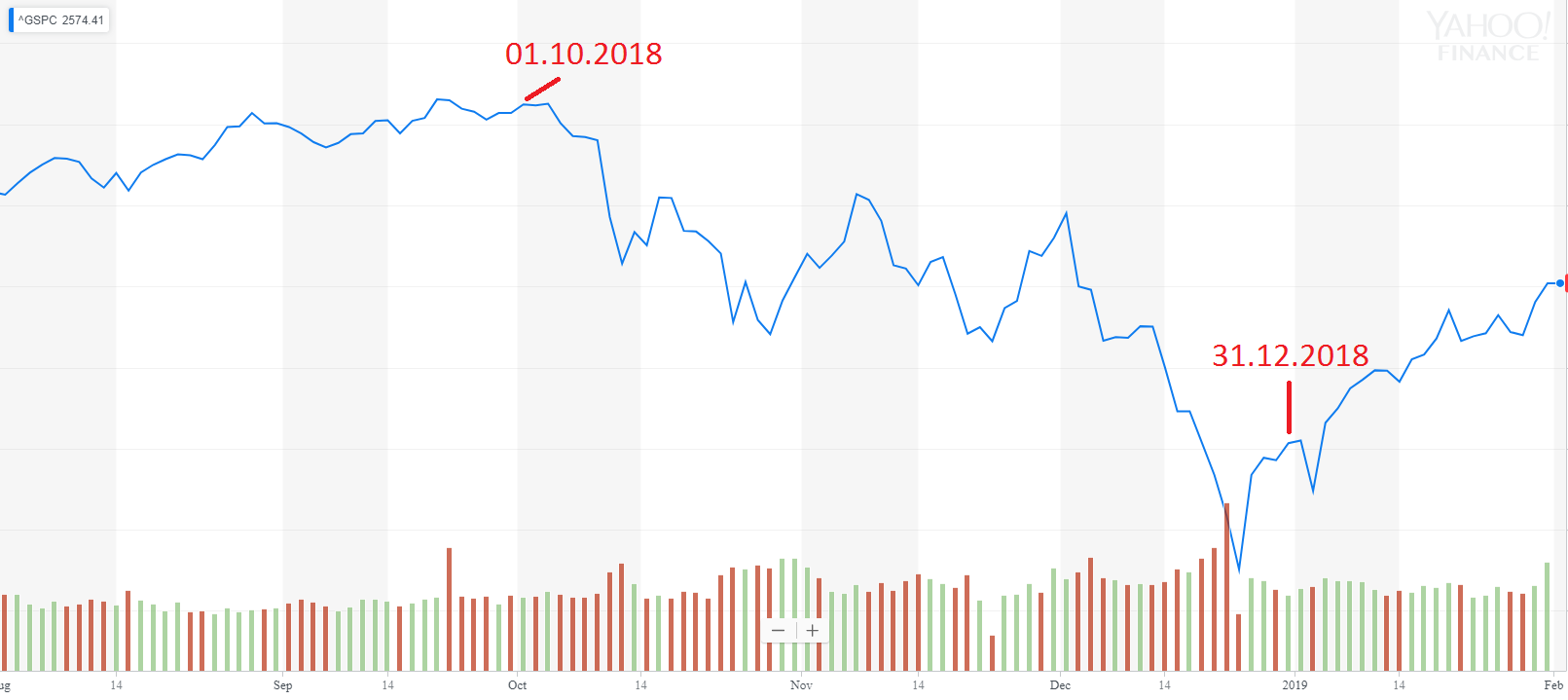
In summary, in the third quarter, both the DAX and the S&P 500 fell by over 14%, and the other stock indices were not in a more prosperous state. These sharp corrections erased a very large part (in the case of the DAX and some other European indices, completely erased) of the returns generated since the end of 2016. This is also the main reason for the sharp deterioration in the profitability of pension funds in Bulgaria for the period 31.12.2016 - 31.12.2018.
Chart 2: Movement of the DAX index (08.2018 – 01.2019)

In general, funds invest between about 25% and 40% in equity securities (stocks), and therefore when there is a sharp, double-digit decline in stock indices, it is inevitable that this will lead to a proportional contraction in the returns of these funds. What saves their returns from falling into negative values is that the remaining 60-70% of their investment portfolios are mainly in debt instruments (corporate and government bonds), which perform better when there is a decline in stock prices.
Of course, this is little consolation for the clients of these pension funds (i.e. all working people, because we are obliged to insure ourselves with a 5% contribution to them), because their returns, although not completely disappeared, cannot even beat the inflation rate recorded in the same period. According to NSI data, the consumer price index in December 2018 was 5.52% higher than in December 2016. The weighted average yield of universal pension funds for the same period is 0.96%. This makes a difference of 4.56%, i.e. 4.56% loss of purchasing power of these savings. If we add the annual management fees (0.85% for 2017 and 0.80% for 2018) and the fee charged on each contribution, the net losses become even greater.
Private pension funds against inflation – an unequal battle?
But wait, it gets worse. If we dig through the FSC data and compare it with the NSI consumer inflation data, we understand that the last two-year period during which universal pension funds beat inflation was 12.2015-12.2017. That is, since the beginning of 2018, pension funds have failed to beat inflation. Now, this should not be a reason for panic in itself. As I mentioned above, 2018 was a very bad year for the markets in general. Stocks underwent several serious downward corrections in the first and last quarters of the year, and the yield on debt instruments such as government securities and corporate bonds did not undergo a noticeable improvement until the end of the year.
Table 1: Return on universal pension funds for the period 31.12.2016 – 31.12.2018

Source: FSC, NSI, EKIP accounts
In such a context, it is entirely logical that the profitability of pension funds would suffer. In fact, in such a context, the profitability of the majority of investment funds of all kinds also suffers. Therefore, it is incorrect to draw apocalyptic conclusions based on the latest data published by the FSC. It is even possible that we will see a serious recovery in the profitability of funds in the first quarter of this year. For example, today the FSC published the data on the return in January and they showed that the funds registered an average of 1.1% profitability compared to December when they reported an average loss of 0.59%.
Pension funds vs. alternative investments – who wins?
BUT, and this is a big "but", this does not mean that everything is tip-top with private pension funds, there are no problems there and we cannot think about improving the quality of their work. This is a topic that the EKIP has touched on before, most significantly in our pension reform proposal (as well as in other recent publications of mine). Pension funds could certainly have performed better over the past year. For example, the so-called "Permanent" portfolio of the American investor Harry Brown for the two years under review (2017 and 2018) generated a total return of 9.07%, significantly above inflation and an average annual return of 4.44%. And this is not some complex investment portfolio, it contains only 4 types of investments - stocks, long-term and short-term government bonds and gold. Harry Brown describes this portfolio in his book "Fail-Safe Investing", which is literature for absolute beginners and non-professional investors, about 150 pages long.
This is also the investment portfolio that the TEAM is replicating within our experimental Virtual Pension Fund. In it, we report the yield of the Permanent Portfolio every month and compare it with the average yield achieved by universal pension funds, according to FSC data. And the data shows that for the last nine months (May-January) Harry Brown's simple strategy has performed significantly better than the average universal pension fund. The average monthly yield of the Permanent Portfolio for the period is 0.16%, while for the average pension fund it is -0.33%. Even an even more elementary, classic portfolio with a 60/40 distribution between stocks and debt bonds also achieves better results than universal pension funds during these periods.
Once again, it becomes clear to us that something is wrong with the work of private pension funds in the second (mandatory) pillar of the social security system. The investment strategy they follow is clearly inadequate. If you yourself can achieve better profitability by simply copying Harry Brown's portfolio, why should you give your money to a pension fund at all? (You can learn more about this portfolio here ). After all, why are such high entry and management fees paid to these funds? They have to be justified in some way, right?
Where does the problem lie and what is the solution?
The elephant in the room is the regulation of these funds. The state regulation, outlined in the Social Security Code, regarding private pension funds is inadequate. First of all, in terms of the restrictions imposed on their investment strategy. They are too restrictive and artificially increase the investment costs of these funds, thus making them more expensive for clients. Second, in terms of the minimum fees set by law. After inflation, investment fees are the second biggest killer of savings. The good thing is that at least in recent years these fees have been constantly reduced, but why they should exist at all is not clear.
But thirdly, and this is the most important problem, the regulatory framework excessively restricts competition in the field of pension insurance. The sector is practically cartelized at the moment – pension funds can be counted on the fingers. The sphere of pension insurance products must be opened up to alternatives such as mutual investment funds on the free market. This, plus deregulation of restrictions on investment activity, is the only way to improve the quality of work, and consequently the profitability, of pension funds in Bulgaria. The less competition, the less quality – this is a fundamental economic dependence.
In short – if we want to improve the profitability of pension funds (and improvement is clearly needed), we need a serious reform of the regulatory framework. We at EKIP have been talking about this topic since the beginning of last year, when we proposed a reform of the structure of the entire pension system. And we will continue to sound the alarm until something happens. Until then, you can join our Virtual Pension Fund if you would like to regularly monitor how the profitability of pension funds in our country performs compared to alternative investment strategies, such as Harry Brown's.






2 коментара
Pingback: 14. What is Phyre and why is it the future of electronic payments? (with guest Konstantin Dzhelebov)
Pingback: How did our "Virtual Pension Fund" perform in its first year? • Pension reform for the young / EKIP — Pension reform