EKIP– Expert Club for Economics and Politics A Different Opinion
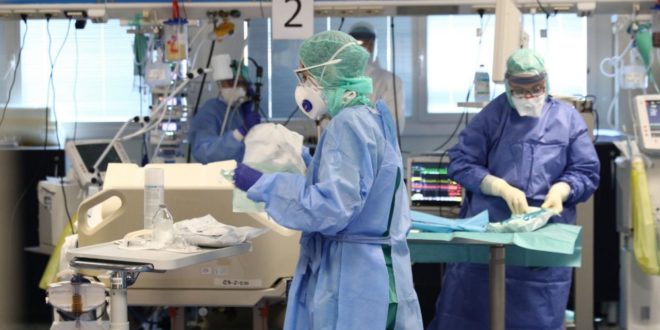
The COVID-19 epidemic in Bulgaria is developing. Speculation about whether it is in its beginning, middle and end should be left aside, as the main goal at the moment should be to minimize the risk of the widespread spread of the virus. Even if predictions are made now about its development, they will certainly be inaccurate, due to the dynamics of interaction between individuals, as well as incomplete information about the number of infected people. Therefore, the focus of the responsible institutions should be on the short-term and long-term stability of the healthcare system, which is currently under great strain. The risk of collapse in financial, infrastructural and human resources is very real.
According to an order of the Minister of Health dated March 27, 2020, inpatient care facilities will carry out diagnostic and treatment activities for patients with COVID-19 under Clinical Pathway (CP) No. 104. This means that the NHIF will pay for the diagnosis and treatment of those infected with the virus. Several important questions arise here:
According to the Transitional and Final Provisions of the Health Insurance Act (HIA), Art. 3a " The republican budget and municipal budgets shall finance healthcare activities for which citizens have the right to free use and which are related to" point 5 "epidemiological and anti-epidemic studies and activities"; In short, this means that the prevention and treatment of epidemics is a function of the state and municipal budgets. And according to the Health Act (HIA), Art. 82 "Outside the scope of compulsory health insurance of Bulgarian citizens, medical services are provided that are related to" point 6 " compulsory treatment and/or compulsory isolation;" and point 6a "providing medical activities for patients with infectious diseases according to a list determined by an ordinance of the Minister of Health, including for the prevention of epidemiological risk;"
The first question that arises is - what happens to the treatment of uninsured persons who do not fall under the scope of the Health Insurance Act? One option is for them or their relatives to pay their health insurance premiums in full at the time of their admission. Such an action, given the epidemiological crisis, would be risky and also very time-consuming. The second option is for them to fall within the scope of the Transitional and Final Provisions of the Health Insurance Act, Art. 3a "The republican budget and the municipal budgets shall finance healthcare activities for which citizens have the right to free use and which are related to", point 1 "emergency medical care;"
The second issue that remains on the agenda is the NHIF budget for hospital care. Since the diagnosis and treatment of COVID-19 patients is paid for through CP No. 102, the question remains who will supplement the public fund's budget to its initial financial parameters before the start of the epidemic. Over the years, this has been done as a transfer from the Ministry of Health to the NHIF, but will it happen in full at the moment, because in addition to an epidemiological crisis, a financial one is also looming? Here, the balance of interest groups from pre-crisis levels must be preserved.
The third question that is gaining momentum is what is happening with the salaries of medical specialists whose medical institutions are currently not performing planned admissions and surgeries, preventive examinations, women's and children's consultations? The income of these medical institutions for the time the order is in force has been reduced. One of the options is for them to be paid based on the income of the medical institution for the same month of the previous year. The problem here is that part of the values of the clinical pathways were updated from last year to now - all this may lead to non-fulfillment of the provisions of the National Framework Agreement for 2020.
Regarding reforms during an epidemic
On 25.03.2020, a Draft Regulation 4/2009 was uploaded, concerning the conditions and procedure for prescribing and dispensing medicinal products. The draft was published on the website of the Ministry of Health and subsequently removed. The change concerned the possibility for master pharmacists to carry out generic substitution of medicinal products with a prescription if the pharmacy does not have the medicine prescribed by the doctor in stock. The justification was that it is a crisis measure that creates an opportunity for patients to obtain their medicinal product without having to go to several pharmacies if it is not available in the respective one. The lack of an impact assessment, as well as discussion with all parties in the field, led to scandals in professional medical circles, at a time when we should all be united around protecting the health of the nation. Such a crisis measure would make sense only when institutions can track the availability of medicinal products in the pharmacy network in real time, and also if a shortage of a specific medicine is created.
First of all - for reform of the state's drug policy and the optimization of public and private resources in healthcare, the EKIP has prepared several pharmaco-economic analyses, which can be seen here, here and here. The conditions that must be in place in order to implement a rational pro-generic and pro-biosimilar drug policy are:
- Conducted public debate and analysis of the needs of all stakeholders in the field - doctors, pharmacists, dentists and patients;
- The availability of an electronic prescription and an electronic file, so that both the prescription of medications by the treating physician and the sale of specific ones by the master pharmacist, as well as the availability on the network, can be tracked;
- Clarifying issues with vertical integration (manufacturer-wholesaler-pharmacy) to ensure equal economic treatment of all pharmacies in the country;
- The elimination of internal price referencing, which is absent in other countries that have introduced generic substitution;
- The certainty that when replacing a given medication with the same international non-proprietary name, the costs for the patient, as well as for the public budget, will be optimized, not increased;
- Increase in the reimbursement rate for cardiovascular disease medications, where patient co-payment is highest (70%);
The healthcare sector is complex, woven with multiple needs, interests, and contradictions. That is why a careful approach to any action or reform is extremely important, especially during a pandemic. Let the topics that cause confusion among its representatives be left for the time when they can gather live and calmly, without health concerns to discuss them.