EKIP– Expert Club for Economics and Politics A Different Opinion
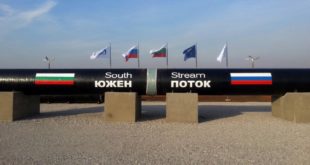
A song sang that “the revolution will not be broadcast on television” (la revolucion no se televisara), but last week we saw Bulgaria losing its sovereignty on television. In a festive atmosphere and high spirits, Alexey Miller, the CEO of Gazprom, and the Prime Minister of Bulgaria, Plamen Oresharski, launched the construction of the Bulgarian section of the South Stream gas pipeline. During the briefing, the welding of the first pipes near the village of Rasovo near Montana was shown to all journalists. There was a lot of praise for the enormous importance of the project, for the fact that streams of gold (2.8 billion euros) will flow to Bulgaria, and we will become a gas distribution center for the entire region, and why not for the whole of Europe.
The reality, however, is quite different. First and foremost, Bulgaria will remain almost completely dependent on Russian gas, and this dependence will be supported by the presence of infrastructure on the territory of Bulgaria. This means that not only are the options for diversified energy routes passing through Bulgarian territory killed, but the physical presence of a pipeline on Bulgarian territory with majority ownership by the Russian state gives the latter carte blanche. white to interfere in Bulgaria's security strategy. Of course, when has this been a problem for Bulgarian politicians? We have not defined our strategic priorities for a long time - this is what they take care of, to paraphrase Konstantin Irechek, in the "Asian" department in St. Petersburg, and nowadays in the State Department in Washington.
Economically justified?
Prime Minister Oresharski reiterated that South Stream will not cost Bulgarian taxpayers a penny. In the economy, however, there is something called “forgiveness” and these amount to hundreds of millions in the form of lost transit fees, with which we will repay our loan to Gazprom. Under current conditions and with the full capacity of the pipe (63 billion m 3 ), the repayment of the loan of 620 million euros will take 22 years (previously it was 15 years). According to the Minister of Economy, Dragomir Stoynev, the forgone benefits will be compensated by dividends for the Bulgarian state, which, however, after yesterday seem surprisingly cut, considering that the Bulgarian participation is reduced to nearly 18% from the 30 percent indicated by Stoynev earlier. Let us also recall that when the initial agreement was signed in 2008, BEH and Gazprom had equal shares in South Stream Bulgaria. In the meantime, the project has risen sharply in price by 400 million euros to 3.5 billion from the previous estimate in July. However, the truth is that no one knows exactly what the agreements are in the contract, which remains a trade secret. The statement that the interest rate on the loan granted by Gazprom to BEH is reduced to 4.25% from 8% is welcome for the seriously troubled financial holding, but this discount sounds more like a consideration of reality on the Russian side, since the indicated interest rate is close to the market rate for Bulgarian government securities (BEH is a state-owned company).
It's not about Bulgaria.
Alexey Miller said that South Stream is justified by the growing demand for gas in Europe. This is actually factually incorrect. Gas demand in Europe is not only not increasing, but has been plummeting over the past 3 years under the pressure of unrealistically high prices for the fuel, which is being replaced by cheap coal from the US, but also weak economic activity in the EU. The result is that the capacity of the sister gas pipeline, Nord Stream, is used at only 27% and does not seem economically justified at the moment. It is not clear how the additional 63 billion m 3 will be absorbed by European consumers. Behind Gazprom’s actions lies despair related to the company’s inability to compete with alternative energy sources and cheaper Qatari and Norwegian gas flooding distribution centers in Western and Northern Europe. Thus, it is not clear at what capacity the new Russian project will operate, which in turn will determine the size of Bulgarian profits and the speed with which the debt to Gazprom will be repaid.
Bulgaria, of course, supports Big Brother when he is in trouble. It is no coincidence that some analysts have started calling Bulgaria the Russian Trojan Horse in Brussels. It is no secret that the implementation of South Stream still depends on the pipeline being excluded from the European legislation of the so-called “Third Energy Package”, which prohibits one company from having a majority stake in both production and transmission of gas. In an attempt to avoid this condition, yesterday’s agreement between Bulgaria and Russia allows access to the pipeline by third-party suppliers, competitors of Gazprom. The question is where these third-party suppliers will come from and how realistic it is, for example, for Azeri gas to be transported through South Stream. The reality is that so far the EU has not given any signal that it will change its position, giving South Stream a special permit to avoid the new rules. This was granted to the Trans Adriatic Pipeline (TAP), which also involves a mix of ownership and transmission, but the EC considers it a strategic project increasing the Union's energy security.
Convenient moment
The first “welding” of the Bulgarian section of the “South Stream” is a convenient moment for Russia to put pressure on its neighbor Ukraine. The context of the Bulgarian events is the ongoing dispute between Gazprom and Naftogaz (the Ukrainian state company) over unpaid debts to the Russian side. This week, Gazprom threatened that it could cut off gas supplies to Ukraine and thus to the EU if the country does not pay its debt. The statement comes on the eve of the signing of a historic association agreement between Ukraine and the EU, which will eliminate customs duties and is one of the most important steps for Ukraine on its path to full membership in the Union. Gazprom threatens to use “South Stream” to completely bypass Ukraine as a transit country and thus condemn it to energy starvation. Russia wants Ukraine to also join the Eurasian Union between Russia, Kazakhstan and Belarus, but the government of Viktor Yanukovych has so far resisted the pressure.
Resistance
Gazprom insists that transit through Ukraine will not stop if the country sells its gas transmission network to Gazprom. However, this means that the country will de facto become an energy appendage of Russia, and even the pro-Russian orientation of the ruling Party of Regions cannot accept such a scenario. For comparison, the Bulgarian government has nothing against taking the risk for its sovereignty and hosting a pipeline that will tie it to the Russian side for decades, practically making real diversification of resources impossible. Yes, it is true that South Stream will bypass transit countries and deliver gas directly to Bulgaria via the Black Sea, but at what cost? Will Bulgaria be able to resist the expansion of Russian interests in Bulgaria? Or, as always, our energy security will once again be taken care of in some foreign “department”.