EKIP– Expert Club for Economics and Politics A Different Opinion

The effects of the disastrous monetary and housing policies pursued by the American government in the early years of the new century became visible around 2008 with the so-called beginning of the financial (later economic) crisis. In law, the economic distortions had long been present, and what we observed after the bursting of the bubble was actually an attempt by the market to clean up the problems accumulated over the years. Of course, quickly thwarted by new interventions by frightened politicians and bankers.
The long-term impact of the crisis, however, comes mostly from what happens in the economic discourse after the real estate bubble bursts. That is, from whether the reaction to the situation (coming from the circles of economic science) will allow the misallocation of resources to be corrected or will lead to a deepening of the problem. In this particular case, after 2008, the development of events was on the one hand negative (we saw a Keynesian response to the crisis and additional state intervention), but on the other hand positive, because the eyes of many commentators and researchers were opened to the dangers of the Federal Reserve's credit expansion and political intervention in the real estate market. And with any luck, in the next episode of the business cycle we may have a more serious resistance to interventionist policies.
Fortunately, another set of problems has become more apparent, both in the hard-hit “southern countries” and in the rest of the “stable” part of the European Union. It is about another ticking time bomb – the welfare state facing bankruptcy. A topic that, if not addressed, will lead to upheavals comparable to what we saw after the end of the property fiasco.
The mathematics of social programs managed by politicians and bureaucrats is ruthless. According to the latest data from 2011, in the European Union governments spend 29.1% of GDP on social protection, with some Scandinavian countries, France and Belgium spending over 30%, while in others, such as Bulgaria, it is less – 17.7% [1]. For example, the data of the Bulgarian Ministry of Finance from the last 4 years can give us an idea of how these huge parts of the output produced in the economies of the Old Continent are managed. The deficit in the state-controlled social sphere for this period is as much as 18.9 billion leva – i.e. revenues are only 21.3 billion leva, while expenditures reach 40.3 billion leva. The main deficit comes from pensions and benefits – 17.2 billion leva, while the health insurance deficit is “small” – only 1.7 billion leva. for the four years [2]. In short - it is spent without any particular restraints.
And the situation is not unique to “developing” Bulgaria. Between 1997 and 2010 alone, nominal annual government spending in the UK more than doubled, from £300 billion to £650 billion. Most of this money went to new or expanded “social” programs, with a significant portion of it targeted at the voting middle class, the recipient of a significant portion of the country’s transfers. [3] In France, budget spending has increased every year since 1958, to the point where the expected debt for 2014 was 95.1% of the country’s GDP. [4] Again, the lion’s share of the increase came from social programs.
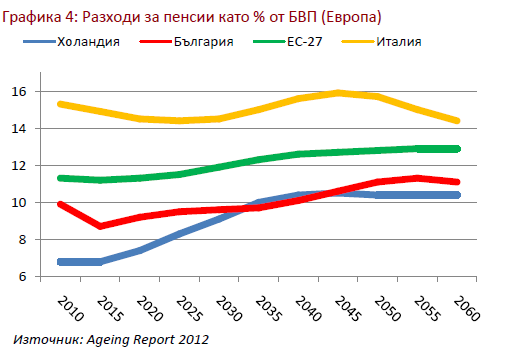
In fact, the future is not rosy for the social budgets of any country in the developed West. As can be seen in Figure 1 [5], pension spending (more than 60% of social spending almost everywhere) as a percentage of GDP will increase, while at the same time the population will live longer and there will be fewer newborns [6].
The reasons for the situation described by the numbers can be traced back to the creation of the welfare state in the 19th century. The author of the German system – Otto von Bismarck – was very direct about his idea, which he himself called “state socialism”. He said: “He who waits for an old-age pension is much happier and easier to manage. Look at the difference between a private servant and one who serves in the chancellery or the court – the latter will endure much more” [7].
That is, benefits, pensions, employment programs, health care have been seized from the private, voluntary and solidarity sector with one goal - obtaining political power. In the modern form of the Bismarckian scheme, we have politicians providing benefits to various electoral groups - some early pensions, others unemployment benefits, still others subsidies for their production. The promises are piled up, the mandates are running, and the bill is written to the workers (from whom taxes are taken) and to future generations, who will have to pay the huge state debts.
“Huge” is not an exaggeration – across the European Union, unfunded liabilities for pension systems alone amount to 285% of GDP. In individual countries, the situation is even more tragic – if all pension promises were to be taken into account, Greece would have a debt of 875% of GDP, France 549% of GDP, and Germany a “modest” 418%. [8] An unthinkable burden, but since politicians and voters can now enjoy the benefits, and the tenure in power is short enough, let someone else bear the burden when the time comes to settle accounts.
In addition to shifting the financial burden from one group of people to another, the welfare state creates counterproductive incentives for behavior. In economics, this is called the “welfare trap,” which broadly refers to a situation in which the combination of taxation and benefits results in a situation where, if some workers find relatively low-paid work, the funds they receive (after taxes and social security contributions) are in fact the same as those they receive from benefits without any effort [9]. Accordingly, large groups of people are taught that it is most convenient to live on someone else’s support. This further worsens the state of the insurance/social model, as the number of workers paying the costs is replaced by recipients of redistributed funds.
If we put together even just the elements of the welfare state outlined in this text, we get a dangerous trap for the future. A financial pyramid with fewer and fewer payers and more and more recipients. A political leadership with a short horizon, voters who want more privileges at someone else's expense. A system that is so set up that it creates the conditions for its own bankruptcy.
If we acknowledge the facts, we can have a serious conversation about other ways to provide health care, help the poor, and protect against misfortune. There are those, but we won't find them in the welfare state and politicians.
[1] Eurostat data
[2] Calculations from Investor.bg
[3] Sharper Axes, Lower Taxes: Big Steps to a Smaller Government, edited by Philip Booth, 45-67. London: The Institute of Economic Affairs
[4]http://www.bbc.co.uk/news/business-24240869
[5] Taken from “Bulgaria’s Pension System in Figures and Graphs”, IME, 2013
[6]http://www.washingtonpost.com/blogs/worldviews/wp/2013/10/31/how-the-worlds-populations-are-changing-in-one-map/
[7]Bismarck the Man and the Statesman, A.J.P. Taylor, (1955; Sutton publishing 2003)
[8]The Welfare State as Pyramid Scheme, Michael Tanner, After the Welfare State, Atlas Economic Research Foundation 2012
[9] A 2013 Cato Institute study found that in 35 US states, welfare benefits provide more income than minimum wage work, and in 13 others significantly more. http://object.cato.org/sites/cato.org/files/pubs/pdf/the_work_versus_welfare_trade-off_2013_wp.pdf