 EKIP– Expert Club for Economics and Politics A Different Opinion

Having barely emerged from recession, the European economy is showing negligible growth and, by all appearances, is on the verge of entering a deflationary spiral. A situation similar to that in Japan, which lost two decades during which it did not record economic progress. It is time for tough measures by the ECB, warn world-renowned financial analysts and economists. The excessively long period of low inflation is a thorn in the side of Mario Draghi, who in his recent statements categorically made it clear that the Governing Council of the ECB is unanimous in its desire to use conventional and unconventional instruments to effectively deal with the risk of deflation [2].
According to the leading financial media, it is time to put an end to verbal interventions and take action. This will probably happen in June at the earliest, after the ECB Governing Council did not change its policy at its last meeting on May 8 [3]. However, when asked during a press conference after the meeting on the 8th whether there was a consensus for action, Draghi replied that the ECB does not accept low inflation as a natural fact and is ready to act once the latest economic data is released. The markets reacted immediately and the euro depreciated in anticipation of future measures. This significantly narrowed the scope for further postponement of real action by the ECB next month.
Graphics 1
 Unfortunately, the intentions of the ECB governors reinforce the feeling that we live in a confused world where everything is upside down. In particular, central banking is economic nonsense, and deflation phobia is built on a parasitic economic dogma, proven wrong and proven immortal. In practice, the ECB's stabilization policy is pro-inflationary, pro-crisis and pro-redistributive.
Graphics 2
The so-called "elite" media has become so entwined with the bureaucratic cartel that it is difficult to find an alternative to deflation phobia. " Why deflation is bad " by Paul Krugman from the New York Times [4] or " The Economic Monster Called Deflation " by Gary Schilling in Bloomberg View [5] eloquently show where the freshly printed money goes. The arguments against deflation are a lie that has been repeated many times, which over time has become a generally accepted truth, opposed by a few "illiterates".
Imagine the economy as a car. [6] Today's bureaucrats and leading economists of the status quo believe that when the car is going too fast, they should press the brake lightly, and when it is going too slow, they should press the accelerator. They differ only in the tools they use, and in the size of the shoes they use to press the pedals. For left-wing economists, the accelerator is government spending, while those slightly to the right prefer monetary policy, in the form of low interest rates for business. Of course, the division is very conditional, and both groups sometimes resort to all possible tools.
For economists from the Austrian School, however, the question has never been about the accelerator-brake plane. When the car is moving slowly, we do not instinctively press the accelerator pedal, but start looking for some kind of engine failure, a flat tire, is there any gasoline at all, etc. That is, for us the real process is much more important and we believe that the problems arise due to the misallocation of resources in the economy. Any state intervention, in turn, whether fiscal or monetary, leads to a change in relative prices in the economy and precisely to this problematic misallocation of resources.
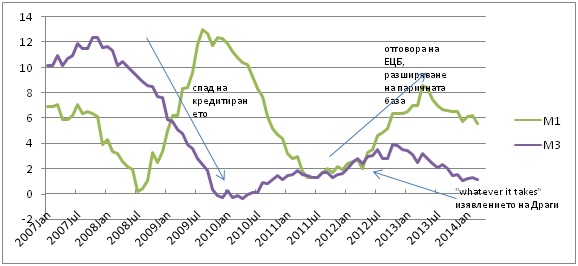
Bank credit expansion leads to the beginning of a business cycle [7]. Two things are interesting to note. First, there is already disagreement about whether credit expansion creates inflation. For most economists, including Krugman and Draghi, if the consumer price index (HICP) maintains stable levels, then there is no inflation. However, the economy is not limited to consumer goods and services, all relative prices are important in it. Most often, inflation goes to assets related to capital markets and resources.
Graphics 3
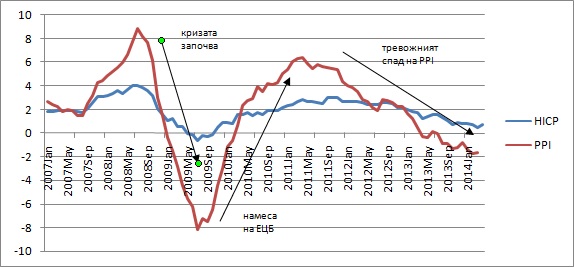
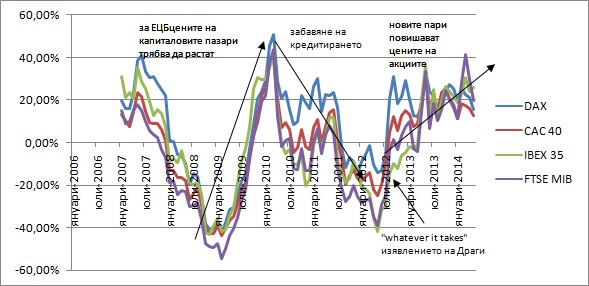 One empirical example of this is that during a credit expansion, the producer price index (PPI) grows at a much higher rate than the consumer price index (HICP) (Figure 1). Hyperinflation in the stock indices of major countries in the eurozone is evident (Figure 3). Property is another asset whose price inflates during a credit expansion (Figure 4). In practice, a central banker cannot explain to you why the price of tomatoes and cheese should be relatively constant (2% inflation), while property and stock prices should grow at double-digit rates (hyperinflation). And yet, that is their goal.
Graphics 4
 Това е причината стабилизационната политика на ЕЦБ да е проинфлационна. Дори при стабилен HICP, увеличението на паричната маса води до кредитна експанзия и инфлация в борсовите активи. При нормални условия с увеличаване на производителността на труда, в резултат на инвестиции и технологичен прогрес, се наблюдава дефлация в резултат на растеж. Затова е про-преразпределителна, защото необосновано променя ценовите съотношения, като обогатява едни за сметка на други и по този начин пропастта бедни-богати се увеличава. Затова е прокризисна, защото целият този процес е нездрав. Което ни води до втора точка.
When it becomes clear that there is a misallocation of resources and prices do not correspond to people's subjective desires, the second part of the business cycle occurs, the so-called bust (bursting of the bubble). Then we observe the reverse process, the prices of resources and capital goods deflate or fall much faster than those for final consumption (again, look at the graph above). One of the reasons for this is bank-credit deflation, as a result of a contraction in bank lending or the so-called deleveraging. Another reason is the pessimistic expectations of economic agents about the economy, who are not inclined to take out loans and invest, i.e. this is the so-called deflation as a result of an increase in the individual's money balance [8].
Gas-brake economists cannot understand the theory of the business cycle and the role of the recovery deflationary process, the time when the misallocation of resources is erased. Their logic is turned upside down. They are very afraid of negative values in PPI and a decline in the price of stock indices, because they believe that costs determine the price of final consumption goods, i.e. that deflation in HICP will follow. That is why Mario Draghi is so worried, not only is HICP inflation currently threateningly approaching zero, but PPI growth is already negative. They also believe that capital markets react much faster than the real economy, i.e. if there is a collapse in the stock and bond markets, a depression will follow in the rest of the economy.
In fact, for a hundred years of central banking, there are already enough episodes that show that the prices of capital goods and the prices of consumer goods do not have a clear correlation. Rather, in times of boom, the former grow much faster than the latter, and in times of bust (collapse) the latter fall much less than the former. This has the logical explanation presented above. Another issue is that it is not costs that determine the prices of final goods, but vice versa, the prices of consumer goods are a benchmark for production costs. In fact, if this were not the case, there would be no boom-bust cycle. And last but not least, the efficiency of capital markets is a myth. They react last to the wrong signals from credit expansion, at a time when in the real economy the misallocation of resources is already a fact.
The logic of the ECB bureaucrats and their media mouthpieces is as follows. When prices fall, people do not make consumer spending and do not invest, in anticipation of lower prices. This leads to a contraction of companies' profits, as well as an increase in their real debt burden. The result is bankruptcies and unemployment, which in turn further strengthens deflationary expectations and the economy falls into a deflationary shock. This is the so-called "Japanese scenario". But here too the logic is turned upside down.
There are at least several reasons why the above is nonsense. The claim that people do not make consumer spending in anticipation of lower prices is arbitrary. They are not robots that are passive to the environment; they make judgments and decisions. What is happening is that at any given moment individuals are making decisions about how to allocate their monetary income between consumption, investment, and changes in their money balances. Since this decision depends on a multitude of factors, it may happen that individuals invest and consume more even when current prices are higher than expected future prices.
One of the reasons why eurozone citizens increase their demand for money in anticipation of lower prices is their unfavorable assessment of the risk in the economy. The process is not only voluntary, but also completely beneficial and healing. It helps individuals’ expectations of the price level and real prices to coincide more quickly. What prevents the economy from recovering is not deflationary expectations, but interventions by European countries that prevent them from becoming a reality. Here we can mention both the intervention in the labor market with the setting of minimum wages, minimum insurance thresholds and concepts such as unconditional basic income, and the intervention by the ECB, which tries to increase the money supply. All this leads to a longer depression and the accumulation of misallocation of resources.
The problem, viewed through the prism of the thesis of stagnant profits and increasing real debt burden, is even more distorted. Profit is the positive difference between revenues and expenses. Which in other words means that it depends on relative, not absolute prices in the economy. Thus, some firms would have higher profits even if the price of their products de facto fell, some would have losses even if their selling prices were de facto higher. The reason some firms suffer losses and go bankrupt is not because the general price level is falling, but because the price of their expenses has fallen less than the price of their revenues.
The real debt burden is growing because it is de facto greater. The credit expansion masks the real cost of credit, in the form of low interest rates and cheap money. What is happening now in the eurozone is that the economy is trying to show this deception by correcting price ratios. It does so through the mechanism of profits and losses and the result is that where there is misallocation and resources are not used economically, companies go bankrupt. But this is not a vicious process, on the contrary, the faster it happens, the more fully the economy will satisfy consumer desires within its real capabilities.
Unfortunately, instead of admitting its mistake and adopting a laissez-faire policy, the ECB sabotaged the process with a new credit expansion. Interest rates are at record lows - 0% on the deposit facility, 0.75% on the lending facility and 0.25% for the main refinancing operations. According to authors such as Gary Schilling, this shows that the central bank's policy is asymmetric. That is, nominal interest rates are 0%, but real interest rates are still positive. This prevents the central bank from creating negative interest rates to stimulate borrowing.
This is absurd! And the reason it is absurd is Mr. Schilling's misunderstanding of the importance of interest rates in the economy. They are not random variables, but the result of decisions that individuals make. The interest rate shows the price of time. When it is artificially low, entrepreneurs do not calculate its price adequately, let alone when the price is negative. This is the reason for the boom-bust cycle. Investments in projects that cannot be completed because within the investment period, the real set of goods that supports the level of consumption desired by individuals is exhausted.
Another problem for the ECB bureaucrats is the exchange rate. For them, low inflation is equivalent to an expensive euro. An expensive euro is equivalent to fewer exports, fewer exports to slower growth. And although the exchange rate is "supposedly" not a goal of monetary policy in the eurozone, the idea is increasingly creeping in that a strong euro means a weak economy, and this is another reason for intervention.
No surprise, this is absurd! An absurdity, subordinated to a mercantile and militaristic understanding of the economy. The fact that the Euro-bureaucrats have decided that there should be a currency war against the USA, China and the rest of the world does not mean that the citizens of the Eurozone want it, nor that they need it. The deficit or surplus in the balance of payments is an illusion, the moment we realize that the border of the territory and the people it covers is an arbitrary quantity. The more people the balance of payments covers, the less information we receive about what is happening between individuals.
The deficit or surplus in the balance of payments depends on the decisions of individuals who, as mentioned earlier, at any given moment purposefully decide how to distribute their monetary income between consumption, investment and changes in their cash holdings. The ECB forgets that the role of the economy in people's lives is to satisfy their needs and desires, not to grow. By attacking the decisions of European citizens, the ECB is following a policy similar to that of China - artificially lowering the standard of living for the purpose of economic growth. The panacea of a weak euro once again disrupts the price structure in the economy and sends the wrong signals to its participants.
For better or worse, the ECB's current policy is "asymmetrical." As Draghi puts it, it is difficult to reduce long-term interest rates when short-term rates are already zero. Indeed, record-low interest rates do not leave much room for bureaucrats to act. Unfortunately, they stimulate their ingenuity, and a new attack on European citizens is currently being prepared in the form of new, so-called unconventional monetary policy instruments. These could be negative rates on the deposit facility, lower or positive rates on credit or direct asset purchases from capital markets. Despite some specifics that make the implementation of the plan more difficult, it is not surprising that one of the three will happen.
Notes:
*- Definition of deflation by Christine Lagarde, President of the IMF, on the looming threat of deflation on a global scale.
[2]- http://www.ecb.europa.eu/press/key/date/2014/html/sp140424.en.html
[3]- https://www.youtube.com/watch?v=3DlfqQRdbc8
[4]- http://krugman.blogs.nytimes.com/2010/08/02/why-is-deflation-bad/?action=click&module=Search®ion=searchResults&mabReward=relbias%3Ar&url=http%3A%2F%2Fquery.nytimes.com%2Fsearch%2Fsitesearch%2F%3Faction%3Dclick%26region%3DMasthead%26pgtype%3DHomepage%26module%3DSearchSubmit%26contentCollection%3DHomepage%26t%3Dqry10%23%2Fdeflation
[5]- http://www.bloombergview.com/articles/2014-04-23/the-economic-monster-called-deflation
[6]- comparison taken from Lolter Block
[7]- more information on the business cycle can be found in Mises, "Human Action" or Rothbard, "Man, Economy and State"
[8]- Salerno, "An Austrian Taxonomy of Deflation"






@Dimo Stefanov
"Then we observe the reverse process, with prices of resources and capital goods deflating or falling much faster than those for final consumption (again, look at the graph above)."
I am a supporter of Reisman and as such I believe that a capital good is a good whose ownership aims to make money from it. And a consumer good is a good whose ownership does NOT aim to make money from it, but only to use it as such.
In this sense, apartments are capital goods from the perspective of the entrepreneur who builds them, but consumer goods from the perspective of the buyer who wants to use them to live in them. And in general, apartments (ready-made ones) are practically at the level closest to the consumer. The Austrian theory that the bubble occurred mainly in capital goods is somewhat inaccurate.
I like to explain, so I'll comment on the following:
"One of the reasons for this is bank-credit deflation, as a result of a contraction in bank lending or the so-called deleveraging. Another reason is the pessimistic expectations of economic agents for the economy, who are reluctant to borrow and invest, i.e. this is the so-called deflation as a result of an increase in the individual's money balance[8]."
There was a company. During the economic miracle (bubble), the boss of the company had as much money as he wanted. And he needed it and went to a banker who said: "Here's my man, take as much money as you want and make us both rich". The result is that the businessman doesn't have enough cash in hand, and he has put everything into circulation (there's no point in money sitting in one place). However, the crisis comes (bust). The head of the company finds out, first, that he has a lot of loans to pay off and second, that he has no cash in hand. There has always been money in the bank, and he has no money in his account. And he can't take money from the bank because they don't give it. Everything has gone into circulation and now there is no money for salaries. He starts paying off loans and trying to increase the money available in the bank (because otherwise there is nowhere to go). Since the banks have reduced lending, more money is coming into the banks than going out. This reduces the money supply. At the same time, as I said, economic agents are trying to fill their accounts to have cash on hand to run their businesses. They have spread very widely before and are now trying to return to a stable position. The fact that businessmen are repaying money from loans (lots and lots of loans) and keeping money in their accounts (increasing their money) also leads to a reduced velocity of money circulation. The combined result of both things: reduced velocity of circulation and reduced money supply leads to deflation. Bad deflation, which is a CONSEQUENCE, not a cause of the crisis. And if we are fighting deflation, then we are fighting the symptoms of the crisis, not its causes.
Deflation during growth is another thing. My company produces women's tights (for example). Because I am a very cool businessman, I invest in a new technology and manage to produce not 1000, but 1050 tights with the same amount of nylon. That is, my costs per tights have decreased by 5%. And by putting them on the market at the same price -> I will get 5% more profit. Great, I put them on the market, but it turns out that since the quantity is larger, the price falls, i.e. people do not want to buy more tights at the same prices, but at lower ones. So the price also falls (for example by 5%). The overall result of falling costs per tights and falling selling prices is that my profit remains the same, but the price of the final product (tights) falls. That is, consumers are in the black, and I as a businessman am not harmed. However, since the price of tights falls, and so do other goods (the same process is taking place with other businessmen), deflation occurs, but DEFLATION CAUSED BY GROWTH. A very useful and nice deflation.
@EE
Where and how credit money enters the economy is a matter of a number of factors. You are right, an apartment may be a final product, but its price has affected a number of prices, back down the chain, which might not have had the same price if the credit expansion had not taken place. That is, you can again have a higher rate of growth in the prices of capital goods. Of course, the topic of "where and how" is always subjective, but that is how I interpret the data.
@Dimo Stefanov
If I remember correctly (correct me if I'm wrong; when I decide something is wrong, I stop reading it and dealing with it, and I haven't read economic theory in years), Mises' claim is that bubbles form in capital goods at levels far from the consumer and only then do they inflate the levels towards the consumer.
My protest is that this view is not true. And the reason is that in the NOT-past crisis, the bubble started from apartments (in practice a consumer good) and from the increase in their prices, construction companies and companies for the supply of raw and semi-finished materials also developed. When you want to see what is the cause and what is the effect, you simply look at what happened first - that is the cause, and what happened later - the effect. So: first the apartments started to rise, and only then the construction materials. That is, the process is reversed, not as Mises claims. And in general, the bubble will start from where the new money flows in, and this does not necessarily have to be in capital goods, as the last crisis shows.
Finding out whether a theory is true is practically impossible because you never know whether you have taken everything into account and tested it in every possible way. However, it is very simple to find out whether a theory is false: you simply find one case where it does not hold. Then it is certainly not true, or at least not completely. The case of apartments is for me precisely this crucial exception.
I don't have an opinion on the higher rate of growth in capital goods prices at the moment. Where will this lead?
@EE
"Finding out whether a theory is true is practically impossible because you never know whether you have taken everything into account and tested it in every possible way. However, it is very simple to find out whether a theory is false: you simply find one case where it does not apply. Then it is certainly not true, or at least not completely. The case of the apartments is for me precisely this crucial exception."
On the contrary. The theory is either true or false. Your understanding of the influence of the various factors that influence the market may not be true or true. That is, the theory is the tool for analysis, the conclusions depend on the tool for analysis + your subjective assumptions. For example, more credit money means, ALL OTHER THINGS BEING EQUAL, a decrease in the marginal utility of money. However, whether the price of money de facto falls in the market depends on a number of factors that you cannot grasp. If today the price of 5 apples is 5 lv/unit, and tomorrow at 20 it is 15 lv/unit, then your logic (which is wrong) will conclude that the demand curve is upward and to the right.
@Dimo Stefanov
"A theory is either true or false."
That's right, there is no other option! 🙂
"Your understanding of the influence of the various factors that affect the market may not be correct or true."
And I agree with the above!
Regarding where the bubbles come from: Are you telling me that Mises's theory is correct, even though the bubble started and developed exactly opposite to the expectations of this theory? That is, you are telling me that we have an atypical crisis, an anti-Misesian one. What do you think are these additional factors that have turned the theory upside down? By the way, I am not an expert on crises, but I am convinced that there are many such cases (of reverse development).
So some time ago I argued with a person on another site who came to the conclusion that Keynes's theory is correct, but other factors intervened and therefore it does not apply in the vast majority of cases.
Look: When you are confronted with a statement like "All swans are white!", then even if you see millions of white swans, you cannot prove it. That is, millions of confirmations do not prove the thesis. But even the presence of a single black swan completely refutes the theory. By the way, they found black swans in Australia, if I am not mistaken.