EKIP– Expert Club for Economics and Politics A Different Opinion
The BNB’s ambitious plan to rescue the banking system actually raised more questions than answers, and the end result was more confusion than relief. To top it all off, on July 14, the media reported the magic number of BGN 3.7 billion – the amount that would be needed to implement the BNB’s plan to rescue Corpbank. But how did the BNB actually arrive at the coveted number?
The intuitive answer to this question probably involves a combination of complex economic models, long audit reports, lots of data, and legislative changes. It is likely that all of this is true. The point is that with a very simple and completely understandable method, we can derive almost the same result. After all, not everything in economics always comes down to complex modeling. “Keeping it simple” is often a winning strategy.
What did the BNB propose?
In short, the BNB plans to declare Corporate Commercial Bank (CCB) insolvent by first transferring some of the assets (the so-called “good assets”) and deposits of CCB to its subsidiary Credit Agricole Bulgaria (CAB). CAB is a small commercial bank with assets amounting to only 0.5% of all assets in the banking system. However, if the BNB’s plan is implemented, Credit Agricole will take the place of CCB as the fourth largest bank in the country.
The balance sheets of CorpBank and KAB as of the end of the first quarter of 2014 are shown in Table 1. CorpBank’s “good” assets, according to the controversial definition of the Bulgarian National Bank, amount to BGN 3.8 billion, or these are all the bank’s assets, not counting those loans for BGN 3.5 billion, for which the documents have somehow disappeared. These good assets will be transferred free of charge to KAB and will take up space on its balance sheet.
All CorpBank deposits amount to 6.7 billion leva, and since the BNB plans to save them down to the last penny, this amount will also be transferred to the balance sheet of the Bulgarian Commercial Bank, but on the liabilities side.
If everything we have listed so far is true, then after the restructuring in the balance sheet of the CAB we should have:
- Total assets = Own assets + Transferred assets from CorpBank
- Total liabilities = Own liabilities + Transferred deposits from CorpBank
- Total equity = Equity (here we have no transfer from CorpBank)
Table 1. Restructuring of Credit Agricole
Note: crossed out amounts are not transferred.
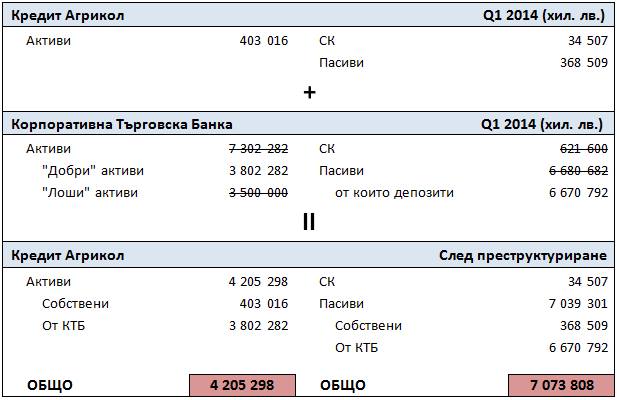
Source: BNB (Quarterly reports of commercial banks), Own calculations
After the restructuring, a serious problem arose in the balance sheet of KAB - the sum of assets is not equal to the sum of liabilities plus equity. In other words, the basic balance sheet equality was violated: Assets (A) = Liabilities (L) + Equity (EC). It is here that the need for capitalization of KAB is also seen - it is necessary to inject such a cash resource that would balance the bank's balance sheet. In the end, apparently, everything that is hidden behind the complex and alienating phrase " capital injection " is not so complicated.
The question is what this amount should be. From the equation discussed above (A = P + SC) we know with certainty only the value of the liabilities – 7.039 billion leva. We obtain it by adding the liabilities of KAB before the restructuring (368.5 million leva) and the deposits of Corpbank (6.67 billion leva).
However, to solve the equation, we need some relationship between assets and liabilities. Here, perhaps the most accurate would be to use the capital adequacy requirement, but unfortunately, we cannot reach such a relationship based only on the data provided by the BNB. However, for this purpose, we can do something simpler – take the average ratio between assets and liabilities in the banking system. As of the end of May, this ratio was 7.797, or in other words, assets were 7.797 times more than equity in the banking system (A = 7.797*SC).
If we substitute in the basic equation (A = P + SK) we will get that 6.797*SK is equal to the amount of liabilities that KAB has accumulated after the restructuring. Thus, we get that the equity that KAB must maintain is 1.035 billion BGN. We can easily get the amount of assets as the sum of liabilities and equity – 8.074 billion BGN. This is what the final balance sheet of KAB should look like:
Table 2. Closing balance of Credit Agricole Bulgaria

And what is the general assistance that should be provided?
The capital needed to be injected into KAB is actually BGN 1.001 billion, or the difference between the equity capital on the final balance sheet and the equity capital that KAB had before the restructuring. However, KAB must also receive assets to balance the balance sheet. The value of these assets is the difference between the assets on the final balance sheet (BGN 8.075 billion), the assets that KAB will receive after the restructuring (BGN 4.205 billion), and the capital assistance that KAB will receive (BGN 1.001 billion). In short, the need for additional assets amounts to BGN 2.869 billion.
Therefore, the total amount that must be provided to fix the situation with CorpBank is about BGN 3.870 billion, of which:
- In the form of equity: BGN 1.001 billion;
- In the form of assets: BGN 2.869 billion.
The final result obtained is 170 million leva more than the BNB’s calculation. One reason may lie in the fact that the BNB will not rescue the deposits of the members of the board of KTB, high-level managers, their relatives, as well as shareholders with a voting right of 5% or higher. It is possible that these deposits are a significant amount. Another reason may be a different ratio between assets and liabilities used by the BNB. After all, we used the average level in the banking system. A third and most likely reason may be the fact that KTB is obliged to hold part of the deposits with the BNB as reserves. These deposits are not lost, do not need to be rescued and can flow directly into the KAB and significantly reduce the amount needed to save the situation.
In the end, however, we got almost the same result with a simple calculation, but more importantly – with a lot of transparency in the calculations. Transparency is something that has eluded the BNB and the ruling party in recent weeks. It is clearly advantageous for them to have the public extremely uninformed and easily misled.
Additional notes
It is possible that a significantly lower amount will ultimately be used to bail out Corpbank. One reason would be the parties’ reluctance to bail out all deposits. Instead, up to BGN 196,000 of each deposit could be bailed out, unless the BNB provides additional information on the case. This would reduce the amount needed for the bailout to just BGN 500 million, if Kapital’s data that these deposits amount to only BGN 3.5 billion is correct.
It is also possible that the documents for the bad loans in question for 3.5 billion leva have not completely disappeared. In fact, this is the more likely scenario, since the very argumentation with the disappearance of the documents is more than absurd. It is impossible for the documents to simply “disappear the day before the audit”, since the BNB had access to them back in time and was fully aware of the situation. In this case, the amount needed to save Corpbank will not change (it will only vary depending on the chosen plan of action). However, the loss of state funds in the long term will be far smaller, since after the nationalization, the government will be able to claim these 3.5 billion leva and collect at least part of them.