 EKIP– Expert Club for Economics and Politics A Different Opinion
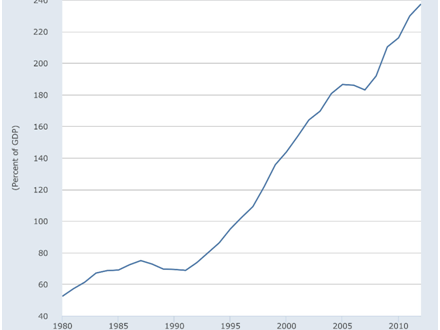
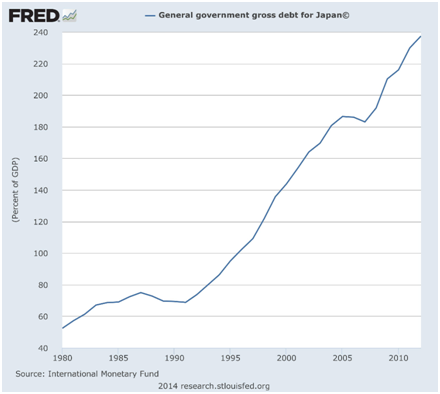
Financially, Japan is fast becoming a Keynesian dystopia. Its entire economy is now hostage to a fiscal time bomb. Namely: the national debt, which already exceeds 240% of GDP, and which is growing rapidly because even the recent painful increase in the sales tax from 5% to 8% does not even come close to filling the fiscal deficit. Moreover, even with today's absurdly low and artificially lowered by the Bank of Japan bond interest rate of 0.6%, nearly 25% of government revenue is being absorbed by interest payments.
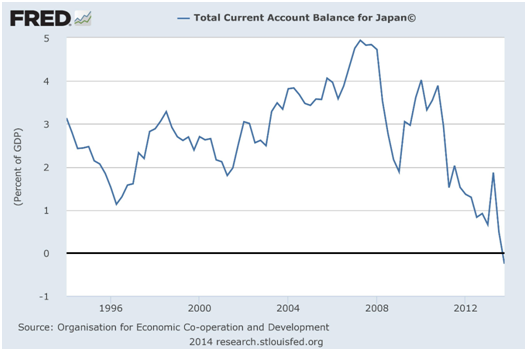
And here comes the death knell. Japan’s savings rate has collapsed (see below), and its vaunted current account surplus will soon disappear. This means that Japan’s accounts with the rest of the world will intersect in a “financial no man’s land”; the country will be forced to permanently liquidate its overseas investments to pay its current accounts—an investment surplus accumulated over 50 years. But this will also reduce foreign earnings, and thus increase Japan’s growing current account deficit.
Accordingly, to finance its “twin deficits,” Japan will have to attract massive amounts of foreign capital over decades—a plan that requires a devastating rise in interest rates, perhaps as high as 4%, according to one expert: “The yield on Japan’s benchmark 10-year government bond, currently around 0.6%, could rise to 4%—a level not seen since March 1995—if the current account balance runs a deficit as public debt overshadows the nation’s savings,” says Toshihiro Nagahama, chief economist at Dai-Ichi Life Research Institute.
Needless to say, if the cost of Japan’s soaring fiscal debt were to rise by even half that amount, it would be game over. Interest costs would absorb nearly 100% of politicians’ current revenues, forcing the government to raise taxes again and again. One expert quoted in the Bloomberg article below says that a 20% sales tax — almost triple the recently enacted rate — would be needed to defeat the fiscal monster that would result from interest rate normalization.
“If the government does not raise the sales tax to 20% or implement drastic reforms in social welfare spending, this scenario is very likely,” Ogawa said. “Higher interest rates will discourage domestic capital investment and encourage the relocation of production overseas, and the number of unemployed will increase.”
The above quote clearly hints at why a Keynesian dystopia is an apt description of what is emerging in Japan, and why this description is also a reflection of the financial horror show that will come to our financial district in a decade or two.
As stated above, the alternative to the economy-killing 20 percent sales tax is “drastic reform of welfare spending.” But that is not even remotely likely. Japan’s population is both shrinking and aging so rapidly that it is on track to become an archipelago of nursing homes.
Japan’s savings rate, as shown below, has fallen from a positive value of over 20% during Japan’s heyday as a trading export power in the 1970s and 1980s to just 3% today. As the number of Japanese retirees approaches 40% of the total population in the coming years, this rate will clearly turn negative as households liquidate their savings to survive.
Chart 1 Japanese household savings
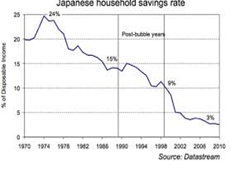
What happened to Japan's huge savings surplus? The government borrowed it! And squandered it on massive Keynesian stimulus projects that kept the Liberal Democratic Party in power for decades, but built bridges and highways to nowhere that will not benefit Japan's pensioner colony as they age.
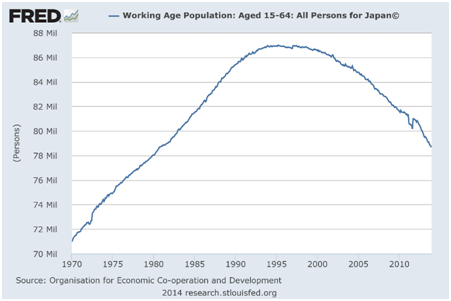
And the demographic drain is indeed powerful, as the graph of Japan's working-age population below shows. In a few short years, the working-age population, which peaked at 88 million, has fallen to 79 million; and will fall below 50 million over the next two decades.
Chart 2. Working age population (15-64 years)
What the Keynesian voodoo doctors who advised Japan to bury itself in fiscal stimulus after the 1989-1990 financial crisis did not explain is how the inexorably shrinking employed population could absorb the tax burden needed to support Japan's enormous public debt.
But there is no other way out of the Keynesian debt trap that Japan is in. As the current account, also shown below, continues to deteriorate, the need to import capital to finance the gap will send interest rates skyrocketing. The burden on Japan's remaining taxpayers will become crushing.
Charts 3 and 4. Current account balance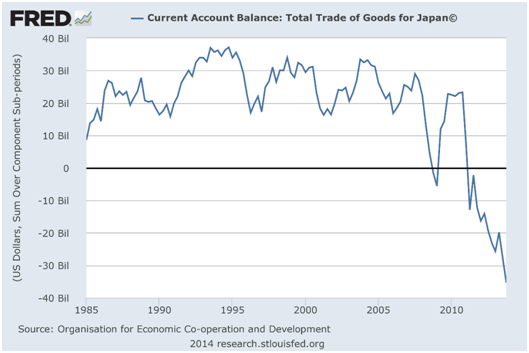
Therefore, the graph below should be copied on the forehead of every American congressman. When the debt spiral goes too far, it becomes a devastating financial trap. And, ultimately, it cannot be overcome by printing money, because if taken to the extreme, even with a so-called “reserve currency,” it will completely destroy the monetary system.
Chart 5. Gross consolidated debt of the Japanese government
It should also not be forgotten that the drastic degeneration of Japan’s public finances occurred in real time – in less than two decades, after its leaders were confronted with one fiscal spasm after another by Keynesian bureaucrats in the US Treasury, the IMF, the OECD, etc. And this is clearly an example of bad ideas imported from abroad. The generation of bureaucrats who led Japan’s postwar miracle may have been hopelessly addicted to the unsustainable patterns of mercantilist export promotion and exchange rate fixing, but they did not believe in Keynesian borrowing and spending.
I know this from personal experience, working with Japanese finance officials in the early days of the Reagan administration. Simply put, they were shocked that America was about to take such a huge fiscal risk, drastically cutting taxes before legacy domestic spending had been cut and the huge buildup in defense spending had been funded.
This was back then, when Japan’s debt was below 50% of GDP, despite two decades of domestic economic development. Yet just a decade later – after being forced to drastically overvalue the yen following the 1985 Plaza Accord – their model of worn-out mercantilism collapsed in a massive central bank-directed financial bubble and crash.
So, left completely out at sea, they became the test bunnies for visiting Keynesian firemen like Professors Bernanke and Summers. Then, Japan launched the biggest experiment in Keynesian fiscal stimulus anyone had ever imagined. The disastrous results speak for themselves and are a wonderful reminder that bad ideas can do enormous damage once they are taken up by the state machine.
You can read the original text here.






They just keep the interest rate at zero and if necessary 25% VAT to bring the national debt below 100%, and with a little inflation