 EKIP– Expert Club for Economics and Politics A Different Opinion
Andreas Marquardt
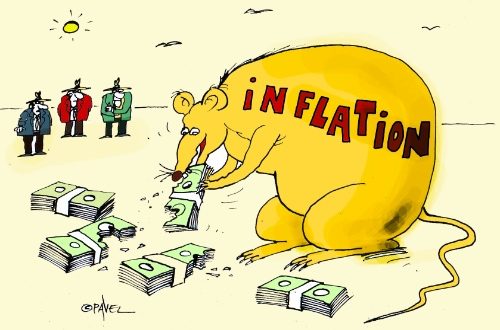
Inflation, defined as the expansion of the fiat money supply, is a primary evil whenever and wherever it occurs. It is the primary and most overlooked cause of numerous economic and social problems, including:
1. Inflation causes cyclicality in the economy
The increase in the money supply, which involves more lending, means that new money is created through loans that are not backed by savings. This causes a greater fall in interest rates than would have occurred without monetary expansion. The result is an artificial economic boom that politicians and the general public initially welcome. Investments are made that would not have been made if the capital for them had first been saved before being invested. Therefore, at some point, there are not enough funds to complete the projects that have been started. Furthermore, resources – which are scarce by their nature – are not directed where they are most needed – to the most urgent projects. When interest rates rise again, the wrong investments come to light, and the result is an economic downturn and crisis. To combat it, the central bank lowers interest rates again. In this way, the crisis is not allowed to correct the market, since it is politically undesirable.
2. Inflation redistributes wealth and purchasing power
The unsecured expansion of the money supply of currency causes the prices of goods and services to rise. The groups that receive the newly created money first benefit. They are able to buy the goods before the price change, while those who received the new money later will enjoy it only after the price increase. This puts the latter group at a disadvantage and it suffers a relative loss compared to the original recipients of the new money – banks, the state and large corporations. Moreover, some economic agents do not benefit from the new money at all. This effect also occurs when the prices of goods do not change during a monetary expansion, but would fall without it. In this case, inflation is practically criminal.
3. Inflation prevents prices from falling
High productivity and the division of labor in the national economy allow for an increase in the quantity of goods and services produced. If the money supply remained unchanged or increased by less than the quantity of goods produced, this would lead to a fall in the general price level. An increase in the money supply prevents such a fall in prices. The European Central Bank (ECB) sets the reference value by which the money supply is generally determined, M3, and according to them, ideally it should grow. This reference value is currently around 4.5% per year. The argument used is always the maintenance of price stability. It is argued that deflation, which is mistakenly interpreted as a fall in the prices of goods, is, to a large extent, harmful to the economy. In this way, a significant part of the population is prevented from receiving a fair share of the increase in productivity and the strengthening of the (international) division of labor.
4. Inflation leads to the expansion of the welfare state
Monetary expansion allows the government to borrow more easily and at lower interest rates than if there had been no increase in the money supply. In this way, expenditures can be financed that would otherwise have to be made after raising taxes. Politicians resort to this method especially before elections. In this way, they can promise “benefits” that they would otherwise not be able to finance. People willingly take the bait and stand first in line, without knowing or ignoring the fact that they themselves are paying for the “big banquet.”
5. Inflation breaks up families
No one has put it better than Hans-Hermann Hoppe in Democracy: The God That Failed:
“ Any form of state social services – forced wealth, or the redistribution of income from the “haves” to the “have nots” – diminishes the value of the individual as a member of the “family-household” group as a social system of mutual cooperation, assistance and assistance. Marriage loses value. For parents, the value and importance of good upbringing and education of their own children decreases. Accordingly, children will value and respect their parents less.”
6. Inflation corrupts people
Faced with the choice of whether to let the crisis correct the market after the economic boom or to postpone the problem, the majority of people prefer the second option. The debt of a large part of market participants is too great to bear the burden of the deflationary crisis. The fear of losing their jobs is too strong. Also, many people are dependent on state cash transfers, state subsidies and other government projects.
7. Inflation leads to the growth of government bureaucracy
Every recession that follows a boom exposes bad investments. Citizens want the state to “fix things.” It is called upon to intervene and act. Politicians are happy to follow this call, and thus can justify a range of otherwise unthinkable actions. But each intervention leads to new ones and becomes a “ticket” for further interventions. Finally, state regulations, in the form of a vast number of laws and regulations, permeate the economy and society and suffocate them.
8. Inflation makes people envious, selfish materialists
Inflation reduces the purchasing power of income and saved assets. For example, when people invest their assets, it takes a long time to compensate for the loss caused by the increase in the money supply. This happens slowly and with great effort, but most often it does not happen at all. The purchasing power of money disappears like sand between the fingers of consumers. People literally chase every cent, envy their neighbor for his property, not knowing that he is also up to his neck in debt. Charity and the desire to help become alien to people, since they themselves barely make ends meet. Meanwhile, statements like “we already paid enough taxes, so let the state do charity” are becoming more and more common.
9. Inflation depresses people
Especially for those who do not earn much, inflation makes accumulating assets through savings a very difficult or even impossible undertaking. The prices of, for example, energy and some food items are constantly rising. Climbing the social hierarchy is becoming more and more difficult. For many people, purchases are only possible on credit. And repaying the credit is increasingly difficult. People are discouraged by their own hopeless situation. This path often leads to unbearable debts and ruin.
10. Inflation leads to waste and natural resources become more expensive
Resources and time are scarce. The artificial boom caused by inflation leads to investments that would otherwise not have been made or would have been made at a later stage. If projects have to be interrupted due to insufficient savings or rising interest rates, it follows that the scarce resources have already been used and – in most cases – cannot be recovered. This means that more natural resources are used than would otherwise have been used. The prices of raw materials are rising. In addition, nature is being unnecessarily damaged. Also, if we look realistically, the infrastructure projects created because of inflation, which are not really needed, are putting an unnecessary burden on the environment.
Translation: Silvia Yanakieva
Editor: Daniel Vassilev
You can read the original article here.





...is inflation to blame???
How can she be guilty?
Inflation is a consequence, not a cause.
What is happening is with inflation, not from inflation.