 EKIP– Expert Club for Economics and Politics A Different Opinion
Often, when something in the economy or politics of their home country is bothering them, Bulgarians start comparing themselves to the countries of Western Europe and the United States, which are supposedly considered models of the good life. However, the Western world has changed a lot in the last few decades and from being a symbol of capitalism and personal freedom, today it is more characterized by large state expenditures and debt, a consequence of the so-called "welfare state". If we are looking for more freedom and personal choice, the answer is sometimes found in places that many people do not suspect.
Chile is relatively the richest (measured as GDP/capita at purchasing power parity) country in South America, known more for the peculiarities of its geography than for its economic achievements over the last 20-30 years. Chile is a country from which Bulgaria can learn a lot when it comes to the most problematic sectors on its own soil, namely healthcare, energy, education and pensions. In all these sectors in the Latin American country, market mechanisms exist that ensure high quality at reasonable prices through competition. For example, Chilean taxpayers have the right to choose whether to use the services of the state healthcare system or to redirect the mandatory health insurance of 7% to a private health fund of their choice. In the energy sector, 100% of electricity production and distribution is carried out by the private sector, which creates competition at all levels of the chain and, as you can guess, there is no such thing as a deficit created by artificially setting prices for the purpose of conducting social policy and buying votes. The education system in Chile works on a voucher principle, which allows private educational institutions to compete with public ones, which in turn constantly creates pressure to improve the service. Last but not least, and quite relevant in view of the events of the last few months in Bulgaria, Chile uses a pension model that the whole world should strive for.
History
Chile is the first country in the world to implement a fully private pension system, where each taxpayer has a personal account managed by a pension fund of their choice. The current pension model in Chile was introduced in 1980 by the country's social minister at the time, José Piñera, with the help of economists from the Milton Friedman school, known as the Chicago Boys. The sharp transition from a fully state-funded pay-as-you-go model to the so-called capital-accumulating model took place during the authoritarian rule of Augusto Pinochet. This greatly facilitates the change of the system, but it is precisely this sharp change in course that guarantees that politicians will not subsequently reverse the smooth transition to private savings, as is the case in Bulgaria at the moment.
How does the pension system work in Chile?
Each worker is required to set aside 10% of their gross salary each month, which represents their monthly contribution to the pension fund of their choice. According to the latest data from the Chilean pension regulator, there are currently 6 companies operating on the market, with each company managing 5 pension funds (AE, with A being the riskiest), differing in the risk they pose to depositors and, respectively, in the types of assets in which the money is invested. The companies compete both in terms of the realized profitability of their funds and in the administrative fees they charge their clients for managing their savings, and according to the latest data (for November), the fees range from 0.47% to 1.54%, with a weighted average of 1.39%. Pension funds in Chile are allowed to invest up to 80% of their funds outside Chile, but on average they allocate 40% to purchases of foreign assets, with the concentration of investments in emerging markets.
How is the pension system doing in Chile?
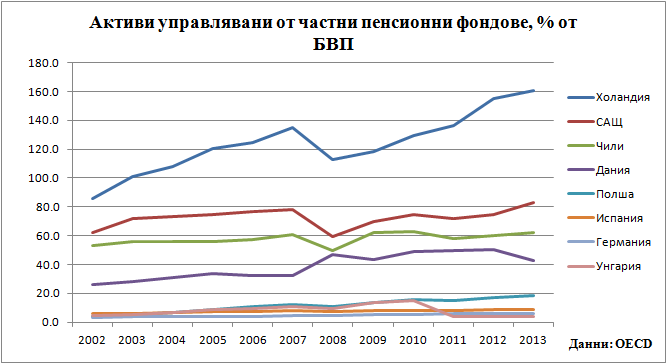
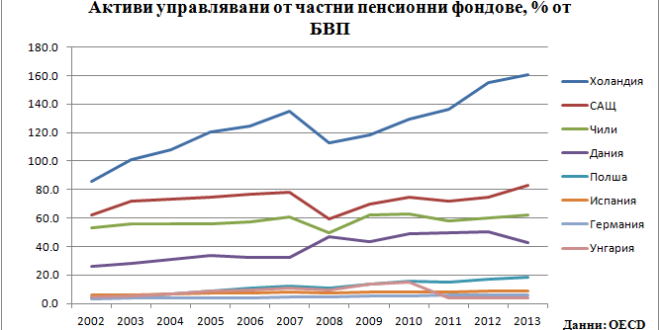
The average annual real return (calculated after removing the effect of inflation) of pension funds in Chile from September 2002 to December 2014 ranged from 4.19% to 6.91% depending on the fund that manages the funds. For the last 12 months, the average weighted real return of all funds is 11.4%, for comparison, the average nominal return on a deposit in Bulgaria in levs is already below 2.5%. The assets of pension funds in Chile at the end of December 2014 reached just over 165 billion US dollars or 69.5% of the country's GDP. In Bulgaria, the money managed by private pension companies is about 8 billion leva or just under 10% of GDP. If we look at the numbers internationally, according to OECD data, Chile ranks 8th in the world in terms of the relative share of assets managed by private pension funds in 2013, ahead of countries such as Ireland, Denmark, Spain and Italy.
Table – Indicators for pension funds in Chile
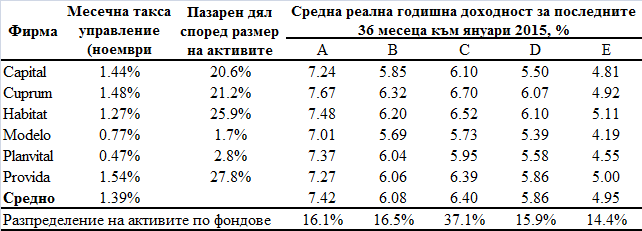
Source: Chilean Pension Regulator ( Superintendencia de Pensiones)
Advantages of the private pension system in Chile
For its existence of almost 25 years, the private pension system in Chile has brought and continues to bring a lot of advantages not only for the direct beneficiaries, but also for the entire country, i.e. there is the presence of the so-called positive externalities. For the users of the service, the private pension model gives the right of choice and the right of ownership over personal savings. These two characteristics are extremely important and their absence in the pay-as-you-go system creates an incentive for people to strive to pay as little as possible in insurance contributions (quasi-taxes) and receive the largest possible pension, for as long as possible (early retirement).
In Chile, every worker can monitor at any time what is happening with their money, where it is invested, what the profitability is in each individual month, and they are given the right to move their money to another fund at any time, which creates fierce competition between companies in the market. In addition, the existence of private pension funds allows each worker to determine their own retirement age, rather than relying on political decisions.
As for positive externalities, private pension funds save taxpayers money, since any pay-as-you-go system sooner or later starts to accumulate deficits due to the constant increase in people's life expectancy and deteriorating demographics. In other words, the revenues of the state pension system cannot cover the costs of insurance and the difference is filled by revenues from other taxes. As an example, the deficit of the National Social Security Institute (including costs for all social payments) for 2015 will be almost 5 billion leva, which is more than 11 times the budget allocated for education.
Last but not least, private pension funds save a resource (unlike the pay-as-you-go system, where the money collected from contributions is spent immediately), which is subsequently invested in the capital markets. Need we say that the capital market in Chile is the most developed and the most attractive for investors in all of Latin America? This creates a competitive resource to traditional bank lending for financing local companies, which in turn creates jobs and economic growth.
From the listed benefits, it is clear that such a system dominates both the economically and socially "competitive" pay-as-you-go system. Therefore, when populist proposals are put forward by politicians for a fundamental change in the pension model in Bulgaria, we should think carefully about what is the goal of such a move and what the consequences would be. The pension model in Bulgaria should increasingly move towards one based on personal savings if we want to guarantee ourselves a more secure old age and less dependence on politicians.
Sources:
International Monetary Fund (IMF) – www.imf.org
Superintendency of Pensions - https://www.spensiones.cl
Ministry of Finance – www.minfin.bg
Financial Supervision Commission – www.fsc.bg






Congratulations on the nice article!
I wonder if there is a mechanism to protect depositors in the event of bankruptcy of the pension fund in which they are insured?
Hello Ventsi,
I'm glad you like the article. The government gives pretty solid guarantees to those insured. I'm copying the text directly from an OECD document ( http://www.oecd.org/els/public-pensions/2429310.pdf )
"The government plays a role that goes beyond the supervision and regulation of the system. The pension system involves three types of government guarantees:
First, the government guarantees a minimum pension to affiliates. The minimum guaranteed is for pensioners that exhaust their accumulated funds in the case of programmed withdrawals, or if the income stream is lower than the minimum pension in the case of a life annuity. In both cases, recipients should have made contributions for at least twenty years.
Second, the government guarantees a minimum return in case that the AFP underperforms the limits imposed by the Superintendency. As was explained, a minimum return relative to the average performance of the system is expected of every AFP. They have to use their profitability fund and investment reserves in order to fill any shortfall in the rate of return. If the funds are insufficient to ring the actual return to the minimum level, the institution is liquidated and the balances of the individual capital accounts transferred to another AFP. In this case, the government covers the difference.
Third, the government guarantees pension payments to pensioners of any insurance company that becomes bankrupt."
The big question is who guarantees that the private fund will not go bankrupt and we've had enough of the Ponzi scheme with fractional reserve banking.
The topic is very big but things are known - http://www.iki.bas.bg/english/CVita/angelov/No218.htm - The world is already abandoning the so-called Washington Consensus and gradually adopting modern Keynesianism. I substantiated this need in my report at a scientific conference on October 8, 1999 at the Institute of Economics of the Bulgarian Academy of Sciences....The Bulgarian public (and not only it) was deceived for many years that Adam Smith was for the complete removal of the state from participation in the management of the economy and for its complete surrender to the market....
51% of the world's problems come from usury plus offshore, etc. deregulation of the financial "industry" - the 1999 repeal of the Glass-Steagall Act of 1933 for the separation of banking, etc. I wrote about it in the article in investor.vg under the code name atanasio and the topic is big because in addition to the financial catastrophe, two more planetary catastrophes are coming (the depletion of oil and the ecological one plus global warming)
This is a violation of the Constitution and GENOCIDE - https://www.facebook.com/atanas.shalapatov/posts/1562875143990714