EKIP– Expert Club for Economics and Politics A Different Opinion
Art Carden
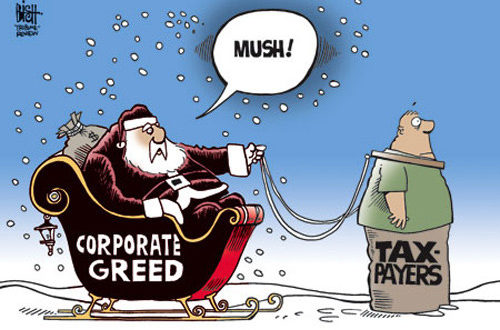
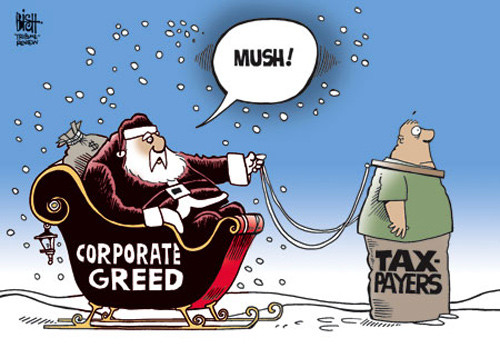
Are the motives of those who defend the “free market” the same as those who support “corporations”? Libertarian economists find this question frustrating because our enthusiasm for free markets is often confused with enthusiasm for particular industries or corporate interests. But just because something is good for General Motors doesn’t mean it’s necessarily good for society.
I suggest we break free from the rhetorical equation of "pro-corporation" and "free market." Or at least we should understand the difference between the two. One of the main characteristics of the free market is that it is a system of profit and loss. "Free" in the context of the market means free entry and exit. In a market economy, you are free to make and deserve huge profits as your just reward for having taken on the world as it is and produced some new good or service that makes that world a better place. In economists' language: you make a profit by creating wealth.
At the same time, you are free to enjoy great losses as a just punishment for having taken on the world as it is and produced something that actually makes it a worse place. In other words, you incur losses when you destroy wealth and squander resources.
Here I will refer to my friend Steven Horowitz's First Law of Political Economy: "no one hates capitalism more than capitalists." Matt Ridley says it well in his latest book, The Rational Optimist, and I agree with him:
"I do not support large corporations, whose inefficiency, complacency, and anticompetitive tendencies often drive me crazy, as do any other person. Like Milton Friedman, I observe that "business corporations are not, on the whole, the defenders of free enterprise. On the contrary, they are one of the chief sources of danger." They are addicted to corporate prosperity, they love regulations that raise barriers to entry for their small competitors, they crave monopoly, and they grow weak and inefficient over time.
Consider the following scenarios and ask yourself what the outcome of "pro-corporation" and "free market" decisions would be:
- A private company wants a piece of land on which to build a hotel, grocery store, shopping mall, or office building. The pro-corporate solution is to seize the land through expropriation and claim that the increased tax revenue is a public good (if increased tax revenue is going to be our standard, why not force labor to participate and have everyone sell their properties to special interest groups?). The free-market solution says, "If the owner wants to sell it to you, it's yours, but don't expect to be able to get government officials with guns to take it for you."
- A private company is struggling to make ends meet. It produces a product that no one wants to buy. The "pro-corporation" solution is to raise taxes and pass the proceeds on to the company or give them a low-interest loan. The "free market" solution says, "Either get better at what you do, or get out of the way of those who can."
- A private company faces competition from foreign producers. The "pro-corporation" solution is to regulate or tax foreign products to make them more expensive than the domestic product. The "free market" solution says "get better at what you do, or cede the resources under your control to those who can serve consumers better."
Do free market decisions sound harsh? Maybe. Is it cruel to leave the fate of a business to the vagaries of market competition? I don't think so. In a free market, people compete to see who can best secure the cooperation of others. Government, on the other hand, operates by threat of violence. If we are going to use government to protect business, we can do so only by threatening violence against its potential competitors.
I teach economics and write for several different online publications. If I were to insulate myself from foreign competition by hiring the mafia, hiring them to prevent foreign economists from teaching courses that compete with mine, or from writing articles that compete with mine, that would be a clear criminal act. Replace "teach economics" with "make cars," "mafia" with "government," and "foreign economists" with "foreign car manufacturers," and you have American industrial policy wrapped in the national flag.
In a free market, you are welcome and indeed encouraged to enter the mousetrap industry if you think you can make a better trap or find a way to make similar mousetraps more efficiently. The other side of the coin is that you will be encouraged to leave the trapping industry if it turns out that your mousetraps are not better, but worse.
"Free market" solutions are not the same as "pro-corporate" solutions. Businesses should not be protected from competition, losses, and bankruptcy. All three are essential to truly free markets and free enterprise.
Original text: http://www.forbes.com/sites/artcarden/2010/09/20/free-market-doesnt-mean-pro-business/2/
Translation: Maria Neeva