 EKIP– Expert Club for Economics and Politics A Different Opinion

About 10 days ago, it became clear to the general public that the government would issue new external debt worth 8.1 billion euros (16 billion leva) in the form of bonds within the period 2015-2017. This news polarized commentators and the public into two camps: defenders of the debt (mainly “right-wing” analysts and intellectuals) and critics of the debt (respectively, mostly represented by the “left”). However, this debate missed the essence of the question – is the issuance of new external debt justified at all and what are the threats from this action of the government.
As some of the defenders of the new debt point out, part of it will be directed to paying off old debts. According to the Updated Medium-Term Budget Forecast for the period 2015-2017, during this and the next two years, debts will be repaid and their servicing costs will be covered in a total amount of 14 billion leva, with the remainder up to 16 billion leva supposed to go to paying off budget deficits. Many correctly point out that the debt issued by previous governments and the interest on it, which matures in 2015, 2016 and 2017, must be repaid and this is a budgetary obligation from which there is no escape. It is also true that market interest rates at which the state issues debt are low as of mid-February – the interest rate on 10-year debt in euros is 2.25%, and the interest rate on 2-year debt in euros is 0.8%. And it is not mandatory to withdraw the entire amount of debt.
According to those who accept the idea of debt as prudent, by issuing new debt for the next three years, its total level will not increase, but will remain at the same level. Some even suggest that “savings on interest costs can be achieved precisely because of the new issues, which have record low interest rates.” As can be seen from the projections in the Updated Medium-Term Budget Forecast for the period 2015-2017, despite nominally lower interest rates, the opposite will most likely happen. Interest on external debts for the period is expected to increase relative to gross domestic product, and their growth will come precisely from interest on external debts:
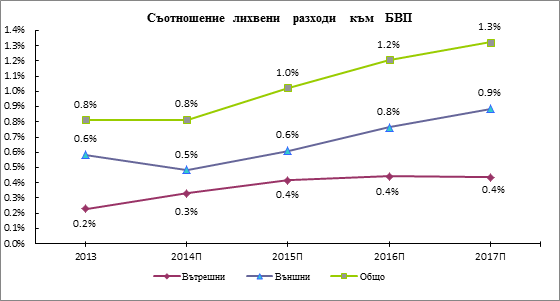
Source: The updated medium-term budget forecast for the period 2015-2017.
Why we don't need new debt
But even though most of the new debt in this and the next two years will be spent to cover old obligations, and even if economists' forecasts come true (i.e., interest rates on debts fall), we still have two objections to uncritically ignoring budget deficits and issuing debt as a way to repay old payments.
First, the idea of budget deficits is something that any pro-market person should presumably criticize. A larger government budget means that more money will be taken from individuals and redistributed. So in practice, in the real economy – i.e. the private sector, which is the real producer of wealth – there is less money left, other things being equal. The direction of this distribution is mostly towards the administration itself and towards unproductive (and often populist) projects, [1] such as the rehabilitation of the panel blocks, [2] as well as towards companies and organizations connected to the government. Respectively, defenders of the free market should defend moves to liberalize the market, and not try to argue for debt, which will simply increase the ineffective policies of the government at the expense of taxpayers and will lead to even greater state intervention in the economy.
Second, although the debt that previous governments have accumulated must be repaid when they mature (as well as the debts that will mature in 2016 and 2017), this is again no argument in favor of taking on more debt. First, even if the assumption is made that the new debt will not increase the total amount of debt to GDP – as the government’s data predicts – it is still debt. Although the interest on it is lower than on other old debts, it will again be borne by taxpayers. In other words, in this case too we will have a withdrawal of funds from the productive sector and from individuals, who will be forced to pay loans that they did not take out themselves and which will most likely be spent counterproductively. That is, we are not solving an economic problem here, but rather perpetuating it, to the extent that interest rates on government loans are negative for the economy as a whole. Secondly, taking on new liabilities is not the only way to finance old ones. The correct action for the government in this case – and in any other case when it comes to debts – would be to finance its old liabilities by privatizing state-owned enterprises, organizations (for example, museums and hospitals), services (education, pension savings and health insurance) or by stopping some of its pointless and expensive activities, rather than by continuing to burden taxpayers with debts.
In the debate over the debt, no real pro-market proposals were heard. The idea of the exact opposite is implicitly creeping in – the coalition between GERB and RB will most likely abdicate from implementing proper reforms, which is evident from the budget deficits set for this and the next two years and from assuming debt for a period of 3 years. And this is precisely the position that the “right” experts should defend, instead of commenting on how the new debt will be harmless and even beneficial for the economy: to reduce the role of the state in the economy and reduce government debts on the shoulders of voters.
[1] Friedrich Hayek's arguments about the problems of knowledge, as well as Ludwig von Mises's theory of the problems of economic calculation, can be fully applied here. They lead unambiguously to the conclusion that state administrators fundamentally cannot know what consumers want in the market and their policies will always be economically inefficient. Public choice theory is also valid here, according to which officials themselves also try to maximize benefits for themselves, and not for the supposed "consumers" of their "service".
[2] We have already described the negative effects of this policy. You can read more about it here.






It is known in economic history as the so-called Keynesian investment multiplier. He claims that when some money is given for pensions and salaries of civil servants or in another non-productive sphere, the result is that 1 lev creates 0.3 - 0.8 leva of GDP growth, while when this leva is invested in new production or infrastructure, i.e. as a government order, then 1 leva can create between 2.5 - 3 leva of GDP growth.
The big question is what to invest in and where the money will come from.
, and I have described everything in comments 1-7 here - http://darikfinance.bg/novini/112887?&order=asc#comments
The Keynesian multiplier is popular, yes, but it is actually based on a mathematical formula that has nothing to do with economics or reality. That's why I consider it a hugely flawed concept.
My idea is to inform more people about the coming 3 planetary catastrophes in order to pressure the government to take measures and monitor what is being done - http://atanasio.blog.bg/drugi/2013/09/16/otvoreno-pismo.1148972
The problem with oil is that there is a technological time of at least 15 years for the transformation of agriculture, energy, and transportation, and it cannot be 100%, meaning we have to keep oil for centuries to come.
According to experts, we can give up up to 90% and I put it at 80%, that is, if 32 billion barrels are currently consumed annually, by 2030 consumption must fall by at least 60%.
The US - 320 million consumes more oil than China and India combined
The ecology and global warming are also scary, and I don't even feel like talking about finances - 320% total debt to world GDP, with the best performers being the USA and the EU with over 300% to GDP, etc. A distinction must be made between financial and industrial capitalism, and deregulation
The 3 planetary catastrophes can be avoided if immediate and correct measures are taken
We need a ''round table'' at the UN and a change of system towards sustainable development - RESOURCE-BASED AND PLANNED ECOLOGICAL ECONOMY
You are right from an economic point of view. No matter how they dress this debt, the following is clear:
1. Even the thesis that this money is needed to "roll over" the debt - it's too much! (16 billion). Let's not forget the budget surpluses.
2. Running a deficit is disastrous, and even with all the empty talk about the economic crisis, it is known that a large part of this money will be stolen in the form of wasteful and unnecessary spending in the budget.
3. This burden is capable of plunging the entire country into the debt spiral in which Greece is already in.
4. I see that people are idiots (without any economic culture), but hunger teaches best. Destruction will come upon us with all its might, and if you think that the situation is bad now, look what will happen in 1-3 years.
After all, everyone pays for their mistakes 🙂