 EKIP– Expert Club for Economics and Politics A Different Opinion
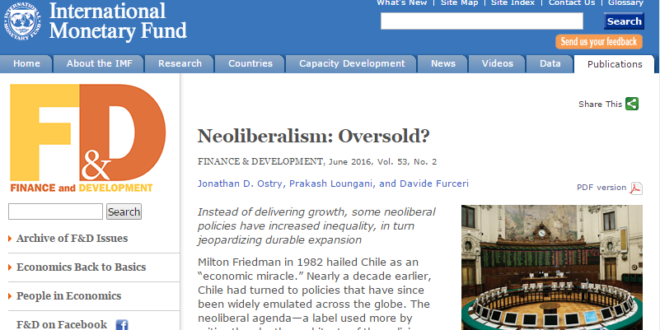
 Миналата седмица списанието Finance&Development (F&D), публикувано от Международния валутен фонд, се превърна в любимо четиво на левичарите по цял свят. Опитвайки се да не забелязват случващото се във Венецуела, почитателите на плановото стопанство започнаха да разнасят статията от F&D, носеща много значителното заглавие “Неолиберализъм: надценен?“[1], доволно потривайки ръце, че видиш ли сега вече я пипнаха тая Айн Ранд.[2]
What's actually in the article?
To begin with, what is written is not an official position of the IMF, it is not a detailed report on the "evils" of the free market, but a short, almost journalistic essay by three left-wing economists working at the Fund. In any case, it is even surprising that the IMF still holds somewhat pro-market positions, given the academic environment in the Western world (from which it draws its economists) and the fact that it is run by a French politician.
The text begins with a definition of neoliberalism as the opening of markets (including financial markets) to international competition and the reduction of the role of the state, combined with smaller fiscal deficits, less debt and privatization. It is correctly noted that the term “neoliberalism” is used mainly by opponents of the above-described ideas of a free market and a minimal state, which we cannot help but perceive as a form of self-admission on the part of the authors.
They continue their exposition with what (in their opinion) we can applaud the market and competition for - little things like: " saving millions from humiliating misery", "transferring know-how and technology to developing economies", "efficient delivery of a range of services thanks to privatization", "reducing the fiscal burden on governments". They then tell us that they will specifically focus their criticism on two aspects of what they define as "neoliberalism" - the free movement of capital and the policy of reducing fiscal deficits (popularly known as austerity). We are left wondering whether an article entitled "Free movement of capital: overrated?" would have pleased the global left so much. Let us consider the two main lines of criticism.
Foreign investments – can they create crises?
It is known from the theory that open international capital markets allow economies to grow significantly faster. Developing economies benefit from borrowed capital, while investors receive a better return on new markets. The main way for rapid economic growth in places like Bulgaria is through maximum openness to capital movements and good conditions for foreign money to remain. And this is without mentioning other valuable imports for long-term economic development (coming with investments) such as human capital, business culture, know-how, technology, etc. This is not disputed in the article.
The authors are concerned about the "fast, speculative capital", which since 1980 (as the study cited in the text shows) can be associated in 20% of cases with some form of financial crisis. There is hardly any room for doubt in the data, but the idea that the crisis (in 1/5 of the cases) is caused by the very free movement of the so-called "hot money" is strange. Financial bubbles do not arise from the ability to freely handle our money - rather, the fault lies with regulatory and especially monetary policy. And the perfect way to avoid the effects of speculative capital (which comes and goes) can be found in North Korean autarky - where there are no investments.
The other problem with the free movement of capital, according to the authors, is the inequality created by the influx of investment into developing countries. In other words, when we are all mired in the misery inherited from the planned economy, some investors come, build enterprises, and those of us who have jobs in the new enterprises are no longer “equal” with our still poor fellow citizens. Calling this “problematic inequality” is acceptable only to people in the leftist ivory tower.
Over-indebtedness – no problem?
The topic of investment and free movement of capital is followed by truly astonishing passages trying to say that the over-indebtedness of Western European countries is not such a problem – despite the situation in Greece, despite the European Central Bank having already fired all its monetary bullets to stop defaults in Italy and Spain, despite the anemic economic growth. It seems that until the situation becomes “Greek” we can calm down and think that everything is fine.
In line in meaning – Great Britain with 90% government debt to GDP, France with 96%, Spain with 100%, Italy with 132%, levels that have been seen in recent centuries only during wars and the size of the first and second world wars. If we also count unfunded liabilities (promises for pensions and social payments) we move to debt levels in the hundreds of percents of GDP.
With evasions like the fact that a drop from 120% to 100% debt/GDP led to a very small reduction in credit risk. With statements that contradict their own thesis – for example, that the markets give a smaller chance of credit default to countries with a better financial history. Or with the claims that instead of budget surpluses, it is better for countries to cover debt with higher economic growth – which will somehow pop up out of nowhere. The authors fail to prove to us in any way that budgetary discipline or even more so the scarecrow of “neoliberalism” are overrated. It would be curious if what is written in the article is really the official position of the IMF – when should we expect the Fund to be withdrawn from the Troika in Greece or the covering of all the obligations of the Greek budget, just like that, without any requirements for reforms.
It is not surprising that leftists (mainly people with poor economic literacy) are rejoicing over the "end of neoliberalism", but it is a little strange that such click-bait headlines are published by a serious institution like the IMF.
[1] Neoliberalism: Oversold?
[2] In fact, the authors of the article are targeting the ideas of Milton Friedman – unlike our leftists, they know the difference between an economist and a novelist.





Let's not forget that we are still talking about IMF experts.
,and a distinction must be made between neoliberalism in industrial and financial capitalism
The functioning of the economy without politics is impossible, that is, neoliberalism, especially in financial capitalism, is a crime against humanity, although "they" made it legal with the 1999 repeal of the "Glass-Steagall" Act of 1933 for the separation of banking and other thefts with "backdoors" are a separate topic, as is the manipulation of LIBOR, with which about 8 trillion were stolen and they were fined some ridiculous amounts.
Prof. Ivan Angelov in his book ''World Economic Crisis and Bulgaria'' finally summarizes it well, that we need a regulated market economy, but now that we know that oil and gas are running out, we need to plan according to the available resources on Earth and according to water, because it is also running out slowly through photosynthesis, but 50% of food is thrown away - in short, we need a resource-based and planned ecological economy, otherwise chaos and wars will follow.
IT IS NECESSARY TO UNDERSTAND THE SYSTEMIC CRISIS BECAUSE OF WHICH CAPITAL PENSION SYSTEMS WILL FAIL, ETC. I HAVE EXPLAINED IT - https://www.facebook.com/atanas.shalapatov/posts/1752811994997027
I don't even want to comment on your article, but only the inconsistency in the use of used and indicated links, which I have observed not for the first time - the article in WaPo is linked, and immediately after it sources are indicated that are not. Inconsistency is inconsistent, no matter what local rural online marketer "trained" you to do so - links to sources are implemented for other basic reasons - for correct identification of the source, known as verification, as well as for the convenience of every user who is not just scrolling, but is interested in the topic in some depth. And yes, if by chance your motive is "for whose convenience should we create conveniences" - you are only reinforcing your amateurism like this!
Level up, beecheez !
What convenience didn't we provide you that you so deserve and are screaming for 😀
Here is the original report - http://www.imf.org/external/pubs/ft/fandd/2016/06/ostry.htm
THE MAIN THING THAT ECONOMISTS AND FINANCIALISTS NEED TO UNDERSTAND IS THE SYSTEMIC CRISIS
Time is wasted by not understanding the problem, which means that chaos and wars can occur over time IF THE RIGHT MEASURES ARE NOT TAKEN, and that is why I am writing to inform more people, and they, in turn, more people, as a geometric progression, with the goal of a strong civil society that demands that the government take the right measures.
In short, leaving aside the topic of division and productivity of labor, the crisis is systemic because economic growth cannot be infinite, because the final demand from the state and citizens cannot be infinite in a closed system like the Earth, and because of exhaustible energy sources (oil, gas...), and because of global warming - in other words, in order to have infinite growth, we need another Earth and tens of billions more people/consumers of goods and services.
BUT the current structure of the global financial system due to usury, etc., yields on stocks and bonds require endless growth, and since this is impossible, a new "system" and a systemic approach are needed - a resource-based and planned ecological economy.