 EKIP– Expert Club for Economics and Politics A Different Opinion
Highlights:
- Growth slowed across all sectors in June, but the average for the first half of the year was significantly higher than that reported in 2016
- Despite the slowdown, the growth rate in all sectors in our country remains above the EU average
- The recovery in the construction sector continues at a strong pace, but there is a risk of bubbles forming
- Inflation continues to weaken, lending data shows mixed dynamics in June and July
- The business climate is deteriorating in all sectors except industry
Manufacturing industry growth slows, mining industry growth accelerates
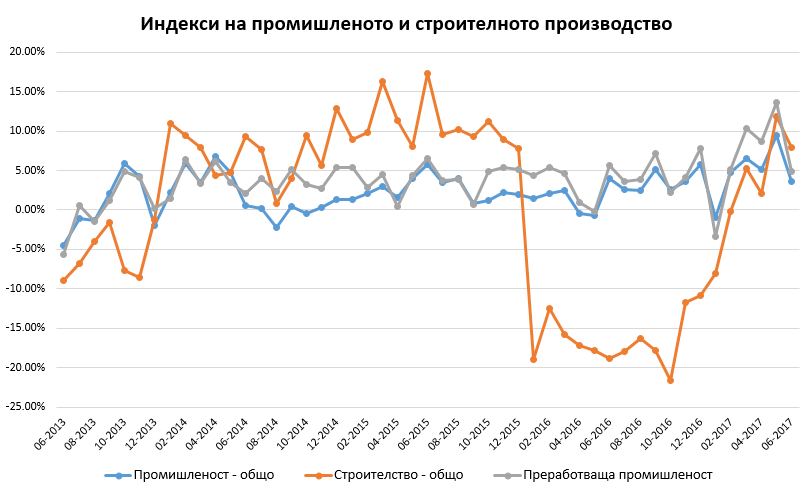
In June, industrial production growth slowed significantly and reached 3.58% on an annual basis, which is the lowest level since the beginning of the year. This in itself is not a cause for concern, however, especially in the context of the record growth level for the last 6 years, which was reached in May. The longer-term trend is important, and it has been very positive in the first 6 months of 2017. If we take a look at the data for the entire EU, we see that despite the significant slowdown, industrial production growth in our country remains above the average for the union, which was 2.9% in June. Overall, however, we are lagging behind in the ranking and from 5th place in growth in May we fall to 15th in June.
Source: NSI
The slowdown is mainly due to the weakening of production growth in the manufacturing industry to 4.87%. This is the lowest level recorded in this sub-sector since January. However, the dynamics are not entirely negative, because while production in the manufacturing industry is weakening, that in the mining industry is strengthening and growing by 7.58% in June. Therefore, despite the slowdown in growth in the manufacturing industry, the condition of the industrial sector as a whole continues to be very good. The average growth rate in the sector for the first 6 months of 2017 is 4.73%, which marks a significant improvement compared to the average level of 1.48% for the first half of 2016.
Growth in the construction sector also slowed, but not as dramatically. The construction production index rose by 7.94% year-on-year in June, compared to 11.90% in May. This slowdown was due to lower production growth in both building construction and civil/engineering construction. Despite the slowdown, there is no longer any doubt that the sector has fully recovered from the period of falling production that it entered in 2016. The improvement in growth in the sector in the first 6 months of this year is so significant, especially in building construction, that it even raises doubts as to whether it is the result of some kind of bubble in the property market.

Source: NSI
In the coming months, we will closely monitor developments in the construction sector for possible indications of bubble formation and potential "overheating" of growth in the sector. The possible formation of a bubble in the construction sector is something that we have already discussed on our national television. In the context of still record low interest rates in the Eurozone, it is entirely possible that a surge in investments as a result of high levels of liquidity and a rise in lending could lead to overpricing in the property market and the undertaking of unprofitable construction projects.
If such a bubble is forming (or has already formed), it could burst very quickly, the moment the ECB changes its monetary policy and starts pouring less and less liquidity into the banking system. Something that is expected to happen in the near future, given the recent improvements in a number of economic indicators in the Eurozone.
The dynamics of industrial turnover are similar to those in production
 Source: NSI
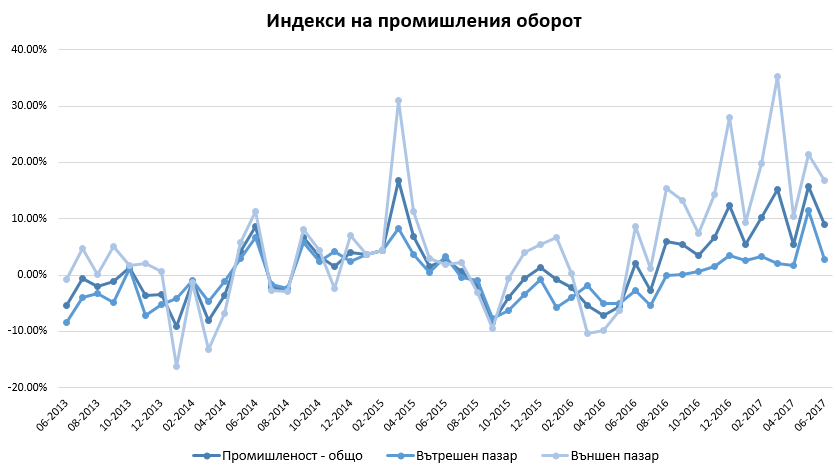
The slowdown in industrial production is logically accompanied by a slowdown in industrial sales. The NSI’s industrial turnover index rose by 8.96% year-on-year in June, slowing from the 15.74% growth recorded in May. This slowdown in the sector is mainly due to a weakening in sales growth in the manufacturing industry, whose growth rate halved to 10.46%. Meanwhile, sales growth in the extractive industry almost doubled to 15.60%. Overall, the dynamics are very similar to those in the production data.
On a geographical basis , the slowdown in sales growth is mainly due to weaker turnover on the Bulgarian market. The data shows that sales in the sector in our country increased by 2.68% in June, which, although a higher growth rate compared to most months in the first half of the year, is significantly behind the impressive 11.45% reported in May. Meanwhile, turnover growth in the foreign market slowed by almost 5 percentage points to 16.85%. Overall, here too, despite the slowdown in June, the data for the first half of the year are strongly positive. The average growth rate in the first 6 months of 2017 is 10.16% on an annual basis, compared to -3.20% in the first half of 2016.

Source: NSI
It should be noted that the growth of domestic turnover in May was to some extent influenced by a base effect, which contributed to its (temporarily) significant acceleration. NSI data show that throughout 2016, the index of industrial turnover in the domestic market reached its lowest level precisely in May. The low level of the index in this month is an exception not only compared to the trend in the remaining months of 2016, but also to every May of the previous few years. In this context, the slowdown reported in June this year does not seem as serious as it might seem at first glance.
Retail growth continues to be significantly above the EU average
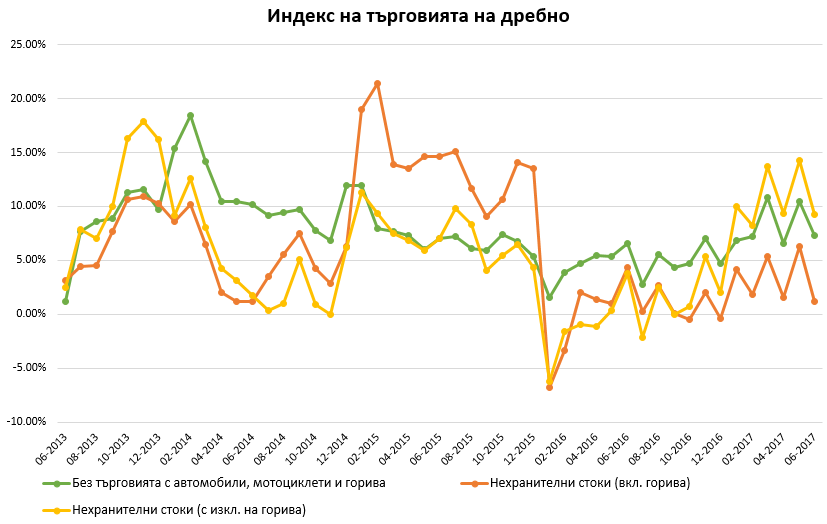
Growth is also slowing in retail trade. Retail trade excluding motor vehicles, motorcycles and fuels grew by 7.33% year-on-year in June, compared to 10.42% in May. However, compared to the rest of the EU, retail trade growth in Bulgaria continues to be higher than the EU average of 3.0% in June, and overall, the long-term trend in this sector remains strongly positive. In the first half of 2017, the average growth rate of retail trade excluding motor vehicles, motorcycles and fuels was 8.20%, compared to 4.61% in the first 6 months of 2016.
Source: NSI
Trade in non-food goods (excluding fuels) slowed to 9.23% in June, after reaching its highest level since 2013 in May. Despite this slowdown , the growth rate in this category of goods in our country continues to be significantly above the EU average, which is only 3.9%. Sales of non-food goods (+ fuels) also grew at a more modest pace of 1.18% in June, the lowest recorded since the end of last year.
The fastest growing category is retail trade in computer and communication equipment, which with a growth of 16.2% again takes first place after a temporary lag in the previous two months. In second place in terms of growth is trade in miscellaneous goods, which grows by 13.9%, and in third place is that of household appliances, furniture and other household goods by 8.5%. A decrease in sales was recorded in retail trade in automotive fuels and lubricants, which fell by 16.2% on an annual basis.

Source: NSI
Inflation continues to weaken
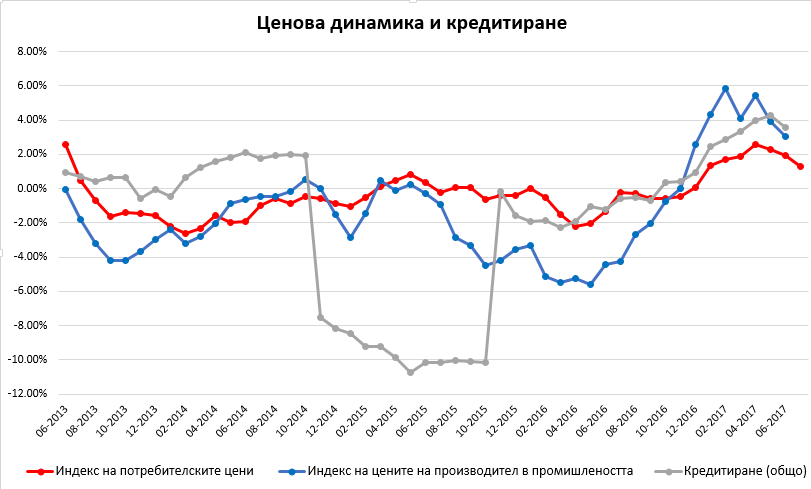
According to the latest NSI data, the weakening of inflation continued in June and July, both in consumer prices and in producer prices. Inflation in the consumer goods index slowed to 1.28% in July, while in June that in the industrial producer price index weakened to 3.03%. Both inflation levels are the lowest recorded in the respective sectors since the end of 2016.
NSI data show that inflation is slowing significantly in both food and non-food consumer goods. For food goods, it is 2.41% in July, while for non-food it falls to 0.34% on an annual basis. In the meantime, however, there is a serious acceleration in service price inflation to 0.83%, which is the highest level recorded since September 2015.
Source: NSI, BNB
Inflation in transport prices also slowed significantly for the third consecutive month to just 0.37%. This is another factor contributing to the lower inflation in the overall consumer price index. At the same time, however, prices of housing, water, electricity, gas and other fuels are growing at a faster pace and inflation in them reached 3.39% in July. This is probably due mainly to the increase in oil prices in the past month.
Inflation in producer prices slowed in June, mainly due to lower growth in energy prices, which was 1.91% in the same month. This is fully expected, given the sharp drop in oil prices in June. However, as mentioned above, this drop was followed by a rapid increase in July, so we can expect energy inflation to rise significantly.

Source: NSI
At the sectoral level, price inflation in manufacturing slowed significantly to 2.84% in June, the lowest level in 7 months. The price dynamics at the sectoral level in industry as a whole are very similar to those of production and turnover. While inflation in manufacturing slowed, that in mining accelerated and reached 8.70% on an annual basis.
In general, inflationary trends in our country continue to follow those in the EU. We recall that lower inflation is no cause for concern and is even generally a positive development, which eases the costs of enterprises and stimulates consumption. In addition, mild deflation is a sign that economic productivity is growing and, other things being equal, means an increase in the real incomes of the population - all positive developments.
Lending growth appears to be stabilizing
Turning to lending, we notice that it slowed down in June, which was followed by an acceleration in July. The level of credit granted as a whole increased by 3.57% in June - consumer credit grew faster, while lending to non-financial corporations increased by 2.10% on an annual basis - a significantly lower level than reported in May. In July, the dynamics were reversed - the growth in lending as a whole slightly accelerated, but due to higher lending to non-financial corporations, while the growth in lending to households weakened. The growth of lending to households and NPISHs slowed down for the first time since the beginning of the year in July and reached 5.49%. Overall, the data on lending in June and July hint at a stabilization in growth rates.

Source: BNB
A more detailed breakdown of the BNB data shows that the level of consumer credit continues to be much higher than that of housing loans, but their growth rates are quite similar – close to 5% in July for both types of loans. Lending has been accelerating at a remarkable pace in the first half of this year, which is a positive development, but it should not be forgotten that there is a risk of bubbles forming, especially in the property market.
A key factor for the future dynamics of lending is the ECB's monetary policy. Many experts expect Mario Draghi to soon begin tightening the central bank's monetary policy and reduce cash injections into the European banking system. If this happens, lending in the Eurozone will drop dramatically, which will accordingly have an effect on lending in Bulgaria, due to our country's economic proximity to the member states of the monetary union, as well as the fact that due to the fixing between the euro and the leva, the BNB must follow the ECB's monetary policy.
Entrepreneurs' expectations for the coming months are worsening
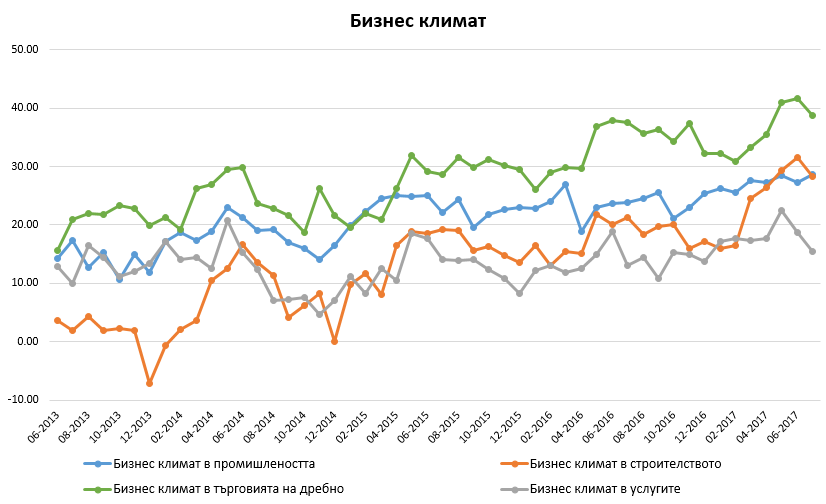
NSI data on the economic situation show that in July the business climate worsened in most sectors, with the only exception being industry, where a very slight increase was reported.
Source: NSI
The business climate in the industrial sector increased by 1.3 points to 28.6 in June, mainly as a result of entrepreneurs' improved assessments and expectations of the business situation of their enterprises. However, their forecasts regarding exports and production activity in the next three months are less favorable and entrepreneurs expect selling prices in their sector to remain unchanged from the current level in the next three months.
In the construction sector, the business climate fell by 3.2 points to 28.3 due to the deterioration of entrepreneurs' expectations for the future state of their enterprises from "better" to "remaining the same". The NSI survey reports an improvement in current construction activity and the forecasts of businesses in the sector for the next three months generally remain favorable, although they are more reserved compared to those in May. The survey indicates the uncertain economic environment as the main factor hindering the development of enterprises in the sector. No change in sales prices is expected in the next three months.
The situation is very similar in retail trade where the business climate also fell by 2.9 points to 38.8 in July due to worsening expectations of entrepreneurs for the next six months. This deterioration is recorded despite the fact that entrepreneurs' expectations for the volume of sales and orders to suppliers for the next three months have slightly improved. The uncertain economic environment, competition and insufficient demand are cited as the main obstacles to the development of enterprises in the sector, but in July a decrease in their negative impact is observed.
Last but not least, the business climate in the "services" sector is also deteriorating, most significantly by 3.3 points and falling to 15.4. This is due to the same factor that is causing the deterioration of the business climate in construction - entrepreneurs' expectations for the state of their enterprise are shifting from "better" to "the same". Entrepreneurs' assessments of the current level of demand in the sector are also more reserved. Here too, businesses expect to maintain the current level of their selling prices in the coming three months.





"Territory without deception" - we make the Internet safer! You are the future owner of earnings of 6000 rubles per day! "Mediator" is an elementary simple and completely reliable service for earning money, which will suit everyone.