EKIP– Expert Club for Economics and Politics A Different Opinion
Author: Hristian Atanasov
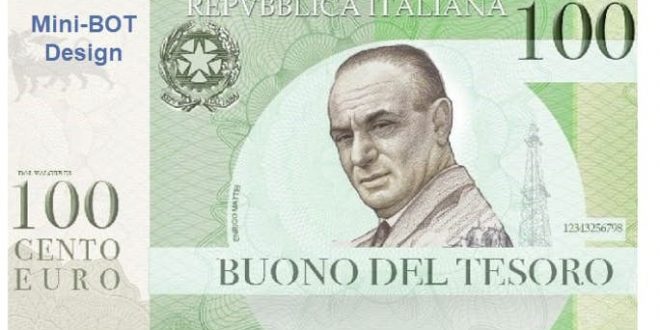
About a month ago, The Wall Street Journal published an article explaining the intentions of the Eurosceptic parts of the Italian political sector to issue mini-bonds (mini-BOT from Buoni Ordinari del Tesoro – i.e. lit. “small ordinary treasury bonds”) with a face value of €50 [1], according to other sources €100. The idea of the Italian Eurosceptics was also relayed on Bulgarian websites and, according to them, the interest-free bonds in question will represent money that: “will not constitute competition to the euro, but will be accepted within Italy for payment of any goods and services , if the payer and the recipient of the payment agree to use these papers as a means of payment”. What was written was also an occasion for active debates, including in Bulgarian social networks. Without my aim being to serve reheated mandis to readers, I will try to examine the case through the prism of a historical example from the Balkans.
What Italian politicians are practically proposing is the issuance of money parallel to the euro, to be used by the state treasury to alleviate the deficit, for internal payments, etc. Leaving aside the reaction of a number of financiers, according to whom this is the beginning of the end of the euro, I will remind you that this practice is not new at all and examples of its application, some of which are successful and others disastrous, can be taken from both recent and more distant financial history. Here I will present a similar example from the Balkans (from the 1840s) and specifically Constantinople. At that time, more or less the same case was present. There was an almost permanent government deficit and increasing debt (as in Italy), a gold-silver standard with a fixed exchange rate between the golden Ottoman lira and the silver grosz (similar to the euro, which is a kind of standard) and a corresponding intention of the Ottoman government to issue small-denomination bonds that would bear interest and be used by the population as money. Later, these bonds were also issued without bearing interest – as paper money, circulating in the markets along with gold and silver, and accepted for tax payments (which is also the idea of the Apennines).
A few words about the Ottoman monetary system
I will look back and see that in 1844, the Ottoman Empire adopted a bimetallic standard and the gold lira and the silver grosz became the main monetary units. The price of the lira was fixed and amounted to 100 grosz. It was strictly determined that the gold coin should weigh 7.216 grams and, accordingly, be of 91.67% purity, or in other words, each gold lira contains 6.6 grams of the precious metal. It was determined that the silver grosz should weigh 1.2027 grams and be of 83% purity. Thus, each grosz contained one gram of pure silver. It was also normatively determined that the ratio between the two precious metals (the so-called gold/silver ratio) should be strictly maintained at 15.09. In other words, the Ottomans adopted a clear monetary system, defined by many researchers as a reliable guarantor against inflation.
On the other hand, the stability of the monetary order does not mean that the Ottoman finances are in order. Budget deficits permanently plague the state treasury. The adoption of the above standard does not allow the Ottomans to devalue their coins. Something they willingly did in previous centuries in order to be able to finance the deficit in the treasury. Internal loans are also limited, as local capital is insufficient and this will result in the first external loans from the 1850s, which in perspective will lead to the bankruptcy of 1875.
Thus, the lack of fresh capital to service the government's expenses led the Sublime Porte to start printing paper money (the so-called kaime ). The aim was, in addition to the profit from seigniorage, to ease the payments of the treasury, to encourage internal trade, to alleviate the shortage of coins for daily purchases in the Ottoman markets, and to strengthen state finances in general.
The first journey into the world of paper money [2] took place through the issuance of securities
The earliest kaymets were handwritten and were put into circulation in 1840. They were in denominations of 50, 100, 250 and more groschen and carried an annual interest rate of 12.5%, with a maturity of eight years. These kaymets were also a means of payment – just like gold and silver coins. Between 1840 and 1844, merchants in Constantinople willingly accepted them and they circulated and were exchanged for coins. Until 1852, their circulations were limited, and accordingly they performed well in the markets.
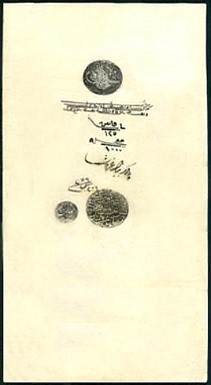
Kaime ( kaime) – manuscript, denomination 1,000 groschen. Source: http://www.numismondo.net/pm/tur/index1.htm
From this year, interest-free kaimetas were put into circulation for the first time. They were of smaller denominations – 10 and 20 groschen. The aim was not only to stimulate daily purchases and sales but also to provide new revenue for the budget. In 1853, the total mass of paper money was 175 million groschen. When large runs of kaimetas were put into circulation during the Crimean War (1853-1856), one gold lira began to buy about 200-220 groschen in kaimetas (or its real value fell to half of its face value). Paper money was constantly depreciating and merchants in the markets of Constantinople refused to accept them.
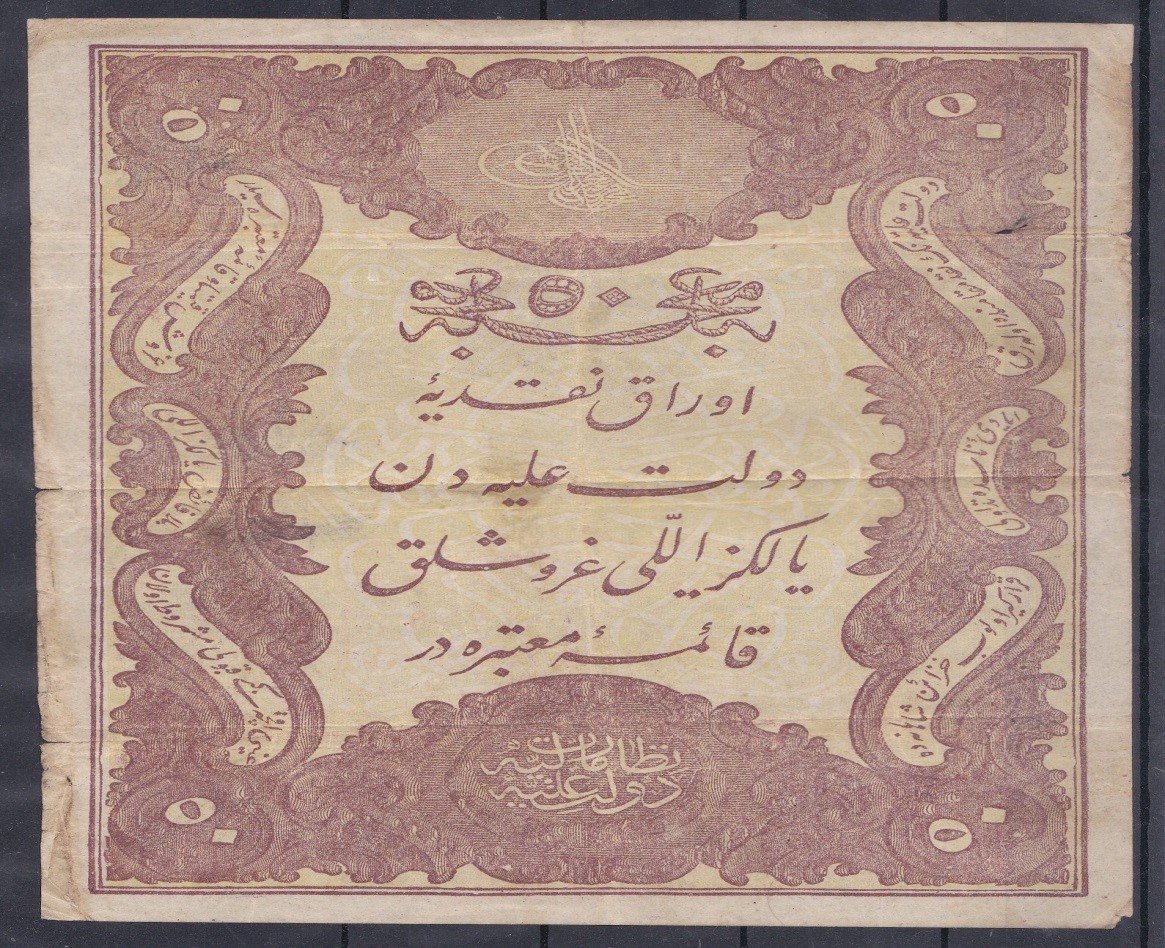
Kaime ( kaime) – printed, denomination: 50 groschen, 1876. Source: https://www.pinterest.com/pin/67272588161716283/
On this occasion, on July 19, 1858, the Bulgarian "Tsarigradski Vestnik" wrote: "The holidays of Kurban Bayram have completely weakened the movement of the market ( i.e. the market ) for everything that concerns goods that come from abroad. On the other hand, the increase in money has greatly damaged sales, and the merchants, as can be seen, are determined not to take kaime, and do not want to sell except with metal coins only." The inflationary trend continued in 1861, the circulation of kaime already reached 1.250 million groschen and its price fell to 400 kaime for one gold lira. The following year, due to public discontent, the government withdrew the kaime with the help of short-term loans from the Imperial Ottoman Bank. In 1876, however, there was a new issue of the kaymet - after the bankruptcy of 1875 and with war with Russia knocking on the door in 1877-1878.
A few words in conclusion
Italy is obviously facing similar financial problems, as those in the Ottoman Empire in the second half of the 19th century. It is clear that the Italian government cannot start printing money – there is another kind of standard (the common European currency) and accordingly there is no way to cover its budget deficits in this way. Reforms both then (for the Ottomans) and now (for the Italians) prove to be a difficult path in the search for balancing the budget and servicing debts. Loans remain – internal and external and respectively another way to “release the money” and alleviate at least the internal debts. This other way is the issuance of parallel money. The Ottomans initially issued interest-bearing securities, which were also used as a means of payment, and as a second “stage” already directly printing money to circulate together with the “regular” ones (in the Apennines they are directly thinking of doing this) – in the Ottoman case the lira and the grosz, in the Italian case: the euro. With the caveat that this is just an idea with regard to Italy, based on the Ottoman experience we can assume what will happen with the mini-BOTs in question.
In the short term they will probably be successful. There should be no major problem in making them a means of payment – i.e. Italian money that will work alongside the euro. In the long term, however, I am convinced that the government will issue them more and more and they will inflate accordingly. Will this be the end of the euro? I am generally against making long-term predictions based on historical experience [3]. The Ottoman bimetallic coinage system coexisted with paper money at certain periods without visibly suffering from it – almost until the end of the empire, when the standard collapsed. So let's see what happens.
[1] Link (23.07.2019): https://www.wsj.com/articles/italy-short-of-euros-flirts-with-a-different-way-to-pay-11560178888
[2] If I may paraphrase the title of the book by my good friend and colleague Orlin Sabev. See Sabev, O. The First Ottoman Journey into the World of the Printed Book (1726 – 1746). S., 2004.
[3] Nassim Taleb has very convincingly demonstrated how stupid they can be.