 EKIP– Expert Club for Economics and Politics A Different Opinion

The introduction of the euro usually breaks fiscal discipline, causing government debt to rise. This phenomenon has been observed for a long time, since the very creation of the eurozone in the countries that founded it.
Debt burden of a country
The ratio of public debt to gross domestic product (GDP) in a country is the most appropriate indicator for presenting the debt burden. This indicator (not so much the nominal amount of debt) is the most correct for measuring and comparative analysis of the debt burden. If the economy is larger, it will be able to bring in greater tax revenues to the budget, which in turn would provide funds to cover interest payments and principal payments on the public debt. Simply put – a larger economy can support a larger public debt.
This is why the debt-to-GDP ratio allows for comparison between economies of different sizes. This ratio illustrates the debt burden not in terms of the size of the debt itself, but in terms of its “bearability” for the economy in question.
Euro and indebtedness in the “old” member states
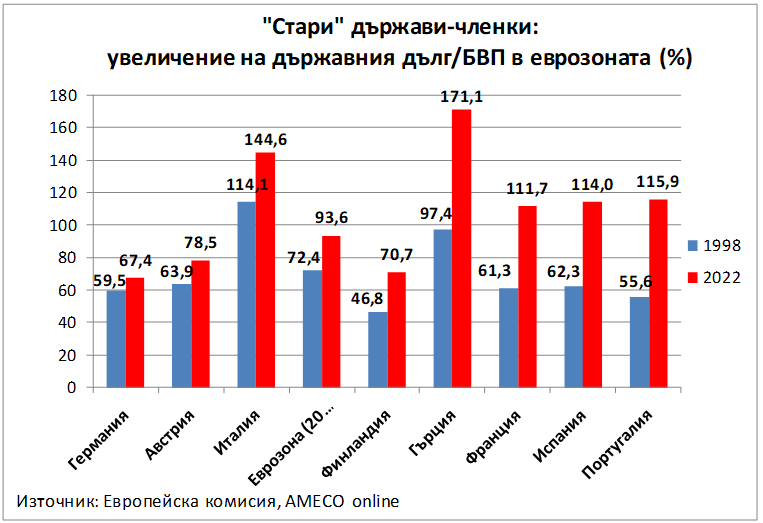
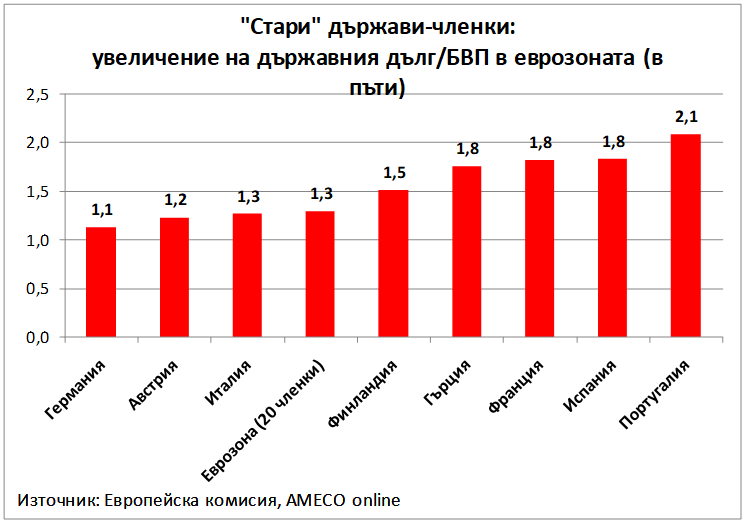
The negative trend of indebtedness is evident in the countries of the so-called "periphery" of the eurozone. For example, in Spain, public debt as a share of GDP in the last year before the creation of the eurozone (1998), when the country was still using its national currency, was 62.3%. At the end of 2022, Spanish debt already reached 114%. This is a 1.8-fold increase.
The development between 1998 and 2022 is similar in Italy – an increase from 114.1% to 144.6% (or 1.3 times), Greece – an increase from 97.4% to 171.1% (1.8 times) and Portugal – an increase from 55.6% to 115.9% (a full 2.1 times).
Although less visible, a similar process of increasing indebtedness after the adoption of the euro has also been observed in countries from the “core” of the eurozone, which have a reputation for fiscal discipline. For example, in Austria, public debt to GDP increased from 63.9% in 1998 to 78.5% at the end of last year (an increase of 1.2 times). In Finland, the increase was from 46.8% in 1998 to 70.7% at the end of 2022 (an increase of 1.5 times). France is also increasingly indebted – from 61.3% in 1998 to 111.7% at the end of last year (an increase of 1.8 times).
Even in Germany, known for its tradition of fiscal responsibility, public debt to GDP rose from 59.5% in 1998 to 67.4% last year (an increase of 1.1 times). By comparison, the average for the entire eurozone (in its current composition of 20 members) the debt/GDP ratio rose from 72.4% in 1998 to 93.6% in 2022 (an increase of 1.3 times).
These growth rates of the government debt burden in the “old” eurozone member states are summarized in the following graphs.
Central and Eastern Europe – indebtedness after joining the eurozone
In the Central and Eastern European region, the experience of the new eurozone countries is also negative. After adopting the euro, they also allowed public debt and debt burdens to increase. This is clearly visible when comparing the situation between the last year before the introduction of the euro in each of these countries (i.e. the last year with a national currency) and the end of 2022.
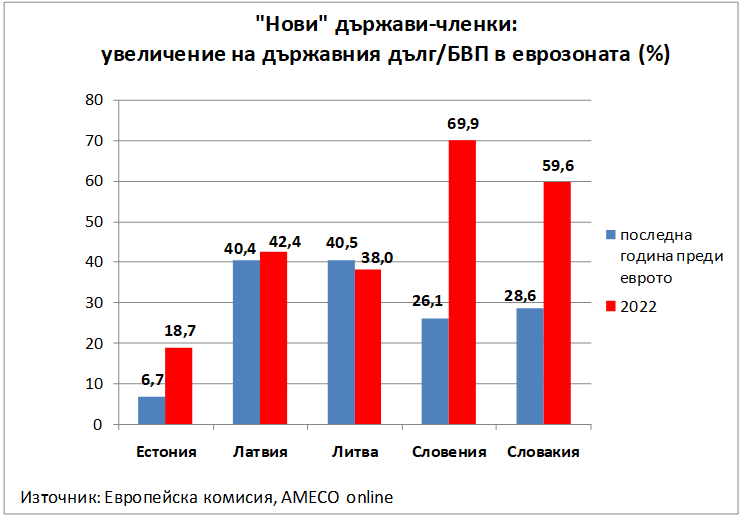
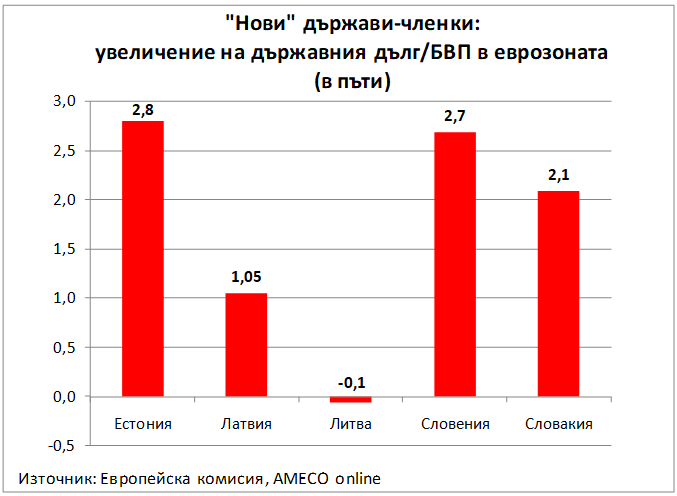
In Estonia, a country that had a currency board before joining the eurozone, the public debt-to-GDP ratio rose from 6.7% to 18.7% last year. This is a nearly threefold (2.8 times, to be exact) increase in 12 years of eurozone membership.
In Slovenia, the ratio of public debt to GDP also increased nearly threefold (2.7 times) from 26.1% to 69.9% last year. In 16 years of membership in the eurozone.
In Slovakia, the ratio of public debt to GDP increased more than double (2.1 times) from 28.6% to 59.6% at the end of 2022. In 14 years of membership in the eurozone.
So far, Latvia and Lithuania have managed to keep their debt burdens almost unchanged. Lithuania has seen a slight decline in its debt-to-GDP ratio compared to the last year before the euro was adopted. In Latvia, the public debt-to-GDP ratio increased from 40.4% to 42.4% at the end of 2022. In Lithuania, the public debt-to-GDP ratio decreased from 40.5% to 38% at the end of 2022.
However, let's not forget that the latter two countries are the newest members of the eurozone (9 and 8 years respectively). Accelerated indebtedness is probably coming, "as it should."
The growth of the public debt burden in the "new" member states of the eurozone is illustrated in the following graphs.
Why does the euro stimulate indebtedness?
This topic has been analyzed many times in the light of historical experience and the problems in the eurozone. There are specific factors and peculiarities in each national economy. But the data also clearly show the dominant general trend.
The main explanations for this general negative trend are that the introduction of the euro de facto weakens the budgetary constraints on governments, despite the supposed existence of rules for fiscal discipline. On the contrary, the euro creates new incentives for “moral hazard”, that is, for the deterioration of discipline with the clear awareness of politicians in one country that the risk (and its cost) will be transferred and borne by someone else. This transfer occurs outwards (to other countries) or is directed towards the future (to the next generations).
How does this Euro-mechanism of breaking fiscal discipline work?
Investors often view joining the eurozone as reducing risk for the economy concerned. The logic of such an interpretation is linked to the idea of eliminating currency risk (the risk of depreciation of the national currency) against the euro. There is also the expectation that a new member state will integrate more strongly (despite the often “nebulous” dimensions of this concept) into a more developed economic area, will trade more, will attract investment, will improve its policies, will strengthen its institutions.
Leaving aside the rationality of such expectations, the result is a blunting of realistic risk assessment. Through the lens of financial markets, this leads to a convergence of the cost of financing between individual member states. Countries that previously paid a higher price for financing are now starting to accumulate debt at interest rates that were previously only accessible to richer countries with stronger economies pursuing more disciplined fiscal policies.
This was seen in practice in the early years after the creation of the eurozone. Countries like Germany and Greece paid almost the same interest rates on their government bonds for a period of time. This is how financial markets valued them at the time, a few years before the Global Financial Crisis in 2008.
But there is another explanation, another channel for the breakdown of fiscal discipline after the adoption of the euro. This is the behavior of the European Central Bank. It ultimately shows a willingness to finance any government in the eurozone, albeit indirectly, through purchases of debt instruments on the secondary market. Regardless of the fiscal policy and the sustainability of public finances in the respective country.
This is how it works. If financial markets start to doubt a country’s economy, or its ability to repay its debt now or in the future, the ECB comes to the rescue. Fiscally troubled member states know that they can count on the ECB to continue buying their debt if other investors start demanding too high a return for it (reflecting the so-called “risk premium”). And to prevent the bankruptcy of a country in the eurozone (which would be a huge shock to the entire monetary union), the ECB will use any excuse to buy government securities issued by that country. Regardless of the high risk and high price (respectively low yield) of such securities, which would otherwise not attract investors on a purely market basis.
That is why, after entering the eurozone, many governments and opportunistic politicians see an opportunity for easier and cheaper borrowing. The cost of debt financing will no longer be discipliningly high, as it was before. Effective or not, justified or not, public spending would provide short-term political (or other) dividends. Without so much importance that it could worsen the budget balance.
The history of the eurozone with the data on the growing debt burden, presented above, also demonstrates the lack of effective corrective mechanisms to impose fiscal discipline in the member states.
Conclusions for Bulgaria
Today, Bulgaria has the second lowest debt burden (as a ratio of public debt to GDP) in the entire European Union. It is significantly lower than the average indicator for the euro area. At the end of 2022 , Bulgaria had a debt to GDP ratio of 22.5%, while for the euro area the ratio was 93.6% (i.e. four times higher).
Moreover, in the case of Bulgaria, over the years of membership in the European Union (now 16 years), the public debt/GDP ratio has remained almost unchanged. In the last year outside the EU (2006), Bulgaria had a debt to GDP ratio of 20.9 percent, i.e. just slightly below the ratio at the end of 2022.
These numbers in Bulgaria are the result of disciplined fiscal policy since the introduction of the currency board in our country. Our monetary regime eliminates the above-described incentives for indebtedness, characteristic of the eurozone, mainly due to the strict prohibition of the central bank to finance the government (both directly and through debt purchases).
Under this regime, the government can borrow only on a market basis. On the market, investors in Bulgarian debt demand a price they are willing to pay based on their assessment of the risk and fiscal sustainability of Bulgaria. With unreasonable policies, especially those implemented over a longer period of time, and deteriorating macroeconomic indicators, the Bulgarian state will begin to finance itself more and more expensively. At some point, a limit is reached on the tolerable cost of financing, respectively on the interest burden on the budget. Thus, purely market pressure requires limiting the growth of the budget deficit through optimization and greater efficiency in the management of fiscal policy.
The currency board contains incentives for prudent fiscal policy that are diametrically opposed to the exact opposite incentives in the eurozone.
In the event of joining the eurozone, the disciplinary mechanism of the currency board will be eliminated. The Bulgarian political class will face the temptations of loose fiscal discipline existing in the eurozone and policies leading to an increase in government indebtedness.
Some main conclusions can be summarized in the following three points:
- History shows how the eurozone undermines fiscal discipline, creating incentives for governments to borrow (measured as a share of debt to GDP, i.e. regardless of the size of the economy and economic growth). This is a golden mean for ineffective policies, even for abuse of public funds.
- Membership in the eurozone leads to an increase in the debt burden, which is passed on as a burden to future generations. In addition to being macroeconomically unwise, this has deeply undemocratic consequences – insofar as those in power today make decisions that will be paid for by future generations. These generations will not have voted for today’s politicians and may not agree or be able to pay their costs.
- The currency board with the preserved Bulgarian lev maintains fiscal discipline in Bulgaria. This saves billions of levs in public spending for both current and future taxpayers. However, if the board is eventually abolished by introducing the euro in Bulgaria, the disciplinary mechanism of our monetary regime will disappear and incentives for loosening fiscal discipline will appear before the eyes of the political class.






The situation with the national debt of the relevant government is successfully solvable.
The national economy is now a victim of the incorrect working methods of the Ministry of Finance. The preservation of state weakness is causing new damage.
To postpone the collapse of the state, the government of the respective country raises money through loans to pay for damages from its mistake.
The improper working method of the US Treasury Department is causing the current national debt.
It is possible to end the poor working methods of the Ministry of Finance. The government will be able to pay off its debts.