EKIP– Expert Club for Economics and Politics A Different Opinion
Author: Lachezar Bogdanov, Industry Watch
The openness of an economy is most often measured by the relative importance of foreign trade relative to its size. Some analyses look at the total volume of trade in goods and services relative to gross domestic product, while others focus on the relative weight of exports of goods and services.
The effect on exports and overall trade volume
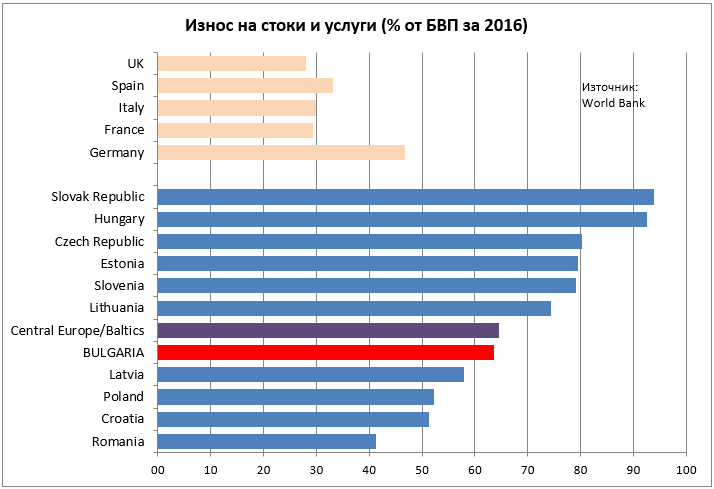
If we look at the countries of Central and Eastern Europe, we find an almost similar process of “opening up” over the past 15 years. In other words, foreign trade has been growing at a faster rate than the change in GDP. For the region, the total volume of trade in goods and services has increased from 84% of GDP in 2001 to 125% of GDP in 2016. Exports have increased from around 40% of GDP to 65% of GDP, with Slovakia, Hungary, the Czech Republic, Estonia, Slovenia and Lithuania exporting the most (relatively). Bulgaria has a more open economy than Latvia, Romania, Poland and Croatia. The importance of exports, measured as a share of GDP, has increased by 92% in Poland, 82% in Bulgaria, 69% in Lithuania, etc.
Let's look at Bulgaria: according to the latest NSI data, exports of goods for the first eight months of 2017 increased by 12.9% compared to the same period in 2016. If the trend of recent months continues, 2017 will be the first year in which exports of goods and services will exceed 65 or even 66 billion leva, the total volume of trade will exceed 130 billion leva, or over 130% of the estimated GDP for the year.
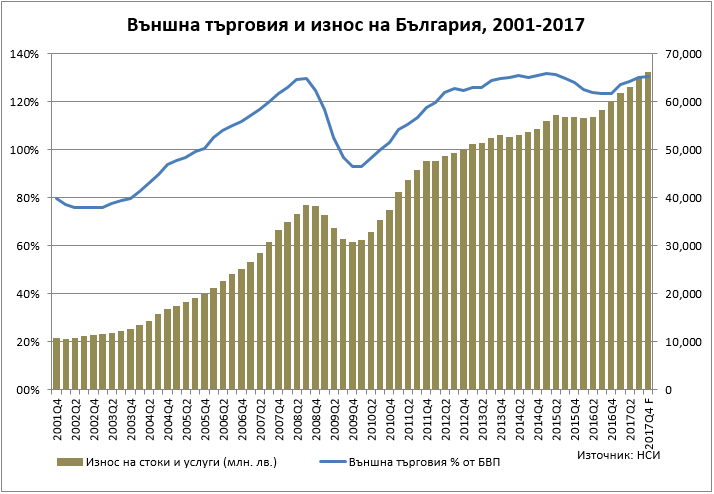
In nominal terms, the increase in exports has been sixfold over the last 16 years– from under 11 billion leva to nearly 66 billion leva expected volume in 2017. In 2001, exports were 35% of GDP, in 2017 they will reach 66% of GDP; in total, exports and imports of goods and services in 2001 were under 80% of GDP – in 2017 they will exceed 130% of GDP.
We need to put all this in context. Access to a large common and, in comparative terms, richer, market is a key prerequisite for increasing trade. The path off the “track” of EU membership can easily be traced to the Balkan countries that remained outside the EU, or countries like Moldova and Belarus.
The particular importance of foreign trade for small economies
The small catching-up economies in Eastern Europe are open and dependent on foreign trade, the richer and larger economies of the West – to a much lesser extent. Italy, Spain, France and the UK export goods and services equivalent to about 30% of GDP, and even Germany, whose economy is considered to be extremely export-oriented, exports less than 47% of GDP. Which means, by the way, that economic policies with a “design” like those for France and Italy, for example, will not necessarily have a good effect on economies like Bulgaria or Estonia – but that is the subject of another analysis.
For a poor, heavily indebted and technologically backward post-communist Europe, fragmented into small countries, it was extremely important to have the opportunity to trade freely in a large market. It is important to note here that low barriers to the exchange of goods and services have not only an immediate effect of lower prices on the relevant product market. A huge part of the new investments in the transition countries were possible solely and solely because of the prospect of access to the EU common market. The “poor” can grow faster if they rely not only on domestic savings, but also on external capital. On the other hand, more capital makes sense to invest when you can sell easily, quickly and without tariff and non-tariff restrictions.
The “relocation” of both industry – from furniture and food to cars and electronics, and services – from IT to document processing and call centers, is almost entirely motivated by the fact that these countries are part of the EU common market. At the same time, some of the “complex” processes– those with a long value-added chain with multiple steps and participants – would not be possible without the country in which they are located having a regime of free trade, movement of people and capital, provision of services with the countries in which all the other participants, as well as consumers, are located.
The benefits of investing in Eastern Europe, including Bulgaria, and integrating their economies with those of the richer West were so great that the global crisis of 2008 only managed to briefly affect export-oriented activities. Exports in all countries in the region recovered to pre-crisis levels within 12-24 months and began to grow again at rates higher than overall economic growth.