EKIP– Expert Club for Economics and Politics A Different Opinion

What is the problem?
Several months have passed since Dr. Ilko Semerdzhiev, as Acting Minister of Health, signed a contract to launch a European project with the Ministry of Health as a beneficiary under the Operational Program "Good Governance". The project concerns the completion of the National Health Information System (NHIS) and has a duration of 22 months. The project was also signed in accordance with the UMIS, and its launch was launched on March 1, 2017 [1] - 7 months ago, which means that there are still 15 months or a little over a year left for its implementation. The problem comes from the fact that there is still no information about launched public procurements and tenders for the implementation of the activities specified in the contract, while the health ministry promises to have completed some of the activities within a few months. The question here is: Who should we trust?
What is the project budget?
The value of the project is 12 million leva, of which 10,200,000 leva are financed by the European Social Fund, and 1,800,000 leva are co-financed by the national budget (fund).
Table 1: Budget Breakdown
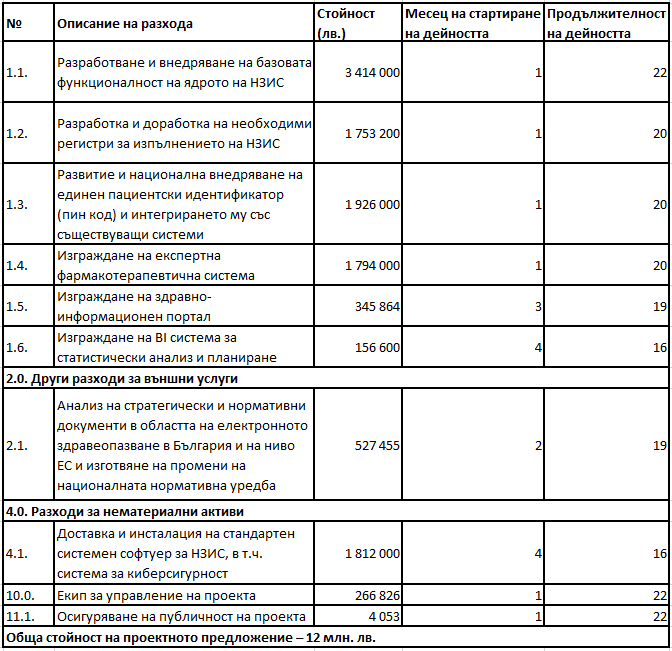
Source: APIA
What are the problems facing statistics in the healthcare system?
The National Statistical Institute (NSI), the National Center for Public Health and Analysis (NCPHA) and the National Health Insurance Fund (NHIF) collect a huge amount of data that does not correspond to the modern needs for information in the field of public health. Only a small part of this data is actually used for decision-making and for assessing the effectiveness of the health system. The lack of targeted analysis and objectively oriented interpretation of data are among the weakest points in national health statistics. Public health reports are still built around the preparation of traditionally long statistical tables on a limited number of topics, although the collected data can also provide an opportunity for multivariate analysis. The construction of indicators (indices) is poorly represented, and there is also a lack of a plan for the dissemination of information. The range of information products is extremely limited and the data is poorly presented.
In order for the National Health Information System to work, a standard must be introduced for the data to be collected. This has already been done with the adoption of the Regulation on the Introduction of Mandatory Health Information Standards. The problem is that it does not provide for the mandatory application of the standards for all participants in the process (it concerns only medical institutions). That is why this regulation is not well enough prepared to regulate and service the exchange of information.
Why is a National Health Information System (NHIS) needed?
The purpose of a health information system is to capture, store, manage, or communicate information related to the health of individuals or the activities of organizations operating in the health sector. This definition includes things like routine district-level information systems, disease surveillance systems, laboratory information systems, hospital patient administration systems, and sometimes human resource management information systems. Overall, a well-functioning health information system is an integrated effort to collect, process, report, and use health information and knowledge in a way that can significantly influence national policies and decision-making in the health sector. Such a system can also have positive effects on program functions, individual outcomes, and public health outcomes and research. Health decision-making at all levels of the health system requires reliable health statistics that are disaggregated by sex, age, and socioeconomic characteristics. Policy decisions that are supported and informed by evidence contribute to a more efficient allocation of health resources.
What can we expect?
E-healthcare in the country has collapsed several times in recent years, after an otherwise solid start. A few months ago, the National Audit Office issued an audit indicating that over the years there have been several unsuccessful attempts to implement projects to create a National Health Information System (NHIS), with public procurements being terminated for various reasons, and in the current project their start has not even been given. Over the years, due to the termination of public procurements, 9.7 million leva of financial aid were not utilized once in 2012 and a second time 12 million leva from a European program in 2014. These unsuccessful attempts show, according to the auditors, that " the overall organization of the process of planning and implementing e-healthcare projects and public procurements is ineffective and needs significant improvement".
[1] http://2020.eufunds.bg/bg/0/0/Project/Details?contractId=WPrKUeV8x1Y%3D