EKIP– Expert Club for Economics and Politics A Different Opinion

(Click on the infographic for a larger size)
Data source: NSI
Comment
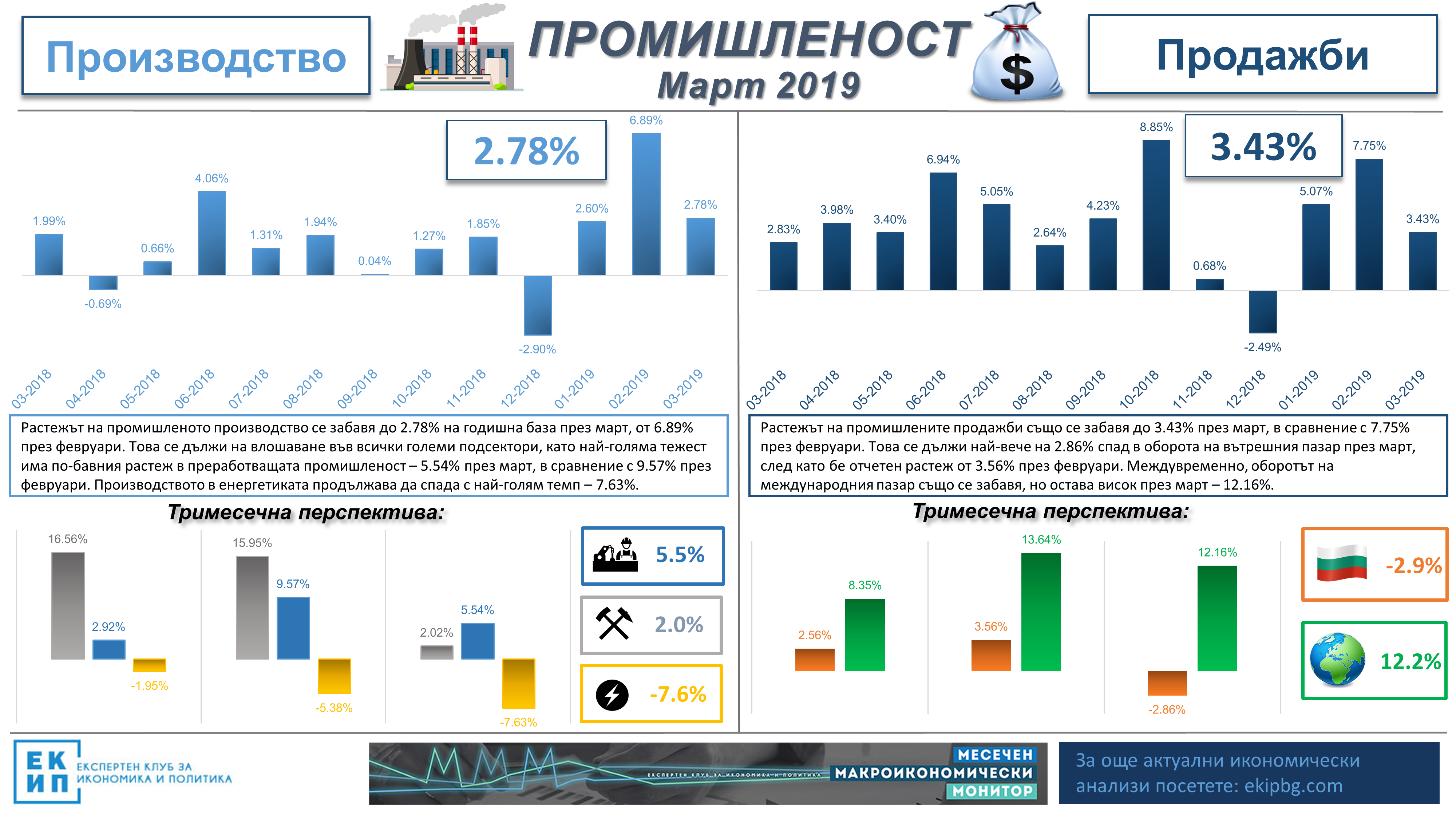
After accelerating growth in the first two months of the year, a slowdown was observed in both production and sales in the industrial sector in March. Interestingly, according to NSI data, this time the domestic market has a greater burden, where a 2.86% drop in industrial turnover was reported. This is the first drop in sales on the domestic market since the summer of 2016. Unless it turns out to be an exception, this is generally a bad signal for the sector, because so far the main source of weaker growth has been the foreign market due to the deteriorating state of the industrial sectors in key trading partners such as Germany, Turkey and Italy. If activity on the domestic market also starts to deteriorate permanently, this means that the long period of stable growth in the sector has come to an end and we are starting to witness the first indications of an impending recession.
When we talk about a "recession," we are talking specifically about the manufacturing sector, at least for now. Of course, in the longer term, this recession would spread to the entire economy - the manufacturing sector and construction are usually the first to fall into recession, before other sectors closer to end users do. This is because manufacturing and construction are more capital-intensive sectors, with a longer-term production horizon, and are therefore more sensitive to changes in interest rates and the long-term business climate.
Returning to the industrial data for March, it should be noted that there is also a slowdown in the growth of sales on the foreign market. This is probably due to the fact that after Italy and Germany reported weak growth in industrial production in February, it fell again in March on an annual basis. The difficult state of industry in these countries has now lasted for more than six months with no prospect of lasting improvement, which is a serious indication that a recession in the European Union is on the horizon. It remains to be seen whether the European Central Bank's decision to initiate a new round of ultra-cheap loans to the banking system will inject enough cheap credit into the economy to prevent a recession. Our assumption is no, at most it will simply slow down or partially reduce its scale.