EKIP– Expert Club for Economics and Politics A Different Opinion

- The epidemic in China has caused a near-historic slowdown in global trade in recent weeks.
- In Europe, the most directly affected are the large economies such as Germany, France and Italy.
- Italy and France saw GDP decline at the end of 2019, while overall eurozone GDP rose by just 0.1%
- The situation could worsen further if trade barriers with the UK are lifted after Brexit.
So far, the word of the year in the markets is "coronavirus." The outbreak in China at the beginning of the year has reached such a large scale that the effects on the global economy are already starting to become really serious. China, being the second largest economy in the world and one of the largest importers and exporters of goods, plays a key role in the global trade scene. You can imagine then what happens when the country's imports and exports slow to almost crawling speed due to all the additional restrictions and quarantines that need to be imposed to control the epidemic.
Global trade turnover has collapsed due to the coronavirus
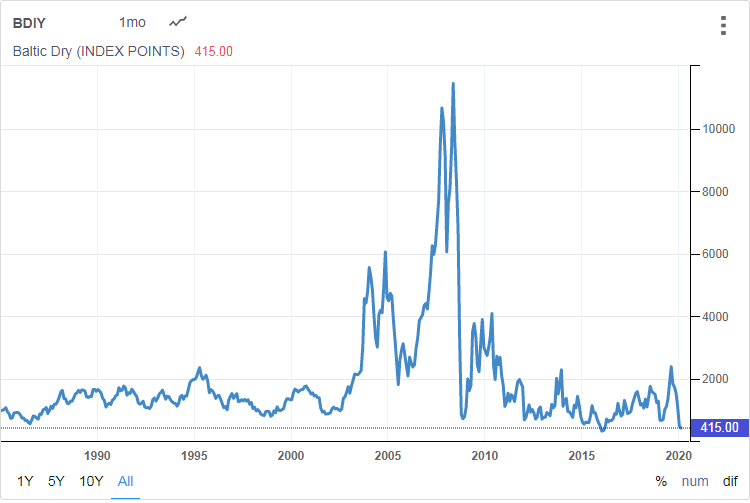
The famous Baltic Dry Index, which shows what is happening to global trade traffic by measuring freight rates on large cargo ships, collapsed to a historic low of just over 400 points in February. The index has only been lower once in its history since the mid-1980s, in 2016, and now it seems to be on track to surpass that. This points to a virtual collapse of global trade turnover, at least temporarily, which carries particular risks to growth, especially in countries where economic activity is already slowing down anyway. Which are most economies in Europe.
Chart 1: Historical low for the Baltic Dry Index , 1986-2020
Source: TradingEconomics
Germany is most directly threatened. Its industrial sector was already in recession throughout 2019, with not a single month of rising production, and things are only getting worse at the start of 2020. China is Germany’s third-largest trading partner, both as an export market and as a source of imports. Germany exports mostly cars and machinery to China, and imports mainly electronics, parts, and also machinery that it uses in its industry. In other words, Germany’s industrial production is falling into a deeper abyss.
The German DAX finally reflected these developments somewhat in late January and early February, when it fell by 4.4% in about two weeks. This is a relatively small correction, of course, and the losses have been recouped in the last few days. Of course, given the massive money printing by the European Central Bank, which has continued at the same pace since the last board meeting in January, it is not surprising that the indices are going up even as European industry is going down.
The Eurozone is getting closer to the edge
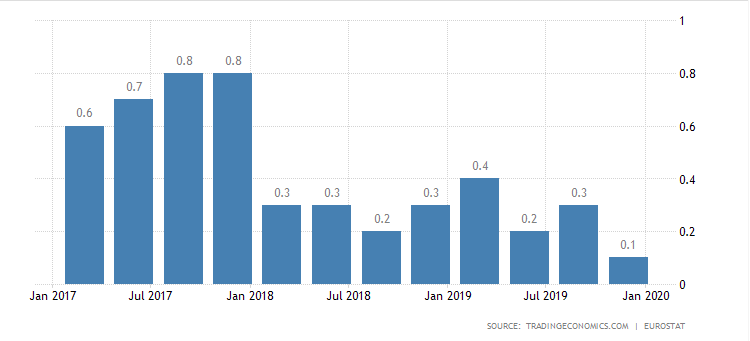
Germany is not the only European economy to suffer from the coronavirus. China is also one of the largest trading partners of France and Italy, the second and third largest economies in the EU respectively. France surprisingly recorded a 0.1% decline in GDP in the last quarter of 2019 compared to the previous one, while Italy recorded a 0.3% decline, the most serious since 2013. As a result of these developments, at the end of 2019, the eurozone GDP as a whole rose by just 0.1% compared to the previous quarter. The eurozone economy was very close to complete stagnation throughout 2019, and now, with the push of the coronavirus in early 2020, it may even fall into a mild recession.
Chart 2: Eurozone GDP growth on a quarterly basis, 2017-2019
Source: TradingEconomics
Overseas, things are looking better as usual. The largest US stock index, the S&P 500, also went through a slight correction in late January and early this month, the losses from which have now been compensated. GDP growth reached 2.1% in the fourth quarter of 2019 - a remarkably better performance than that of European economies, although GDP growth in 2019 as a whole fell short of the sought-after level of over 3%, which the Trump administration is aiming for.
The effect on Bulgaria may not be clear-cut
As for Bulgaria, it is difficult to accurately determine the effects of the epidemic in China. First of all, China is not that big a trading partner of our country. On the other hand, however, as I said, it is a key partner of countries like Germany and Italy, which are our key partners, to which we export many goods for the industrial sector. From here we could speculate that if industrial activity in these countries worsens due to the situation in China, this will also hit our industry. However, there is also the other side of the coin.
Germany, for example, imports very similar types of goods from China and Bulgaria, which it uses in its industrial sector. That is, China is a competitor of Bulgarian industry for the German market. Accordingly, if Chinese exports of this type of goods slow down and the Germans seek to compensate, we are one of the potential winners. This is just speculation, of course. The NSI has not yet released a date for industry in December, so there is time before we understand exactly how the coronavirus crisis has affected us.
Overall, however, 2020 does not seem to be off to a good start for the global economy as a whole, and Europe looks the worst. Don't forget that with Brexit already underway, we could also see further disruptions to EU trade flows, as the UK is, logically, a key trading partner for almost all European economies. If Boris Johnson imposes serious restrictions on trade with the continent, as he has threatened, this could completely derail growth in the eurozone and send it into recession. Which would hit us too, of course.