 EKIP– Expert Club for Economics and Politics A Different Opinion
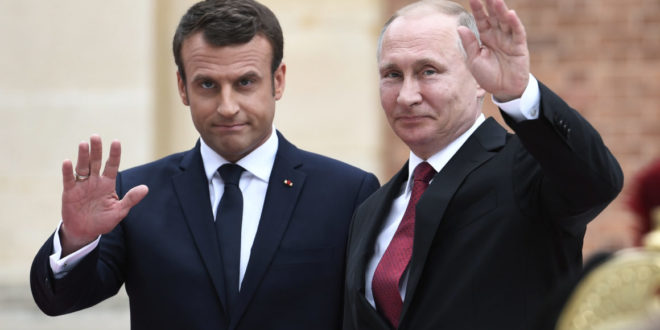
On Monday, during his visit to Poland, French President Emmanuel Macron made statements that scandalized the Bulgarian public. Macron said in plain language that the admission of Bulgaria and Romania to the European Union was "hasty", thereby directly questioning our place in the so-called European community. Let's not be fooled. Such statements by the French president are not just a random joke. They are part of an already clear trend, after the blocking of Albania and North Macedonia's accession to the EU and the incessant requests in recent months that the EU should seek rapprochement with Russia.
These actions are a clear statement that the French president is trying to make a radical turn in the foreign policy not only of France, but of the entire European Union. From a categorically Euro-Atlantic one, always together with the US and the UK and never with Russia to... a far more "flexible" one, in which the Kremlin from an eternal enemy turns into a possible tactical ally. To a large extent, such a move is logical, given the growing tension between the EU and the US amid the election of Donald Trump as president, as well as the official secession of the United Kingdom from the union. Yes, both developments are dictated mostly by economic and trade considerations, but they undoubtedly and inevitably also have serious geopolitical dimensions.
The Schism in the Euro-Atlantic World
The Anglo-Saxon world has been visibly cooling its relations with continental Europe, represented by the EU, over the past 5 years. First of all, Brexit is already a fact. After the referendum in 2016, the United Kingdom made the categorical decision to terminate its membership in the European Union. This means severing the previously established political ties and fundamentally rethinking the trade relations between the Island and the Continent. Meanwhile, the American president has repeatedly given clear indications that his attitude towards the EU, especially when it comes to trade issues, will be far from as friendly as that of his predecessors. When Trump is done with China, he will certainly also seek to renegotiate the European-American trade relations from the ground up.
But in addition to these developments, the cooling in relations between continental Europe and the Anglo-Saxon world is also reflected in disputes within NATO. The American president has repeatedly criticized the European partners in the alliance for not contributing enough to maintaining NATO's military power and has even questioned the meaning of its very existence. In such statements, Trump did not mean that Russia is no longer the main geopolitical opponent of the United States in the Eurasian region, but rather that the alliance is not contributing enough to opposing attempts to expand Russian influence.
And indeed, this is so. The opposition between the European Union and Russia has always been much weaker than that between the United States and Russia. The largest European economy, Germany, has very deep ties with Russia, which are not at all about to be severed, given the Germans' willing approval of the Nord Stream project. France has also historically always, and to this day, had a relatively evasive attitude towards Russia. This is precisely why Paris spoke so actively about political rapprochement with Moscow.
What was the EU and what is it becoming after Brexit?
From a geopolitical point of view, this is a completely natural behavior for France. In the context of Europe, far more immediate threats to French influence in the region have historically always been Germany and Britain. Russia is a relatively distant player, who has often found himself in the position of a tactical ally. Diplomatic habits die hard. Especially in view of the retreat of the deterioration of relations between the Anglo-Saxon world and the EU, Macron's turn towards Moscow is not at all strange, if we consider the historical and geopolitical context of France.
With the UK leaving the EU, a foreign policy vacuum has emerged. Without the UK in the union, France is the undisputed leader in the EU. Germany remains the economic colossus of Europe, but in military and foreign policy terms it continues to play a rather passive role. In fact, the EU has been intended to function in exactly this way since its inception – with France at the helm as the undisputed geopolitical leader in continental Europe, and Germany placed under its foreign policy and economic control.
This formula was largely shaken by Great Britain. It is no coincidence that the most significant leader of France after World War II, Charles de Gaulle, actively blocked Great Britain's accession to the (then still nascent) European Union in the 1960s. In view of the military and, accordingly, foreign policy "castration" of Germany after the War, Great Britain is the only European power that can compete with French influence in the EU. And throughout its entire stay in the union, it has indeed largely fulfilled exactly this role. The diplomacy of island Great Britain and its geopolitical interests have historically always differed from those of continental France. Therefore, its very presence in the union, albeit with only one foot, with all the conditions and without joining the eurozone, blocked in the bud any ambitions of France to subordinate the EU to its own geopolitical interests.
What is France's geopolitical interest?
After the memorable date of January 31, 2020, all this changed. The final secession of the United Kingdom from the EU cuts off almost any possibility of it playing the same role of a balancer in the EU and blocking French ambitions. The vacuum of foreign policy influence that is forming inside the union gives Paris carte blanche for a radical change in the EU's geopolitical course. And, judging by his hints so far, Macron has a very radical change in mind indeed.
France’s blocking of the accession of countries like North Macedonia and Albania to the EU is a clear sign that Paris has no intention of playing the role of an eternal opponent of the expansion of the Kremlin’s influence in the Balkans. Any debates about the readiness of these two countries to join the EU and the problems with the quality of their institutions are of only secondary importance and even largely irrelevant. The main considerations in the accession of new countries to the EU have always been of a foreign policy nature. With these actions, France shows that it is ready to put a brake on the expansion of Western European influence in the Balkans. And if the Western superpower, i.e. the EU, does not expand its influence here, then the Eastern one (i.e. the Kremlin) will. Nature does not tolerate a vacuum.
French ambitions require US opposition
It is in this context that Macron's statements regarding Bulgaria and Romania in recent days have appeared. In no case should we underestimate their significance. So far, no leader of one of the leading countries in the EU (currently the most leading) has allowed himself to so directly question the meaning of the membership of countries that have been in the union for more than a decade. This is an unprecedented move that reinforces the impression created as a result of the blocking of the membership of Albania and North Macedonia. Namely, for France, EU enlargement is no longer a goal that must be pursued at all costs.
This, combined with Macron’s emphatic message that the EU should seek rapprochement with Russia, suggests that Paris would be willing to trade influence in Eastern Europe and the Balkans with Putin. What France would get in return is more flexibility and the opportunity to exert more independent influence on the world stage, outside the control of the US and UK, which dominate NATO. Until now, France has always played a secondary role on the world stage, below the level of the major players such as the US, Russia and, more recently, China. Even within the European Union, Britain has limited French ambitions. Macron is determined to change that.
Turning France into a major player logically requires rapprochement with Russia. There is a natural convergence of interests between Moscow and Paris. On the one hand, Putin wants to expand his influence in Eastern Europe and the Balkans and, above all, to regain the "lost" Ukraine, which was taken away from him by the active intervention of the United States. On the other hand, turning France into a major player on the world political stage necessarily requires a retreat from the rather subordinate position in which it finds itself vis-à-vis the United States within NATO. And this retreat, within Europe, goes only through rapprochement with Russia. Otherwise, France simply risks isolation.
The EU is no longer a guarantor against Kremlin influence
For us in Bulgaria, one thing must be crystal clear. At the moment, with London already outside the union, whatever Paris says, Brussels will say. The geopolitical direction that the European Union takes will now be dictated entirely by France. This must lead to a fundamental rethinking of Bulgaria's attitude towards the European Union, our expectations from this union, specifically in terms of foreign policy, and accordingly – our own role in it.
It is no coincidence that Bulgaria's accession to the EU and NATO proceeded as parallel processes. One was synonymous with the other. Both had the same leading function in foreign policy – to separate us from the sphere of influence of the Kremlin, under which we found ourselves for more than half a century after World War II. Today, judging by the new foreign policy direction of France, this consideration certainly no longer applies to the EU.
We must adapt to the changing environment
The clear indications of the French president that blocking the Kremlin's influence is no longer a priority. This should be a clear sign to the Bulgarian rulers that our expectations from the EU must change and accordingly our attitude too. Only the USA and Great Britain remain categorical allies against the spread of the Kremlin's influence in the Balkans.
Despite all the speculation (most of which has now been proven unfounded) that Donald Trump managed to become president with Russian support, on the world stage Russia remains the main enemy of the United States. The history of the Cold War cannot be forgotten, and to this day the competition between the two powers continues to be fierce, especially in regions such as the Middle East. But as long as Washington continues to be a permanent opposition to Moscow, the position of Brussels, under the influence of Paris, will become increasingly uncertain. It is very likely that with France's rapprochement with Russia, peripheral and border countries such as Bulgaria will find themselves in the position of bargaining chips in the trade of influence.
In this context, we must realize that deeper integration within the EU will no longer be a guarantee against Russian influence. In fact, the union may soon even become the opposite, given the direction taken by France in foreign policy. The justification of analysts and politicians that adopting the euro, despite all its negatives, and submitting to all EU centralization efforts is necessary because otherwise "the Kremlin will take over" is starting to crumble very quickly before our eyes. The dichotomy "ever deeper into the EU or ever more subordinate to the Kremlin" no longer seems relevant at all.






I hope this interesting analysis turns out to be an unfulfilled prophecy, but it sounds so logical and convincing that it once again gives me cause for anxiety and depression. Unfortunately, external and internal factors fully justify the pessimism of the forecast.