EKIP– Expert Club for Economics and Politics A Different Opinion
At first glance, monetary relations are not the most suitable environment in which honesty and trust thrive. Again, at first glance, when it comes to money, the selfishness and greed inherent in everyone are exposed. However, the intuition at first glance is not accurate. For money and the institutions related to it to exist, a certain degree of trust and honesty are mandatory. Their absence makes transactions insecure and expensive and slows down overall economic development. Trust and honesty are especially important when the state government makes monetary promises.
When, why, and how were the monetary promises made by the Bulgarian state authorities clearly violated, and what is the significance of this act? These are the questions that will be answered in this article.
Money and credit immediately after the Liberation
Even before the formation of the first government of the Principality of Bulgaria, the Bulgarian National Bank (BNB) was established. According to its Statute, the BNB is a government institution with a capital of 2 million francs. The bank performs the state's cash service free of charge, i.e. it receives amounts from various state revenues and pays state expenses incurred. The BNB accepts amounts on term and demand deposits and on current accounts, distributes limited short-term loans, etc. The bank is not entitled to issue banknotes.
The first credit operation was registered on August 17, 1879, almost three months after the bank was opened. At first, the demand for loans in the Principality was limited and the BNB had difficulty placing even its own funds. Until April 1883, it did not accept deposits because there were no applicants for loans and interest payments to depositors could not be ensured. Mihail Tenev, who was a long-time employee and manager of the bank from 1894 to 1899, explains this situation with the traditions of “taking and giving” between merchants and artisans. They were carried out “on the basis of an honest word and in a ledger, without any mandatory documents and without the obligations becoming public knowledge”. His words are evidence of underdeveloped market relations, but also of the importance of mutual trust between participants in economic activity.
The lack of banknotes means that the functions of money are performed by coins. In May 1880, a law established the lev as the national monetary unit of Bulgaria. The levs are gold and silver, i.e. a bimetallic standard is imposed, which resembles the principles of the Latin Monetary Union. The exchange rate of gold to silver is officially fixed at 1 to 15.5. In fact, the market ratio between gold and silver is different from the officially fixed one. In the 1880s and 1890s, silver depreciates. The so-called agio appears, which can be called inflation with some conditionality. The monopoly right to mint coins under the law of 1880 is reserved for the state.
The promise of the state
In the first years after the establishment of the Bulgarian Principality, discussions began on the reform of the BNB. On February 11, 1883, the Third Ordinary National Assembly adopted the Statute of the BNB. It contained a number of innovations. The BNB was transformed into a joint-stock company with a share capital of 12,000,000 leva in gold, divided into 40,000 shares of 300 leva each. It was envisaged that one third of the shares would be purchased by the state, and the rest would be offered to private individuals through public subscription. Article 2 of the Statute stipulated that “the Bulgarian National Bank has the privilege of issuing banknotes, which it will pay in gold to the bearer”. The quantity of banknotes was determined by the General Assembly of the company, in agreement with the government. The BNB must have gold reserves in its coffers “in an amount equal to “one third of the value of the banknotes issued”. Banknotes can be of 20, 50, 100, 500 and 1,000 leva, they are accepted by the state treasuries and all government institutions and upon request the bank is obliged to exchange the banknotes for gold coins immediately. This is a key promise from the state, which aims to gain the trust of consumers that behind the paper there is a real gold coating. Penalties are provided for counterfeiting banknotes.
The attempt to transform the BNB into a joint-stock company with the participation of private capital failed.
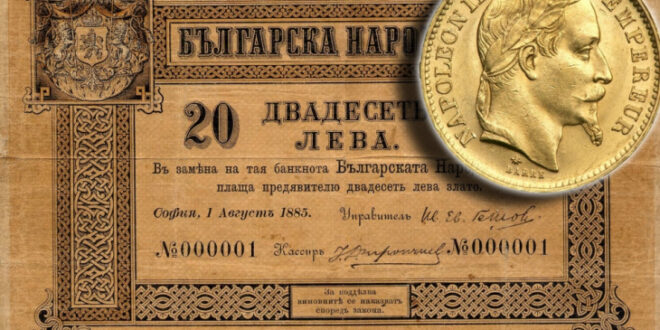
In January 1885, at the initiative of Finance Minister Petko Karavelov, the Parliament adopted the Law on the Bulgarian National Bank, and in August of the same year the provisions of the law were further developed in a special Statute. With this Law, the capital of the bank became 10 million leva, paid in entirely by the state, i.e. the shareholder principle was abandoned and the BNB became state-owned. From the point of view of printing banknotes, the issuing functions of the bank envisaged in 1883 were preserved. According to Art. 4 of the law, the BNB has “the exclusive privilege of issuing banknotes that will be accepted for payments in the treasuries of the state and in all government institutions… The banknotes will be paid immediately to the bearer in gold”. The promise that paper banknotes are substitutes for gold remains. The bank’s obligation to keep gold coins in its vaults, which are equal to at least one third of the value of the banknotes issued, is also preserved.
Banknotes as a substitute for gold: for how long?
In the years after 1885, the BNB issued various amounts of gold banknotes, i.e. banknotes that were freely convertible into gold. The promise to exchange them for gold on demand was kept. Printing banknotes seems to be an operation from which the bank (through it the state) and business profit. The bank profits because money is created practically out of thin air through banknotes. This money can be given out as loans and interest can be received from it, it can be used to pay for government supplies, etc. Business profits because it is easier to carry and store money. The supply of paper money is limited, banknotes are difficult to accept by Bulgarians and are often returned to the bank's vaults. People prefer to have gold coins because they are a form of protection against inflation (the premium, or devaluation of silver coins).
At the very end of the 19th century, the Bulgarian economy faced a severe financial and economic crisis. The governments of St. Stambolov and K. Stoilov took out loans from abroad, which were in gold, and the servicing of these loans was also in gold. A large part of the loans were wasted on military supplies and did not bring income to the treasury. The income itself depended on the export of grain, against which gold coins were received abroad. In the last years of the 19th century, due to poor natural and climatic conditions, grain harvests decreased. Exports were restricted and less and less money entered the treasury. Most of the income in the state treasury came in silver, which was cheap, and the loans were serviced in gold, which was expensive. With this perfect storm, the end of the promise that banknotes were simply a substitute for gold came.
On November 13, 1899, amidst an extremely stormy session of the National Assembly, an amendment to the BNB Law was adopted, a “small bill” in the words of the Minister of Finance. According to it, gold banknotes would not be exchanged for gold, but for silver until December 31, 1900, at the gold-to-silver exchange rate (i.e. agio), which was determined by the BNB itself. The state reneged on its promise that banknotes were a substitute for gold. It lasted only 14 years. The first lie was quickly followed by a second. The promise that the exchange of banknotes for silver would last only a year was not fulfilled. Gold banknotes would only be exchanged for silver until October 1902, not until November 1900.
What's that?
The conditions under which the state breaks its promise are indeed complex: the treasury is empty, taxes are high, servicing external loans is difficult, deductions are made from the salaries of officials... However, the complexity is not a bad coincidence, but is caused by the actions of the state authorities themselves before the crisis.
The parliamentary opposition is categorically against the temporary suspension of the exchange of banknotes for gold. The most influential parliamentarians point to arguments against the “draft law” that are difficult to refute. They claim that its goal of keeping gold in Bulgaria will not be achieved, the premium will increase, which brings losses to the Bulgarian population and difficulties for trade, and confidence in banknotes will be destroyed, which will lose value. The words of the brilliant lawyer Dr. Nikola Genadiev are strong and prophetic. They deserve to be quoted: “ For a National Assembly that drafts laws to commit to entering the path of lawlessness; to destroy the rights of citizens, there is no end to this path and tomorrow or the next day in another case the right to property may be seized. And surely, if you go down this path, you will end up there”.
Seen through the perspective of the decades after 1899, Dr. Genadiev turns out to be right about property. The “little bill” that violated previously made promises has long been forgotten. Probably rightly so. There is a point in recalling it: its adoption is part of the actions of the state, due to which trust in it is critically low. Especially when it comes to money.