EKIP– Expert Club for Economics and Politics A Different Opinion
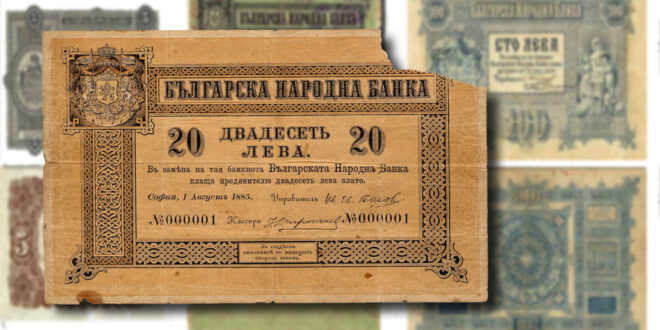
In 1928, with these words, the Bulgarian economist G. Toshev characterized paper money in conditions of inflation. His definition was the result of the experience gained during the First World War (1914-1919) and after it. This was the first clearly outlined inflationary wave in the history of post-liberation Bulgaria. The country's monetary system underwent a radical transformation. A visible aspect of the change was the disappearance of gold and silver coins from circulation, their replacement with paper leva and the increase in the general price level.
A brief reconstruction of this episode can help answer several important questions: why and how does inflation happen, and what does it lead to?
About wars, economy and money
In the second decade of the 20th century, Bulgaria fought three wars for national unification: the First Balkan War (1912-1913), the Second Balkan War (1913), and participation in World War I (1915-1918). They ended with two national catastrophes, tens of thousands of victims, and enormous material losses and expenses.
The costs of participating in the wars exceeded 3 billion gold leva. The Balkan wars cost about 300 million gold leva, and the rest of the money was spent on the world war. The fighting during the First Balkan War cost 1 million gold leva per day, while during the First World War the amount was 2 million gold leva per day. An approximate clarity about what these amounts mean can be obtained from the fact that the revenue part of the Bulgarian state budget in the peaceful year of 1911 was just over 178 million gold leva, and the state expenses incurred for the same year were over 198.7 million gold leva. Obviously, war is a very expensive “pleasure”. Especially for an economy that has a primitive structure and for a population that is poor.
Wars also lead to other economic changes that in one way or another affect the monetary system and prices in the country. During the First World War, almost a million people, mostly young men, were mobilized and torn away from agriculture. Mostly old people, women and children remained to work in it. The arable land was limited, part of the livestock was requisitioned for the needs of the army. As a result, agricultural production decreased, and its demand rapidly increased. Foreign trade was limited, as was access to foreign loans. This led to a drastic reduction in customs, tax and other revenues in the budget, while expenses were constantly growing. Attempts were made by the state to impose price rationing, limit consumption and direct production to the needs of the army, but they did not solve a single problem.
Is inflation an uninvited guest?
Immediately before the start of the First Balkan War, the classical gold standard was in effect in Bulgaria. The monetary circulation consisted of about 164 million leva. These included gold, silver, copper and nickel coins and banknotes. The purchasing power of all types of money was equal to that of the gold leva. A good worth 10 leva could now be paid for in silver, gold or other coins or in banknotes, without the need for an additional payment due to the difference in the exchange rates between gold and silver. The banknotes were freely exchanged for gold at the cash desks of the BNB, which was obliged to keep in its cash desks a gold reserve of no less than one third of the banknotes put into circulation. The requirement was a guarantee that an unlimited number of banknotes would not be printed.
In 1912, two important changes were made to the legal framework regarding money, which opened the door to inflation. In February 1912, an almost imperceptible technical change was voted in the current law on the BNB. In its art. 7, the following paragraph was added: “The Bank’s claims against foreign countries, covered by term exchange or foreign short-term treasury bills, are also considered to be gold reserves.” The content of the new wording is clear only to professional financiers. The BNB is allowed to print banknotes that are not directly backed by gold, but by foreign currency, for example, which is supposedly backed by gold. The other change in the monetary system dates from October 10, 1912 and is the work of the executive branch. By decree of the Council of Ministers, the exchange of banknotes for gold was terminated. This also allows banknotes to be printed with a view to financing military operations and other extraordinary state expenses. Inflation was invited into the country by the ruling elite.
The First and Second Balkan Wars caused a heavy financial burden, but did not lead to a major devaluation of the leva. True inflation occurred during the years of Bulgarian participation in World War I and continued after it. The government did not resort to new taxes or loans, but preferred to pay its expenses by printing banknotes. During the course of the military operations, there were moments when the Bulgarian state did not have enough paper money. In September 1917, a monetary crisis occurred because the government did not have enough banknotes. The banknotes put into circulation up to that point were held by the peasants, because there were not enough goods on the market and the few that were available seemed too expensive.
The banknotes were printed in Germany, and their production led to tension. Misunderstandings arose between the Ministry of Finance and the BNB over printing orders. The two institutions had different views on where to print the Bulgarian banknotes. Suspicions of bad faith and personal interests arose. Ultimately, two different printing houses received orders for Bulgarian banknotes. Some of the printed banknotes were "thrown into the bank's cellar, as unusable," according to a report by a parliamentary inquiry committee investigating the activities of the BNB during the period 1914-1920.
Formally, the banknotes that were printed were not backed by gold, but by German marks. This was allowed by the changes in the law on the Bulgarian National Bank from February 1912, but the connection of marks with gold became increasingly fictitious during the course of the war. By the end of the war, the money in circulation reached 2,298 billion leva, and the depreciation of paper money against the gold leva during the war years reached 16 times. The printing of paper money continued long after the end of the war. From the end of 1918, the exchange of banknotes for gold or silver was suspended by law "until a second order". And this order never came. In 1920, the gold coverage of banknotes was only 1.56%. The available data show that all prices increased dramatically, although at different rates.
What does inflation lead to?
A visible consequence of inflation was the increase in speculation in commodities and foreign currencies. The economy entered a "gambling period," as one economist of the time defined it.
The first to benefit from the increased prices were merchants, industrialists and suppliers to the army. They received a large part of the newly printed new banknotes from the state and were able to use them before all prices had risen. For example, Bulgarian tobacco manufacturers and exporters managed in 1916-1917 to purchase tobacco in the country at a price of between 4-10 leva, and sell it in Germany and Austria-Hungary at prices between 30-40 leva. They had an incentive to seek the cooperation of the military and civil authorities in order to obtain exclusive rights to purchase the tobacco, to obtain wagons for export to Germany, etc. Some of the merchants took advantage of the wartime situation and deliberately bought up all kinds of local goods, stored them and waited for what they believed was a sufficient increase in prices to sell them at a profit. The accumulation of free cash in economically active people stimulated the creation of numerous new joint-stock companies. The attentive observer St. Bochev notes that some people turn the founding of new companies into a craft, with the sole purpose of founding them being to sell the shares and collect the money of naive investors. He writes: “We ourselves have observed subscriptions in 1917 and 1918, where the public was jostling … to the detriment of themselves in order to subscribe for shares.”
There are many more losers from inflation. These are all those with fixed incomes: civil servants, pensioners, teachers, military personnel, peasants who do not spend their increased income but hide it in anticipation of better times, etc.
Brief summary
Inflation is not a random phenomenon and is not the result of the greed of merchants and speculators. Its roots are in the decisions and actions of state authorities who manage foreign, domestic, military and monetary policy. At the beginning of the 20th century, inflation was resorted to in the presence of an emergency, in this case – war. Inflation disrupts the normal functioning of the economic system and, once applied, it is a constant temptation for those in power.
Perhaps the most severe consequences of inflation are for business morale. The Deputy Governor of the Bulgarian National Bank, Zh. Burilkov, wrote in an article from 1928: “Profits are no longer the result of abilities and merits; losses occur without any fault or guilt. The virtue of saving leads to ruin; indiscriminate purchases of various objects and ornaments become the most expensive commercial transactions. The middle and lower social classes with fixed cash salaries, wages and other incomes are ruined, widows and orphans lose their savings…”.
His words deserve attention as a warning about the long-term devastating effect of inflation.