 EKIP– Expert Club for Economics and Politics A Different Opinion
The past few days have seen severe financial market turbulence in most of the developing countries in Asia. In India, the situation has begun to be compared to the financial crisis of 1991, while in Indonesia, parallels are being drawn with the Asian crisis of 1997.
Leaving aside the similarities and differences between the current situation and the crises of 15-20 years ago (at least then, both had a fixed nominal exchange rate regime), this article will look at what lies behind the volatility of recent days.
The reason for the collapse in local currencies, stock indices and bond markets in many emerging Asian economies is the capital outflow (Chart 1), which has been observed since the Federal Reserve (the US central bank) announced that it intends to reduce the size of its program for purchasing government and mortgage bonds by the end of the year.
Graphics 1
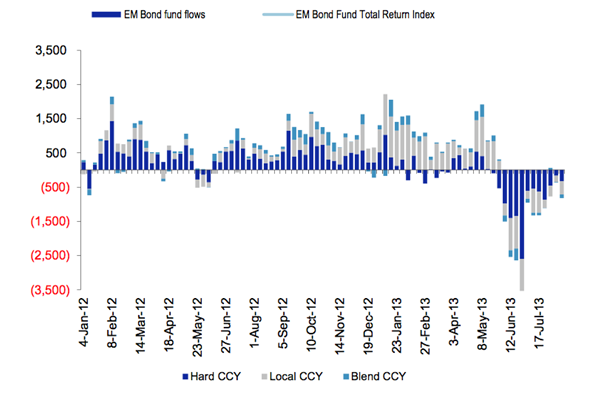
While the Fed’s intentions may turn out to be mere talk, the verbal intervention was enough to burst the post-crisis bubble in emerging markets, inflated by the loose monetary policies of major central banks. Most of the money flowing into emerging markets over the past five years was the result of investors seeking high returns due to the arbitrage opportunities created by central bank policies.
The interventionism of the latter has allowed major players in the financial markets to borrow funds at almost zero interest rates from countries such as Japan and the United States and to invest this money in places such as Indonesia and India, where the rate of return is relatively high. Many commentators have confidently stated that the loose policy of central banks will not lead to inflation, but as has been commented on several times in the EKIP, inflation is an increase in the money supply beyond the money demand. In other words, inflation in the past few years has been quite high, but the increase in prices has been observed mainly in financial assets (including in emerging markets) because it is to them that the excess liquidity was directed.
The results of the bursting of yet another bubble created by monetary interventionists are already here. The Indian rupee is hitting new all-time lows against the dollar day after day (Chart 2), interest rates on the interbank credit market are soaring, and the yield on 10-year government bonds has increased by over 1 percentage point in a week (Chart 3).
Graphics 2

Graphics 3

The situation in other emerging Asian markets (and beyond) is not much different, although the speed with which events are developing in India seems to stand out above the rest. The authorities in India have already begun to take measures to deal with the growing crisis. A number of measures have been imposed to restrict capital movements (limiting gold imports, limiting the amount of investments outside India by local companies, limiting money transfers, etc.), and the central bank has poured 80 billion rupees into the banking system in order to improve liquidity. Will these measures have an effect in dealing with the crisis? Very limited...
Government interventions aimed at reducing the negative effects of previous interventions lead to a vicious circle, from which taxpayers always lose. It can be expected that capital outflows from developing economies will continue to grow, and the measures of the authorities aimed at limiting them will only lead to the growth of black markets. Currencies will continue to depreciate, and central banks in these countries will begin to increase their key interest rates, in order to limit price inflation generated by more expensive imports, as well as to attract foreign capital back with more attractive rates of return.
And so on until the country officially declares bankruptcy or the International Monetary Fund comes to the rescue. Finally, the mass of "experts" will start blaming bad speculators seeking short-term profit, forgetting two main factors behind the behavior of these market players - bad economic policy in the country of investment and the artificial lowering of the price of credit by central banks in developed countries.






Why are they worried about a developing crisis?
Perhaps due to a lack of knowledge about full-fledged state governance in a euro economy?
The situation in the world is clear.
In 2013, the economic difficulties were due to a mistake - an unprofitable way of governing the country.
Example: If this weakness were absent, countries would not have the debts available in 2013.
The premise of the error is disregard for the qualities of money.
Within 24 hours after the end of the state error - the danger of escalating an impending economic crisis will have been successfully overcome.
Ivan Mitev - economist