EKIP– Expert Club for Economics and Politics A Different Opinion

Electricity and gas prices in the UK are expected to rise by 8-9% over the winter season. From the apocalyptic picture that the British media is trying to paint, one might be left with the impression that we are talking about some developing country whose energy supplies are monopolized by Russia. Let's see if this is so, whether the "problem" with prices is not being helped by the government, and what the desired populist measures will lead to.
Albion residents will pay an average of about 8% higher energy bills this winter. According to a new survey, 32% of them will definitely take measures (you know – they will heat less), and another 35% will probably change their heating “habits”, with 88% of households being affected by the price increase. Only 4% are of the opinion that energy supply companies should set their own prices; the remaining 96% want state intervention (50% of all respondents propose direct central pricing by the state and a freeze on electricity prices). The group most affected is expected to be people with the lowest incomes, namely young people between 25-34 years old.
This scenario has played out in our country as well: the price of electricity (and gas) is rising and in the winter people are taking to the squares. As in Bulgaria, what is visible is the increasing costs of heating. But what is not visible is that the proposed solutions for direct state intervention will increase the problems for electricity and gas consumers on the Island.
Part of the reason for the high price is due to government regulations and energy policies. The UK, like us, has a goal of 15% of its energy capacity being from renewable energy sources by 2020. To achieve this, it must subsidize inefficient “green” production, which is one of the reasons for the increase in the cost of electricity and the reduction in the disposable income of taxpayers. Less than two weeks ago, parliament proposed a further increase in the tax on “green” energy, which, according to the BBC, will increase the cost of household bills by another £50 per month.
Consumers in the United Kingdom are also required to pay other taxes on the energy they consume. Among them is VAT – 20%, which is paid by both companies and households. Consumers are also required to pay a whole range of other taxes. These include: direct tax, carbon tax, a levy to support low-emission production, a levy to maintain energy efficiency and a levy to help vulnerable consumers. The dynamics of the regulatory burden are depicted in Chart 1. Businesses (in practice, consumers, through whose accounts the supply companies collect the funds for the tax) are also burdened with another tax (which aims to make enterprises, whose price increases, be more energy efficient?!) – the so-called climate change levy. It amounts to between 0.182 pence/KWh (for gas) and 1.172 pence (for kg of propane-butane).
Chart 1: Dynamics of regulatory taxes and levies on household electricity consumption in the United Kingdom
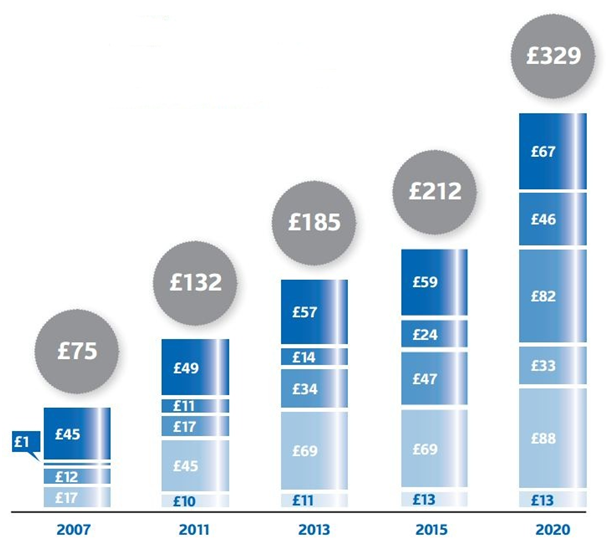
Source: Energy Explained: The Changing Cost of UK Energy, RWE, 2013 ( legend: from darker to lighter blue: direct tax, carbon tax, low-emissions levy, energy efficiency levy and vulnerable consumer levy).
If the forecasts for the growth of the regulatory burden on electricity consumers for the period 2007-2020 come true, state taxes and fees will have the largest growth both in percentage terms and in absolute value. Their dynamics against the background of the other components is shown in Chart 2.
Chart 2: Components of the price of electricity for households in the United Kingdom
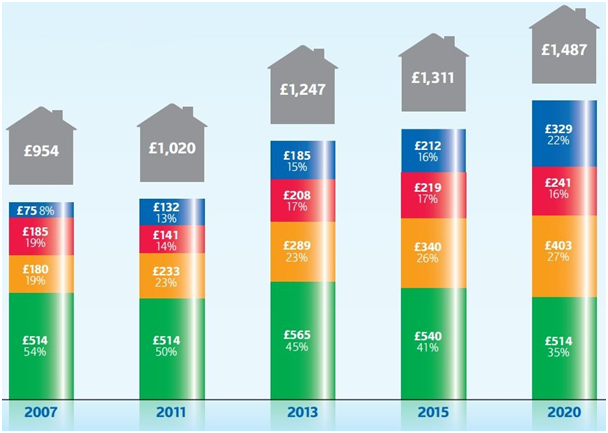
Source: Energy Explained: The Changing Cost of UK Energy, RWE, 2013 (legend: green– cost of energy production; orange– cost of transmission; red– supplier cost; blue– government taxes and fees)
Another thing to keep in mind is that in England, up to 45% of net income is taken from income tax alone. Added to this are all indirect taxes, social security and health insurance payments, indirect taxes and corporate taxes (which increase the price of companies' products, and this is paid by consumers).
The result is the following situation: by the time it comes to suppliers and companies involved in energy transmission increasing the price, a huge part of the income of individuals and households has already been taken away by the state, including through taxes and fees on the electricity itself. If all this money had remained with the people who produced it, an increase in electricity and gas of 8% might: 1. have less value and 2) not be felt by consumers at all. In other words, the bigger problem is that 80% of individuals' incomes are being forcibly taken away, not that the price of electricity is moving.
When companies increase the price of their products on the free market (to the extent that a market burdened by several types of taxes can be called “free”), but the government freezes it, companies have no incentive to continue supplying it – a shortage of the good results. This is explained beautifully by Dr. Madsen Peary, one of the founders of the Adam Smith Institute, in this short video.
The state has not stopped at restricting free competition through high taxes alone. Electricity distribution companies must obtain a license from the regulator to operate. This further increases the price of electricity because it effectively blocks the entry of new suppliers, effectively creating an oligopoly – a trading structure that would not be possible in a free market.
Electricity and gas are commodities. The prices of commodities, even in a market where access is restricted by licenses, are influenced by external effects – i.e. they can change. We witness price fluctuations almost daily. Usually this does not scare us. But if electricity prices are subject to market movements (up and down) and therefore the authorities “have to act” through further restrictions and freezes, then why not freeze the prices of every single commodity, even though the prices of absolutely everything are not constant, but are subject to market forces.
The answer is easy. We can see it outside of economic theory. The USSR and the collapse of the empire are indicative of the results of price fixing and central determination. It would be naive to believe that those in power are not aware of elementary economic theory, which even a first-year student could handle, or that they do not know the history of a huge socio-economic experiment like the USSR. However, the price of electricity is extremely convenient for instilling panic, as a tool for increasing the restrictive functions of the state and as a political lever for buying votes. It was taken advantage of by the Labour Party, who promised to freeze electricity prices for 20 months if they managed to win the 2015 elections. But using this lever for these purposes will only lead to even higher electricity prices or to the unthinkable for a developed country like England – a deficit of electricity and gas.
It is not the 8% increase in electricity and gas that is the problem. The invisible to many is already a state-created evil that makes citizens poorer and that limits competition between companies. The solution is no more state intervention; the solution is for the state to leave the market to the Invisible Hand and to stop its criminal practice of stealing individuals' money. If the British government wants the people of the country to live better, the logical first step is to stop forcibly seizing their incomes.