 EKIP– Expert Club for Economics and Politics A Different Opinion
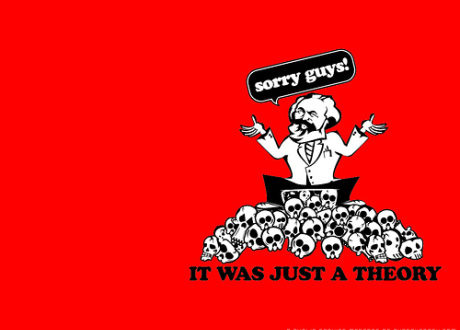
This article examines the main problems in one of the fundamental constructs of Marx's theory of capitalist economics. The shortcomings of the labor theory of value are pointed out in Marx's Capital to show how this leads to the collapse of the "capitalist exploitation" thesis. The subjective theory of value in its Mengerian (Austrian) interpretation is also explained.
In the labor theory of value adopted by classical economists, Marx found the path to communism through the progressive impoverishment of the proletariat, subjected to expropriation by the unproductive capitalist class. This theory is the basis not only of his criticism of capitalism, but also the starting point for the bloody revolution that will lead humanity to the final historical stage - socialism.
Obviously, if the labor theory of value proves untenable, so too must the inexorable laws of history that Marx claims to have discovered. With this in mind, Marx, in composing his works, pays great attention to the definitions of commodity and value, so that they fit into the theory. In the very first lines of the first chapter of Capital, we find the following statement:
“A commodity is, above all, an external object, something that, with its properties, satisfies human needs of some kind.” [1]
By excluding services from the definition, Marx greatly facilitates the task of deriving a theory of the origin of value, which, however, because of this exclusion, cannot be universally valid. Prices arise on the market for services and for “immaterial” goods and these are exchanged, so that obviously acting individuals recognize utility in them as well. In the following lines, utility is mentioned as a condition for considering a given object as a commodity, but according to Marx this utility does not “hang in the air”, but derives from the properties of the commodity:
“Determined by the properties of the commodity body, it does not exist without it. Therefore the commodity body itself, e.g. iron, wheat, diamond, etc., is a use value or good. This character of the commodity body does not depend on whether the appropriation by man of its use properties costs him much or little labor.” [2]
As we see, Marx views utility as a physical phenomenon inherent in the commodity, but still recognizes that utility has no connection with the labor required to produce it. Since this fact does not fit at all into the labor theory of value, Marx repeats Ricardo's division between use value and exchange value, but both, in his opinion, are objectively measurable values, and gives an example from geometry to reinforce this view:
“In order to determine and compare the areas of all rectilinear figures, the latter are divided into triangles. The triangle itself is reduced to an expression quite different from its apparent figure, — half the product of the base and the height. In the same way, the exchange values of commodities must be reduced to something common, of which they represent greater or lesser quantities.” [3]
And this common denominator for all goods represents the average socially necessary labor time for their production:
“A given use value or commodity has value only because abstract human labor is objectified or materialized in it. But how can the magnitude of its value be measured? By the quantity of the “value-creating substance” contained in it, by the quantity of labor. The quantity of labor itself is measured by its duration, and labor time has its scale in certain fragments of time, such as an hour, a day, etc. […] Each of these individual labor powers represents the same human labor power as all the others, insofar as it has the character of a social average labor power and acts as a social average labor power, that is, it uses only the average or socially necessary labor time for the production of a commodity . ” [4]
Marx insists that exchange value has nothing to do with use value. However, several questions immediately arise here, such as what, if not the subjective preferences of consumers, determines which work creates goods and which does not, what is this external unit of value? Moreover, how would Marx's theory explain the value of a glass of water in the desert, for example? First, water does not require human labor to produce, and moreover, a physically equivalent unit of water would have very little or no exchange value in areas where it is abundant compared to the Sahara. In general, natural resources that have arisen without human intervention also clearly have both use and exchange value, which, however, cannot be explained by labor theory.
Also, what can we say about the value of unique and unreproducible goods such as works of art? This example actually illustrates another serious problem even with “ordinary” mass-produced goods. It is obvious that we cannot measure the works of Michelangelo or Da Vinci in “average necessary” labor time, precisely because the quality of their work is clearly incomparable to the imaginary average social value. The collection of the labor of many mediocre artists cannot lead to a masterpiece. The same applies to seemingly homogeneous goods produced in millions. To arrive at a product ready for consumption, development and design work, logistics, preparation for production, multiple stages of manufacturing, technical and financial control, distribution and countless more working hours performed by different people, with different qualifications and with different quality are necessary. Instead, Marx decides to ignore the real circumstances of the inhomogeneity of labor, abstracts from its use value and thus
“the different concrete forms of these types of labor also disappear: they no longer differ from each other, but are all reduced to the same human labor, to abstract human labor.” [5]
Marx perceives the amount of abstract labor embodied in a commodity as the basis for exchange relations and prices:
"Now let us take two commodities, e.g. wheat and iron. Whatever their exchange ratio may be, it can always be expressed by an equation in which a given quantity of wheat is equated with a certain quantity of iron, e.g. 1 quarter of wheat = a centner of iron."
iron. What does this equation mean? That something of the same magnitude exists in two different things, in a quarter of wheat and in a hundredweight of iron. Therefore both are equal separately to a third thing, which in itself is neither the one nor the other. So each of these two things, in so far as it is an exchange value, must
can be reduced to this third.” [6]
From this paragraph we understand that the exchange of two goods necessarily means that they are of equal value, objectively commensurate with something third, and we can represent them as two sides of an equation. We do not understand, however, why some people then bother (and accept the transaction costs) to exchange two goods whose objective exchange values are equal, so that the choice given to them should leave them indifferent. Nor is the converse of this question clear - why other people in similar circumstances do not make such an exchange of equal for equal? In a later paragraph Marx nevertheless returns to this question, making an implicit concession to the subjective theory of value, stating that exchange occurs because two individuals have a different assessment of the use value of the commodity.
In fact, the circumstance of equivalent exchange is the basis of Marx's theory of exploitation. Since commodities are always exchanged on the basis of the average labor necessary for their production, i.e., equivalent is always exchanged for equivalent, there is no place to take profit (and in this sense, loss). It is possible only because the capitalist pays the wage worker the equivalent of the average labor necessary for his "reproduction", but requires him to work more than would be necessary to create the products necessary for his survival. If, for example, 6 hours of labor are sufficient for the worker's subsistence, the capitalist forces him to work 8, and thus the additional 2 hours constitute surplus value (Mehrwert) that the capitalist acquires by exploiting the worker. Moreover, Marx even comes to the conclusion that the worker always credits his employer, because the latter consumes his labor power now, and pays for it only at the end of the contractual period:
“So everywhere the worker advances the use-value of his labor-power to the capitalist; he lets the buyer consume it before he has paid him its price; therefore the worker everywhere credits the capitalist.” [7]
Menger, methodological subjectivism and marginal utility
It is not unequivocally historically proven whether Menger's interest in the problems of the theory of value arose due to his journalistic activity related to monitoring developments on the Vienna Stock Exchange, but it sounds logical that someone confronted with constantly and sharply changing prices, speculation based on expectations rather than the past, would have difficulty seeing reality explained and analyzed by the naive labor theory of value (used by Marx).
Perhaps this is why Menger approaches things in a fundamentally different way, placing the acting person and his perceptions at the center of the study, laying the foundations for the scientific principle of methodological individualism. [8] Thus, the definition of a “good” is oriented primarily towards the individual and in particular towards the needs, knowledge and resources at his disposal. Menger formulates four conditions for considering something as a good:
"1. Human need.
2. Such properties of the thing that make it suitable should be placed in a causal relationship with the satisfaction of this need.
3. The person's knowledge of this causal relationship.
4. The disposition to this thing so that it can actually be attracted to satisfy this need.” [9]
That is, only the fulfillment of all four conditions leads to the emergence of the status of a commodity, and the omission of one of them removes the considered object or service from the sphere of human action. For example, almost universal needs for heating and transportation can be satisfied (in combination with other goods) by oil (i.e., processed oil products), fulfilling the second condition. Oil as a raw material was formed millions of years ago, but only relatively recently did humanity learn that this resource has an application for satisfying needs (fulfillment of the third condition) and technologies for its processing began to be developed, covering the fourth criterion. Previously, in the few places where oil was so close to the surface that it gushed out independently, local people viewed the same physical units as a problem rather than as a valuable resource. Also, the technology for extracting oil from unconventional sources has been known for several decades, but only the decreasing costs caused by improvements in technology and rising prices make extraction by this method economically "affordable", fulfilling the fourth characteristic of this commodity type of oil.
Menger develops the argument further in the following lines by mentioning various types of goods that do not show a direct or even any objective connection with the satisfaction of human needs, but are nevertheless considered as goods by acting individuals. As an example, Menger gives almost all cosmetic products, amulets, most medicines used by primitive peoples, love elixirs and the like. All objects that can only be subjectively considered as an appropriate means to achieve the ultimate goals set by the acting individual. It follows from this that even the causal relationship between the object or service and the ultimate goal does not need to be objectively provable, the subjective judgment of the acting individual that such a relationship exists is sufficient. On the other hand, Menger introduces the classification of “economic” and “non-economic” goods, the latter obviously having utility, but being available in such quantities that the loss of a certain amount of them does not lead to the non-coverage of any human need. It follows that such "goods" (the most common example being air) do not need to be economized and thus do not fall directly into conscious human action.
Here we see the clear contradiction with the naive objective theory of value, which accepts utility as a derivative solely of the physical properties of the object, without taking into account the actions of the individual.
Menger concludes that
“Value is therefore nothing attached to commodities, it is not their property, nor is it an independent, separate thing. Value is a judgment that economizing people make about the importance of the commodities that are at their disposal for the preservation of their life and well-being, and for this reason it does not exist outside the consciousness of the same. It is therefore wrong when a commodity that has value for economizing subjects is called “value” or when economists speak of “values” as if they were independent real things, thus objectifying value. For what exists objectively is always only the things, respectively the quantities of them, and their value is something essentially different, namely the judgment that economizing individuals create about the importance that having them has for the preservation of their life and well-being. The objectification of commodity value, which is by its nature subjective, has contributed greatly to the confusion of the foundations of our science.” [10]
The “discovery” of marginal utility is attributed in standard texts equally to three economists who arrived at the theory independently and almost simultaneously – Leon Walras, William Stanley Jevons and Menger. In fact, beyond the superficial similarities between the texts of the three, fundamental differences in methodology are hidden. Walras and Jevons are mathematical economists and according to them utility can be measured, added up, subtracted and in general any mathematical functions can be derived from it. In general, the mathematical approach, aimed at deriving a series of equations describing a timeless state of general equilibrium, is useless in an attempt to explain the cause-and-effect relationships behind economic phenomena. And Menger considers this to be precisely the purpose of economic science [11].
In fact, the term marginal utility (Grenznutzen), which entered modern economics, was introduced by one of Menger's students, Friedrich Wieser. Menger himself does not give an explicit name to this concept, but discusses it, for example, in this paragraph:
If the need for a commodity exceeds the available quantities, then we find that since a part of the needs will remain unsatisfied anyway, there is no way that the available quantity of the commodity in question can be noticeably reduced without thereby leaving some need, previously covered, un- or incompletely satisfied, compared to the situation we would have had without the occurrence of this contingency.
In all commodities which are in the above-mentioned quantitative relation, the satisfaction of some human need depends on the possession of any concrete, practically significant quantity of the same. And when economizing individuals recognize the circumstance that the satisfaction of any of their needs depends on the possession of the commodities in question, respectively of any concrete commodity in the above-mentioned quantitative relation, then these commodities acquire that significance which we call value and thus represent the value of the significance which concrete commodities or commodity quantities acquire for us, that we are aware of the dependence of the satisfaction of our needs on the possession of the same commodities. [12]
Considering specific quantities of a good, which in any case cannot be sufficient for all needs, we come to the conclusion that the last unit of this good will be used for the last most important need. Reducing the available quantity by one unit then leaves the need in question unsatisfied. It is this difference that is the marginal utility, and the sequential arrangement of needs according to their importance for the acting person is determined by the subjective preferences of the same.
Once we have concluded that value is subjective, we should not expect that both parties to a transaction will value the goods exchanged equally. On the contrary, it is precisely because two economizing individuals recognize greater value in the acquired good than in the given good that an exchange occurs at all. Menger lists three conditions necessary for this to happen:
"a) At the disposal of an economizing subject there must be quantities of goods which have a lower value for him than other quantities of goods at the disposal of another subject, and in the latter case the inverse ratio must be given in the assessment of value
b) The two economizing entities must have come to know about this ratio and
(c) it must be within their power to effect the aforementioned exchange.” [13]
The theory that prices are determined by the costs of producing a commodity in Marx's view, of course, also applies to the wages that capitalists pay the proletariat. They are always just enough to cover the most basic living expenses, i.e. the costs of producing labor power - the survival of the worker and possibly his family. Even if we assume for the moment that Menger did not unequivocally refute the labor theory, the idea that surplus value arises solely from human labor has serious consequences in considering the percentage of profit that capitalists extract from the exploitation of the worker.
In fact, the labor theory of value in combination with his capital theory confronts Marx with an insoluble contradiction that requires him to abandon one or the other, which is what he ultimately does. We will deal with this in more detail when we present Böhm-Bawerk's critique of Marx in the next article. For the moment, it is sufficient to mention that later apologists for Marx such as Paul Sweezy and Hilferding try to save [14] the labor theory by claiming that Marx never tried to explain actually occurring prices, but rather some mystically inscribed "values" in the nature of commodities, without any connection to the real world. Not a particularly plausible claim, considering what Marx literally says:
The constant fluctuations of market prices, their rise and fall, compensate for each other, cancel each other out, and themselves reduce to the average price as their internal norm. [15]
This approach is more familiar to us from religious sects, which, confronted with their unfulfilled predictions, change their content.
[1] Marx, Karl: Capital, First Book, Sofia, Publishing House of the Bulgarian Communist Party, 1948, p. 31
[2] Marx: Capital, Volume I, p. 32
[3] Capital, Volume I, p. 32
[4] Capital, Volume I, p. 34
[5] Capital, Volume I, p. 33
[6] Capital, Volume I, p. 33
[7] Capital, I, p. 143
[8] Mises, Ludwig von: Human Action: A Treatise on Economics, 4th Edition, Fox & Wilkies, San Fransicso, 1963, p.41-44
[9] Menger, Carl: Grundsätze der Volkswirtschaftslehre in The Collected Works of Carl Menger, Volume I, The London School of Economics and Political Science, London, 1934, S. 3 (the Bulgarian translation is by the author of the article)
[10] Menger: Principles, p. 86
[11] White, Lawrence: The Methodology of the Austrian School Economists, first published by the Center for Libertarian Studies, New York, 1977
[12] Menger: Principles, pp. 77-78
[13] Menger: Principles, p.159
[14] Rothbard, Austrian Perspective, Vol. II, chapter 13.
[15] Capital, p. 137





Congratulations to the author, who apparently read Marx's "Capital". That is a feat in itself. As far as I've heard, few people have had the desire and time to do the above. I am not one of them.
And Marx is popular and will remain so in the future. For me personally, the reason is that he made good use of the available situation and gave an explanation of things that is simple and wrong, but seems more than obvious.
Example: I am a worker in a transportation company, for example. I dare not complain and raise my voice, no matter what my boss says because otherwise outside, and as we know outside there are many people who want my job and little chance of finding another job. The employer also knows the above and therefore allows himself to behave "exploitatively", making me work 12 or more hours a day, paying me miserably and constantly delaying my salary. So how can you not come to the conclusion that Marx is right? And that the employer is an exploiter? Marx was right! And how else!
The problem with this conclusion is that it is not true. Marx described things well, but he was wrong about the reasons. That is, it is important to ask ourselves the question "Why does the above happen?". That is, why can an employer nowadays (but not always) mess with workers? The answer is actually completely prosaic and it is that the worker has no choice because of the EXISTENCE OF UNEMPLOYMENT.
Imagine for a moment a situation where there is as much work as you want. And your boss tries to make you work more or do something that you don't like. You automatically take your hat and move out. And there will be no problem, because jobs are scarce. The employer, on his part, however, finds out from experience that it is not desirable to try to screw over the workers (they leave and others will not come) and starts to behave with them properly. Note that the employer may be the biggest monster on earth, but he will have to behave properly, whether he wants to or not. The market will impose such behavior on him.
In modern times, employer and employee are not equal, but if there were no unemployment, they would be on equal footing.
So, the problem is unemployment. Now the question is what is it due to. If I am not mistaken, both Marx and modern economic theory (with which I do not agree) claim that unemployment is something normal for capitalism. And if this is so, then we must directly conclude that the worker is screwed by capitalism. There is no other option.
Anyway. Austrian economic theory claims that unemployment is an ABNORMAL state of an economy. And that unemployment is due to the state's intervention in the economy, trying to regulate it.
For example, taxes on profits (they reduce profits, and from profits come investments, and from there jobs), minimum wage and minimum insurance thresholds (lead to unemployment), bans or difficult dismissals (with the result that people simply are not hired because the risk is high), licensing and other regimes (many businesses cannot develop due to these obstacles), lack of a functioning judiciary and executive branch (then people do not produce because no one can protect them from theft, encroachment, etc.; example: almost the entire African continent), and many more.
The above obstacles, however, are simply taken for granted because we are taught since school and with the help of television and the media in general that "Whatever the state does, it does in the interest of the people". With the consequence that all of the above things are labeled "RIGHT". And no one cares that you can't just get something for nothing, and that every action against the market economy has bad consequences.
Where is it simpler and more sensible to say: "Capitalism is to blame! Employers are exploiters! Marx is right!"
In general, this argument is pointless and regardless of what a commodity is and how much it costs, exploitation exists and this is proven in an elementary way. The most general definition of exploitation is taking from someone something that they deserve and giving it to someone else who does not deserve it. In his theory, Marx tries to prove exactly this, that what is deserved is taken from the worker and given to the capitalist. So, in general, the question comes down to a fair distribution of the total produced goods. I do not know if according to all economists, but at least according to extreme neoliberals, to which I also include the Austrian School, fair distribution is carried out by the market. This assumption is made axiomatically and is not subject to doubt. The definitions of value also revolve around it.
But the market is actually a unfair game. The division of labor and the private ownership of the means of production make it an unfair game. They place the private individual and the wage earner in different positions in relation to the market, and the different positions immediately lead to privilege and disprivilege. Thus, the private individual hires labor and sells goods, while the wage earner sells labor and buys goods. The continuous existence of unemployment, which EE points out, is one of the signs of the privileged position of the private individual in relation to the wage earner. But there are others. Due to the division of labor, the wage earner does not produce a ready-to-use product. Therefore, his, the wage earner's, existence (even physical, since in the production of food there is also a division of labor and private appropriation of the produced product) falls into direct dependence on the private individual. It is this dependence that expresses the often mentioned expression "investors will flee". The inverse dependence of
The private individual's protection from hired labor is many times weaker, since through bankruptcy the private individual risks only becoming a mercenary, which should not be so problematic for him, since he believes that mercenaries are not exploited and get what they deserve.
The correct determination of prices "by the market" is also very controversial.
Economic bubbles are definitely not a sign that the market is capable of determining prices. The Austrian School view that economic bubbles were the result of expansionary monetary policy "by the state" simply does not correspond to the truth. The first economically recorded bubble in the world was the "tulip mania" in Holland in 1637, the first global economic bubble was the "South Seas bubble" of 1720. In these times, not only were central banks out of fashion (the Bank of England was founded in 1694), but fiat money was practically non-existent. What was used was not just the gold standard cherished by the Austrian School, but outright gold and silver money. And yet there were bubbles.
Second, since private individuals own all or almost all goods (and services) of almost every kind, their herd behavior may be decisive for the selling price of goods, rather than the balance between supply and demand. In other words, private individuals selling comparable goods look out for each other, and when one raises the price, the others follow. An unintended monopoly results. People have no choice but to buy. This is a good mechanism for explaining the inflation of bubbles. The fact that the bubble will burst sooner or later is of little consolation, since the bubble has already done its damage. Obviously, the balancing of supply and demand is either too slow or does not work in the first place. It turns out that the dependence of private individuals as a group of mercenaries on the market is actually quite weak, which once again puts private individuals in a privileged position.
I think these arguments are more than enough to recognize the market as an unfair game leading to an unfair distribution of collectively produced goods. Hence - the privileged players - the privateers - receive undeserved benefits at the expense of the mercenaries (because the produced amount is a finite amount) and therefore appear to be exploiters.
The result can be seen in the data on global inequality. As Oxfam reported last month, 85 people own as much wealth as 3.5 billion people. One immediately asks, what were the merits of these 85 people? What exactly did they contribute so much to the development of humanity, in what direction, why in this particular direction, etc.? Obviously, this is not about any rewards according to merit. This is about unfair play, and it is no wonder that people do not accept it, resent it and try to expose it.
Now about the myth "the state is to blame". The elementary and naivety of this view are of course indisputable, but it needs to be commented on due to its widespread distribution. The Austrian School is a school that is amazingly at odds with factology. In fact, it treats facts arrogantly and does not hesitate to distort and falsify them. And the historical facts are that those countries that have been implementing a free market since the 18th century in the middle of the 20th century are the poor third world, and those that apply protectionism towards each other (with the exception of Great Britain and 4 other small European countries) turn out to be rich and developed (details and sources here http://antipropaganda.comxa.com/IkonomIst.html http://antipropaganda.comxa.com/BadSam.html ). This fact is explained by the theories of the Austrian School in a way that refutes it. The Austrian school divides private individuals into honest ones, who do not use the state to gain an advantage over competition, and dishonest ones, who use the state for such purposes. It turns out that capitalists in Western countries have used their states to protect themselves from competition from their neighbors. In addition to falling into the category of “bad capitalists” (respectively, Third World capitalists are good!), the theory claims that such capitalists cannot gain an advantage, but corrupt and destroy the entire system. The fact is, however, that Western countries, respectively Western “bad private individuals”, gain an advantage by using the state. The “bad private individuals” from South Korea did the same in the second half of the 20th century. The “bad” Chinese private individuals are doing the same now. It turns out that either “bad private individuals” can profit by using the state without destroying its system. In conditions of competition, the use of the state is clearly decisive, which is why there simply are no “good and honest” people (according to the definition of the Austrian School, e.g. Reisman) and there will never be any. This also makes the whole theory of “ideal” capitalism meaningless, it is inapplicable. It does not correspond to reality. Yes, one can generalize the system and say that these “bad” capitalists have corrupted the world capitalist system and that is why there is now such great social inequality. But what does this change, since only a vicious system is possible.
That's not all. Since Reagan and Thatcher, the world economy has become more liberal, but for some reason it has not become more stable, and inequality, instead of decreasing, is growing. Well, it may be stagnant if we include China, but China is generally a ("socialist") country that heavily interferes in the economy (similarly for India). The former socialist countries, thanks to shock therapies, are some of the most liberal. In most cases, the result is deplorable compared to theoretical expectations. And finally, we have the almost pure Chilean experiment from the Pinochet era. An experiment conducted under the supervision and guidance of two Nobel laureates - Friedman and Hayek. The result - failure. With the withdrawal of the state from the economy, a collapse occurs, unemployment jumps incredibly (from 3% under Allende to 20 under Pinochet and to 30 in 1982), inflation doubles, and in the 1980s hyperinflation hits. 45% of the Chilean population falls below the poverty line. Even now, Chile is one of the countries with the greatest social division (8th place in the world). (Of course, Milton Friedman invented the lie about the “Chilean economic miracle”. As I said, neoliberals and the Austrian school do not respect the facts.) Thus, the empirical conclusion is formed that the less the intervention of the state, the greater the inequality, i.e. the more unfair the distribution of goods and, accordingly, the greater the exploitation (of workers). And this is natural - the redistribution of the state corrects the result of the unfair game called the market.
Of course, there is no escape from dogma – if it has not happened, it is because of the intervention of the state. There is no pure capitalism anywhere, everywhere the state interferes, i.e. there is “socialism” according to the definitions of the Austrian School! Notice the brazen Jesuitism – any capitalism that has failed is “socialism”, and pure capitalism that has not failed is nowhere to be found. The question remains, why whenever we get closer to this “pure capitalism”, as in Chile, in most of the former socialist countries, in the Third World, the worse it gets and the greater social stratification occurs, and vice versa, the further we are from this “pure Austrian capitalism”, the better it turns out, as in Western Europe, the USA, Japan and especially the Scandinavian countries. The trend is clear and obvious, just as when you approach a hot stove it gets warmer, and when you move away it gets colder, and when you approach pure capitalism it gets worse, and when you move away it gets better. But the Austrian School wants to convince us that if we sit on the hot stove it will be best for us. You can call it that.
Finally, if ideal capitalism does not exist in reality, then it can be modeled by computer. This is done using the “agent method”, which is widely used in economics. The result is that no matter how goods are exchanged, and note that they are equal! agents, and not privileged and unprivileged, as is the case in reality, the distribution of income and wealth is of the Gibbs-Boltzmann type. The interesting thing here is that the distribution of American households by income (taken from tax returns) follows the Gibbs-Boltzmann distribution with exceptional accuracy for the economy, which confirms the relevance of the model. The bad thing is that the Gibbs-Boltzmann distribution is actually exponential and already represents a sufficiently large social division. Well, the data on the income of American families differs slightly from the Gibbs-Boltzmann distribution – they have a “Pareto tail” at high incomes, which is due to the fact that in reality the agents are not equal – private individuals are privileged. The model also explains why inequality increases as we approach the “ideal Austrian capitalism”. If constant lending is added to the model with agents, then a constant (stationary) distribution is not established, and inequality grows to infinity. Here the Austrian school will say – oh, that’s why we want a 100% gold standard. Except that the capitalist system cannot exist with a fixed total money supply and even according to their own models, deflation and a decrease in profit growth are reached, to which they respond – no, this is not deflation and it is not a decrease in profits. Clever! But even if they are right, the stationary Gibbs-Boltzmann distribution already represents an unacceptable social division and a high degree of exploitation of workers. Well, the unemployed are not exploited – they are simply rejected by society. In the utopian “ideal capitalism”, they may not exist, but as we approach it, millions will starve to death. That is why it is up to the state to stop the madness of the market and reduce its harm.
So, returning to the original question – as you can see, neither Marx nor any theory of value is needed to prove that exploitation exists and that it increases with the withdrawal of the state from the economy. Regardless of whether Marx is wrong or Menger is wrong, people are completely justified in resenting it, completely justified in wanting change and completely justified in fighting for it. Man is the only starting point in the search for a measure of justice. Such a measure cannot be imposed on him from the outside, neither by the market, nor by another similar game (for example, “here there is, here there is not”), nor by the Austrian School or the Martian School. The only question is that people are asked and listened to, and not lied to and manipulated.
@Kihano
I see your post a little late. Let me note that I am very pleased to discuss with you. You are one of the people with an opinion, who reads, has something to say and is interested. And the fact that you hold socialist views even makes the discussion more interesting. I see that you have read some things about the Austrian school, which is very commendable and you are definitely one step ahead of me (I have not read Marx, but I am an admirer of Chomsky's observations (not theories).
Comments:
"I don't know if according to all economists, but at least according to the extreme neoliberals, to which I also include the Austrian School, fair distribution is carried out by the market. This assumption is made axiomatically and is not questioned. The definitions of value also revolve around it."
I personally wouldn't say that I have anything in common with neo-liberals. My ideas are different. About the axiomatic assumption: you are right in my opinion. However, it is based on philosophical principles, namely the non-use of violence (not inciting violence).
"The continued existence of unemployment, which EE points out, is one of the signs of the privileged position of the private individual over the hired worker"
I'm glad we agree.
"The private sector's inverse dependence on hired labor is many times weaker, since through bankruptcy the private sector only risks becoming a hired laborer, which should not be so problematic for him, since he believes that hired laborers are not exploited and get what they deserve."
I disagree. A private individual risks much more than a worker. And what he risks is the capital he has invested. Example: I have been saving for 10 years and have saved 20,000 leva to start a company. I rent a building, buy machines and hire people. However, the company does not work and goes bankrupt. And then I am on the street but with a 20,000 leva loss. And my workers are on the street with 0 leva personal loss. As a private individual, I risk more than them.
"Economic bubbles are definitely not a sign that the market is capable of determining prices. The Austrian School's view that economic bubbles were the result of expansionary monetary policy "by the state" simply does not correspond to the truth. The first economically recorded bubble in the world was the "tulip mania" in Holland in 1637, the first global economic bubble was the "South Seas bubble" of 1720. In these times, not only are central banks out of fashion (the Bank of England was founded in 1694), but fiat money is practically non-existent. It is not just the gold standard cherished by the Austrian School that is used, but outright gold and silver money. And yet there are bubbles."
The correct view (my) on the matter is that the expansion of the money supply is to blame for the bubbles. Typically, the state is responsible for this, but in different ways. Nowadays, the process is commanded by central banks, but earlier it was not like that. And again, money increased. I have heard of your examples, but I am not familiar with the details. Let me just say that the so-called "gold standard" that you are talking about was typically a partial one, i.e. the money in circulation (banknotes) was not 100% covered with gold, but only partially. And this means that if, for example, 1 ton of new gold entered the market, the banks made the equivalent of 4 tons from it (at 25% coverage). That is, in one way or another, even in your examples, money increased. Yes, there probably were no central banks, but the result is the same. Another way in which the state allows monetary expansion indirectly is when it does not allow the use of alternative currencies. In practice, there has always been a state monopoly/control over money. I know the history of Great Britain, which really wanted to finance its wars, but somehow (the population rebelled against new taxes, and no one wanted to lend gold to the state anymore). Then they imposed today's monetary system by force and found money to wage their conquests.
“In other words, individuals selling comparable goods look out for each other, and when one raises the price, the others follow. You get an unintended monopoly. People have no choice but to buy. This is a good mechanism to explain the inflation of bubbles.”
It's not a good explanation. Imagine that the money supply is fixed. And a group of private individuals somehow raise prices together (just for the sake of discussion). This means that people will have to pay more money for these products. However, with a fixed money supply, this also means that they have to pay less for OTHER products. That is, to buy the same amount of a given good as before, they will have to give up something. However, people don't like to give up something. The result is that the more expensive a given good becomes, the less people will buy it. And the reason is that people won't have the money to buy it with. You can't buy houses when you can't afford to buy bread.
In contrast, in an economic bubble, people can buy without depriving themselves of anything else. And the reason is that there is a lot of money in the banks. If the money in the banks were fixed, then at the beginning of a “bubble” it would start to run out. And when it runs out, the banks will have to raise interest rates, which means that the “bubble” cannot inflate. The market will work against it. However, when money increases, the regulating function of the market cannot work.
"The result can be seen in the data on global inequality. As Oxfam reported last month, 85 people own as much wealth as 3.5 billion people. One immediately asks, what were the merits of these 85 people? What exactly did they contribute so much to the development of humanity, in what direction, why in this particular direction, etc.? Obviously, this is not about any rewards based on merit. This is about unfair play, and it is no wonder that people do not accept it, resent it, and try to expose it."
Yes, inequality exists. And when it is due to pure human, productive abilities, then it is OK. However, nowadays a huge part of inequality is caused by non-market factors: control over money (it first falls into companies close to the state, such as Goldman Sachs), non-market privileges: state licensing, concessions (other participants are excluded), direct state support (aid for agricultural producers), taxes on various activities, MZ (direct unemployment) and many, many others. I suppose you know what happened after the 1989 transition in Bulgaria. Thefts and sales of our people at "our" prices. Not to mention the forcible seizure of property and "insurance" (VIS, SIC, etc.). All this happened with the conscious action or inaction of the Bulgarian state. And in this, contrary to Marx's views (about "initial accumulation of capital"), there is nothing market. But NOTHING!
@Kihano
"And the historical facts are that those countries that have been implementing a free market since the 18th century in the mid-20th century are the poor third world, and those that apply protectionism towards each other (with the exception of Great Britain and 4 other small European countries) turn out to be rich and developed"
We have discussed this topic with you. You are wrong. Third world countries are further from the free market than, for example, Europe and America. And this is the reason why they are poorer. A free market means that there is protection of private property (in short). Protection of private property in Somalia is non-existent. There is practically no court or police there. The result is that no one wants to produce anything. And the reason is that they cannot produce it under such conditions and keep it. In Europe there is a functioning (to some extent) judiciary and executive branch (police). That is why things are going well (not well, but MUCH better than in Somalia). And even with protectionism, they still went better. That is, protectionism is not the reason. The system has developed DESPITE it, because its foundations were better.
"However, the fact is that Western countries, respectively Western "bad privateers" gain an advantage by using the state."
That's right. The Austrian School is against this too, but today's views maintain the status quo.
"This also makes senseless the whole theory of 'ideal' capitalism, it is inapplicable. It does not correspond to reality. Yes, one can generalize the system and say that these 'bad' capitalists have corrupted the world capitalist system and that is why there is now such great social inequality. But what does that change, since only a vicious system is possible."
You are right that "ideal capitalism" cannot be introduced. However, the reason is not that it cannot work functionally, i.e. that it is impossible, but that it contradicts people's views. They simply do not want it. In fact, 99.99999% do not even know what it is. For comparison: hundreds of years ago people wanted kings and nothing else. And if a contemporary would have offered them a government, and a democratically elected one, they would have hanged him for such blasphemy. "How can someone else rule us, and not the king, huh?" The situation today is no different. With the current beliefs of people, another economic system is not possible. However, as you know, beliefs change. We no longer have kings. So: Pure capitalism is possible, but unacceptable for society. And in this sense I will agree with you that it contradicts TODAY'S reality. Nobody wants it.
"It's just that the capitalist system cannot exist with a fixed total money supply, and even according to their own models, deflation and a decrease in profit growth are achieved, to which they respond - no, this is not deflation and it is not a decrease in profits. Smart!"
Yes, it comes to deflation, but a useful one. And the profits of companies remain. If you notice, the profit of companies is a differential quantity. That is, revenues minus expenses. A company can increase its profits by reducing its expenses with constant revenues, or even with decreasing revenues (when expenses decrease faster). This is how deflationary growth can exist. The deflation that modern economic theory complains about will be from growth. Nowadays, because deflation only happens during a crisis, it is considered a bad thing. However, during a crisis, deflation is not due to growth, but to a decrease in money and its velocity of circulation.
By the way, the computer industry is exactly a case of deflationary growth. Computer prices stay the same with higher productivity and ever-increasing costs for wages, resources, etc. That is, you can grow by reducing costs. Fact, but who cares when we have Keynes' theory? When theories (beliefs) and reality clash, beliefs always win. "This is how it is, it has always been like this and it will be like this."
"In the utopian 'ideal capitalism', they may not exist, but as we approach it, millions will starve to death."
If we now somehow (there is no way) suddenly switch to pure capitalism, then there could really be people who died of hunger. And the reason is that you can't switch from one system to another in 1 day. The system needs time to restructure. However, the reason is not that capitalism is bad, but the very previous existence of an incorrect system. That is, when you've been drinking all night, you can't expect that when you stop, you won't have a hangover. Yes, but a hangover is not a reason to keep drinking. It is a consequence of your previous stupidity. Would you keep drinking non-stop to avoid a hangover? According to modern views, this is exactly what should be done.
@EE
I see that you have written a lot, but you have not touched on the main thesis that the market is a unfair game at all. As I have written, the only circumstance that private individuals and mercenaries are in a different position and role in relation to the market is a sufficient condition for declaring the market to be an unfair game. From now on, no matter what you say, you will hardly convince anyone that mercenaries are in a privileged position. If that were the case, then private individuals would have long since surrendered their property, for example, to the state. And they are doing the opposite, and with extreme zeal.
I have already encountered the "philosophical" considerations for not initiating violence. This is such a hollow statement that even Raisman, after defining freedom as "not initiating violence," has to parenthetically equate fraud and theft with physical violence. Anyway, according to his definition, if you stand naked in prison and no one beats you, then you are free. This is such complete nonsense and illogicality that they are worthy only of humor and satire. For example, your right to free movement is a violation of your right to property because you could not use your shoes as you wish. But if you go barefoot, preferably naked, across the border, then they can stop you, because they do not violate your right to property. Thus, human rights are reduced to the right to property, from which it follows that if you do not have property, you have no rights! The latter is a wonderful illustration of our capitalist existence. And I'll bet that this philosophy originated from the sick minds around Ayn Rand. Raisman himself is a supporter of her, a McCarthyist, and shows all the signs of sociopathy. And he's so ignorant about anarchism that you just laugh. And of course he lies and rips.
As I wrote, a private individual, if he goes bankrupt, risks becoming a mercenary. A mercenary, if he is left without a job, risks dying of hunger. I think the things are incomparable. Moreover, the private individuals themselves insist that social benefits or insurance should not be paid. So the stranded mercenary should die. And you assume that society should feel sorry for or care about some amount of money that the private individual has! Where does this come from? Thinking only in terms of money and amounts is too limited! We are talking about social status!
You are wrong about the economic bubbles, banks and the state. /I know you are repeating classical, which means learned, positions, but you are wrong. Money is debt and existed long before the appearance of coins, gold or silver. Coins as such arise only as a medium on which the state (at that time the royal, royal, etc.) debt is recorded. But the state is not the only source of debt, i.e. of money. Any economic agent can be. Money is created in the economy. The role of the central bank is only not to interfere. The adoption of a gold standard is a short-term (against the background of history) deviation in which the bearer of the debt record – gold – is considered to be the bearer of value instead of the owed good or service recorded in the coin. It is like mistaking the novel for the paper on which it is written. There is no objective benchmark for value in nature. All values are relative and therefore gold cannot be such a benchmark.
The thesis that if there was a bubble, then there was an emission of money is not provable. It is even less provable that the state is responsible for it.
With a fixed money supply, the total profit is zero. If one person wins, another loses. Then no increase in prices is necessary to see that the goods cannot be bought and that people will be left without money. Moreover, the money supply actually increases, and precisely with the reinvested part of the profit. This profit becomes someone's debt, i.e. money is created. Thus, the total money supply increases constantly. The particles can raise the price as much as they want, as long as it is not shocking. If nothing else, the state will fall into debt and money will be created.
The fact that people would have excess money in banks and inflate balloons with it contradicts a basic principle of economics – that human needs are limitless. Moreover, you are implicitly claiming that in order for there to be no bubbles, people should not have savings? Some consider savings to be absolutely necessary for development. The bubble is inflated for profit, profit is debt, and debt is money. The economic bubble itself is a source of money!
"Yes, inequality exists. And when it is due to pure human, productive abilities, then it is OK. However, nowadays a huge part of inequality is caused by non-market factors: "
I think I have shown quite well that it is precisely market factors that create inequality, without the slightest connection with abilities and contributions. Moreover, the freer the market, the greater the inequality! Limiting the market also limits inequality and vice versa. The statements you make usually aim at the state not working against the injustices of the market, but strengthening them. This cannot happen! No one will allow it! There will be a civil war!
"Third world countries are further from the free market than, for example, Europe and America." This cannot be an argument. We are talking about 200 years of history, not about now. This history is well described in the books that are retold in the link I gave. However, you did not indicate where you get your information from. The fact that private property in underdeveloped countries was not well protected (I repeat, we are talking about 200 years!) is unprovable. Private property has been well protected throughout the world for a long time. I assume since Roman times.
Pure capitalism is an extremely harmful utopia, because with its help a tiny minority of capitalists crushes, corrupts and degrades the population of the entire planet. The only result of this situation will be a war of everyone against everyone and of course hellish misery.
"Yes, it comes to deflation, but a useful one. And the profits of companies remain."
I have already commented on this. By quoting the Austrian School, I did not say that their theories are correct. Monetary profit is impossible with a fixed money supply. The computer industry cannot be a yardstick, since it is part of the system, not the whole system.
The analogy with a hangover is hardly relevant. The impossibility of ideal capitalism is easily proven starting from minimal assumptions as I explained in my comment. There are logical theoretical considerations, there is a corresponding computer experiment – also a very minimalist model, and finally you have facts from capitalist reality itself – all logically consistent. What do you have against the supporters of “pure capitalism”. Bare fragmented statements, logical bankruptcy and contradiction with the facts. In other words, you have a belief.
@Kihano
"This is such a hollow statement that even Raisman, after defining freedom as "not initiating violence," has to parenthetically equate fraud and theft with physical violence."
Yes, fraud and theft are physical violence. Something is taken from you by force.
"Anyway, by his definition, if you're standing naked in prison and nobody beats you, then you're free."
The problem is that you are in prison, not that you are naked. The fact that you are being held in prison is physical violence. Someone is holding you there by force. In other words, if you are in prison, you are not free.
"As I wrote, a private individual who goes bankrupt risks becoming a mercenary. A mercenary who remains unemployed risks dying of hunger."
If the hired hand loses his job and the private worker goes bankrupt, both are penniless and in the same situation. In TODAY'S situation, both could starve to death.
"But the state is not the only source of debt, i.e. of money. Any economic agent can be. Money is created in the economy."
Money is created only and exclusively with the consent of the state. It controls it. During the gold standard, private individuals could also create money, but currently this is not possible.
"There is no objective benchmark for value in nature. All values are relative, and therefore gold cannot be such a benchmark."
The above is true, but nothing follows from this.
"With a fixed money supply, total profit is zero. If one person wins, another loses."
You are wrong. The above is just a belief of yours (and a fairly popular one at that). Show how the total profit will be zero. You have no argument here. I can explain it to you, but I need to understand how you think first. I have had this argument with other people before.
"The fact that people would have excess money in banks and inflate balloons with it contradicts a basic principle of economics - that human needs are limitless."
I never said that people's savings caused the bubbles. I said that the large and increasing amount of money in the banks is the cause of the bubbles today. You can't save money you don't have. You can't spend money you don't have. The more money that flows into the economy, the more money people and companies will have in their accounts. In short: you didn't understand my point.
And I'm glad you also agree that people's needs are limitless. Nowadays, the prevailing belief is that people don't hiccup to spit (according to Keynes).
"I think I have shown quite convincingly that it is precisely market factors that create inequality, without the slightest connection to abilities and contributions."
You are not.
"The claims you make are usually aimed at the state not working against the injustices of the market, but rather reinforcing them. This cannot happen! No one will allow it! There will be a civil war!"
Here I argue the following: The state works against the market under the pretext of equalizing people's standards, but de facto it works against the people. People don't understand this, but it doesn't change things. The example is the Minimum Wage. It sounds fantastic, who wouldn't want to be guaranteed a minimum income? The problem is that you can't get something for nothing. The result is increased unemployment, which is a much bigger scourge for the people than low wages. But who cares when we have our beliefs? Once upon a time, the earth "was" flat and there was no force in the world that could convince people that this was not so.
"Limiting the market also limits inequality, and vice versa."
Look, that's true. In the absence of a market, a man like Faraday or Ford can dig ditches. It's no wonder his abilities are enormous.
"Private property has been well protected throughout the world for a long time."
Go to Somalia and try to start a company and produce something. You will see firsthand how well this private property is protected. Europe, America and Asia are doing well because there is some (not perfect, but at least good) protection of property (court, laws, executive branch).
"Pure capitalism is an extremely harmful utopia, since with its help a tiny minority of capitalists crushes, corrupts and degrades the population of the entire planet. The only result of this situation will be a war of everyone against everyone and, of course, hellish misery."
You can't crush someone you can't control with force. And when that person has a choice. Right now, many people don't have a choice because of unemployment.
And I am of the opinion that under pure capitalism there can be no war. For war you need three things (according to Churchill): money, money and more money. And if the state cannot print money, where will it get it from? War is a very, very expensive pleasure.
"Bare fragmented statements, logical failure, and contradiction with the facts. In other words, you have a belief."
I disagree with the above.
I should also mention that I'm impressed that you read Raisman. Unfortunately, I'm always late seeing your posts.
It seems I should start this comment with the same thing as the previous one - you didn't touch on my main point at all, namely that the market is a unfair game.
Now, if you insist so much on fraud being violence, then since the market is a game of deceit, i.e. a fraud, it is a huge source of violence. So the whole pro-market and non-violent theory goes to hell. Whatever you do, capitalism is morally and ethically unjust! Capitalism is industrial feudalism. This is more than obvious!
"Yes, fraud and theft are physical violence. Something is taken from you by force."
Anyway, I don't agree with this, although as I have shown it fits well into my argument. This is just a replacement of the meaning of the words. An unnecessary linguistic perversion. And what was seized? The factory was expropriated? But the world does not revolve around the property of the private individual!
You can torture a person without them knowing and without them ever bothering about it. What kind of violence is that? None! Even less physical.
"TODAY'S situation" is entirely due to capitalism. 24 years ago, in a large part of the planet, such dangers did not exist. They arose precisely because of private property and the market.
"Money is created only and exclusively with the consent of the state."
Not true! Money existed before states appeared. However, the state acts as a guarantor for it. That is, if no one else repays the debt they represent, the state will repay it.
"She controls them."
That's not true either! Haven't you heard of "central bank independence"? You have, right? But you prefer to believe.
"During the gold standard, private individuals could also create money, but currently this is not possible." That's right, these were counterfeiters, persecuted by the kingdoms, because gold money is a debt of the state and when someone makes gold money, it increases its debt without it actually having it. As for printing its own gold money, it does not circulate because there is no one to guarantee it. And again you are confusing "the novel with the paper it is written on". Private money is still being created. Starting from vouchers, and ending with the Bavarian keimguair.
"The above is true, but nothing follows from that."
On the contrary, it follows that gold cannot be a guarantor and measure of value.
"You are wrong. The above is just a belief of yours (and a fairly popular one at that). Show how the total profit will be zero. You have no argument here. I can explain it to you, but I need to understand how you think first. I have had this argument with other people before."
I doubt you are prepared on the subject. Kalecki, Marx, Keynes and whoever else have worked on this issue. Reisman himself writes on page 725
"I believe
the theory of aggregate profit and the average rate of
profit must solve, namely, to explain how, in the conditions of a fixed quantity of money, the existence of a
positive average rate of profit is possible on a long-run,
permanent basis, and is so, moreover, without the rate of
profit having continually to fall"
Most economists think they have found a solution by reducing money profit to commodity profit. But that is not the problem. The problem is precisely money profit, since every commodity profit has a money expression. Reisman thinks he will find a solution further - money profit was equal to the consumption of the capitalists. But this is not a solution either, because again it is at zero total money profit.
Otherwise, there is no way to refute the principle that with a fixed money supply, one's gain is another's loss. It's such simple algebra. Since the amount is constant, in order for one to have more, one must take from another.
"And I'm glad you also agree that people's needs are limitless."
No, I don't agree with that, classical economics agrees with that, and as far as I understand, the Austrian School does too.
"I think I have shown quite convincingly that it is precisely market factors that create inequality, without the slightest connection to abilities and contributions."
You are not."
For those who have faith and deny logic - I am not.
"Here I am arguing the following: The state works against the market under the pretext of equalizing people's standards, but de facto it works against the people. People don't understand this, but that doesn't change things. The example is the Minimum Wage. It sounds fantastic, who wouldn't want to be guaranteed a minimum income? The problem is that you can't get something for nothing. The result is increased unemployment, which is a much bigger scourge for the people than low wages. But who cares when we have our beliefs? Once upon a time, the earth "was" flat and there was no force in the world that could convince people that this was not so."
This is again a belief. There is no evidence that the minimum wage leads to unemployment. It is a fabrication. And what is the point of working when you will be working for something that does not cover your expenses? The minimum wage sets a threshold for the level of exploitation and if combined with social benefits and high taxes on the rich, everything falls into place.
"In the absence of a market, a man like Faraday or Ford can dig ditches. Nothing, his abilities are enormous."
And how many Fords and Faradays has the market wiped out, could you say? Considering that the distribution of geniuses on earth is even and 80% of the planet's population lives in poverty and without education precisely because of the market, it turns out that about 80% of geniuses have been wiped out. You point out to me the surviving 20% as an advantage. And I don't see what Ford is doing next to Faraday?
Moreover, it is quite limited to think that great scientific and technical discoveries are made for money. They are made out of curiosity and as a manifestation of a free spirit that cannot manifest itself under capitalist exploitation.
And finally, you attribute to people only and only material aspirations. But they have other aspirations as well. That's why no one will sing "Hasta siempre senor Ford", while "Hasta siempre comandante" is one of the most popular songs despite the vicious pro-capitalist propaganda.
Have you been to Somalia, sorry for sending me there? Somalia's problem is no different from that of other poor countries. Namely - insolvency. Or in economic terms - lack of demand. Linking the lack of goods with the lack of money to buy them in the concept of "demand" is also a pretty big perversion. People may die of hunger, but if they can't pay for their bread, then there is no demand ...
I leave aside the fact that in most cases, the intervention of Western countries has brought the underdeveloped countries to this state.
"Right now, many people have no choice because of unemployment."
This is only partially true. The cause of unemployment is the market itself and the unequal position in which the private individual and the wage earner find themselves. The fact that under pure capitalism there would be no unemployment is a utopia, as is pure capitalism itself. Capitalists will never allow themselves to lose the advantage that the market gives them. The Cold War is fought for this advantage, and it is because of it that the communist nomenclature turned to capitalists. You have to be crazy to think that just because of the Austrian School, capitalists will give up their privileges. It is precisely the privilege of private individuals that is the essence of capitalism!
"And I am of the opinion that under pure capitalism there can be no war."
Utopia, utopia and more utopia, which as we see again contradicts the facts quite drastically! War is a very profitable venture for private individuals. Reference - the reconstruction of Europe after WWII, the "reconstruction" of Iraq after the 2003 war. Yes, war is an expensive "pleasure" for the people and a bonanza for private individuals.
No matter how much you disagree, you have a belief. I repeat - bare fragmented statements, broken logic, contradiction with facts@ these are signs of belief, not reason.
However, I read Raisman with disgust. He is extremely duplicitous, he lies and distorts, as befits a capitalist propagandist. It is obvious from everywhere that he divides people into "superior" - the capitalists, and inferior - the rest. One of his most cynical statements is this
"To some extent, the process of the destruction of
freedom has taken place under the code words of combatting "white-collar crime" instead of "blue-collar crime."
The latter type of crime is genuine crime, involving the
initiation of physical force. The former type of crime
incorporates some elements of genuine crime, such as
fraud and embezzlement, but consists mainly of fictitious
crimes" - page 26.
It's pathetic how Raisman calls the Indian lands "nobody's". Maybe because they didn't have a notarial deed from the Queen of England. 🙂 But we don't have notarial deeds from Washington either. One day your property may turn out to be nobody's and the Americans may "find it". Like they found "nobody's" oil wells in Iraq.
If we go back to the "definition of freedom", then "not initiating physical violence" means that once it is initiated, the parties can fight as much as they want and are still free. In general, laughter from everywhere. But the pathology is obvious, such one-sided thinking and overt taking of sides is a sign of sociopathy. The same as Ayn Rand's - narcissism! If you are not familiar with psychology, let me explain to you that narcissism is not a character trait, but a mental personality disorder, which is indicated in the international classification of diseases.
@Kihano
First of all, let me tell you that I'm very impressed that you read Raisman, and that carefully. Talk about genuine intellectual curiosity. I assume that I'm the one who pushed you towards Raisman, because I'm the only one who mentioned him on the blogs. Let me just say that I disagree with him in a lot of places, but in my opinion he's absolutely right about a hell of a lot of things.
I will limit the discussion for now, as it has become too broad. I will be happy to return with you later to the issue of "fairness" in the market, etc., but personally I am more interested in the question of the possibility of profit with a constant amount of money, so I will focus on that.
"I doubt you're prepared on the subject."
Well, try me! 🙂
"Most economists think they have found a solution by reducing monetary profit to commodity profit. But that is not the problem. The problem is precisely monetary profit, since every commodity profit has a monetary expression."
I didn't understand exactly what you meant, but I'm talking about the existence of monetary profit. And I'm saying that it's possible with a fixed amount of money.
"Reisman thinks he will later find a solution - monetary profit was equal to the consumption of the capitalists."
Here I DEFINITELY disagree with Raisman. My personal opinion is that the above is nonsense. I won't dwell on why right now. About the Indians and Raisman's opinion about their lands: you are absolutely right. Complete nonsense. I completely share your opinion. Their property was seized by force and Raisman is trying to somehow excuse the above perversion.
"Otherwise, there is no way to refute the principle that with a fixed money supply, one's gain is another's loss. It's such simple algebra. Since the amount is constant, in order for one to have more, one must take from another."
Your reasoning is incorrect.
Just for example: A worker receives a salary every month. The sum of his salaries is a positive number. If he receives a salary of 100 leva every month (for example), then for a year this is 1200 leva. However, this does not mean that at the end of the year these 1200 leva have disappeared from the economy. That is, they have remained there, spent on food, clothes and other things. The economy is a closed system. The money there simply goes from one person to another.
Now about the profit: It is the de facto salary of the businessman. The difference is that it is variable. And the businessman does with it the same as a normal worker. He spends it or invests it somewhere. That is, if a capitalist's profit per month is 1,000 leva, then annually it is 12,000 leva. However, this does not mean that at the end of the year he has 12,000 leva in cash. This money has long gone back into the economy and has circulated there many times. 12,000 leva is simply the sum of his salaries. An accounting number that is not that important at all.
You're not surprised at all that the "profit" of a worker (salary) for a year or a month is a positive value, but look how the "salary" of a businessman can be positive? Well, in the same way that you "accountingly" receive a positive salary every year.
One businessman's profit per month or year does not mean another's loss, because the other businessman makes a profit on that same money! Profit is simply an accounting phenomenon. It is not directly related to cash on hand.
A businessman may have 1000 leva profit and zero leva in cash at the end of the month. That is, profit (accounting) and cash in hand are different things. And unrelated.
I guess the above is a bit unclear (I haven't read it directly anywhere), so I'll try to explain it another way.
In an economy there are 1000 leva (total). There are only 3 companies in it. In one company at a given time there are 400 leva, in the other also 400 leva, and in the third 200 leva. Of this money, the first company pays 360 leva to its workers, and 40 leva is its profit. The second company also gives 360 leva to its workers and 40 leva profit, and the third gives 180 leva to its workers and has 20 leva profit. There is no problem. Everyone's profit is positive and exists. And it is not at the expense of someone else. It is just that a part of the total amount (in this case 10%) is set aside for profit. And this part stays the same all the time.
For comparison: At the end of the month, the first company, after paying the salaries, has 0 leva in cash (but has 40 leva in accounting profit), the second company has 40 leva in profit and 40 leva in cash (they match), and the third company has 20 leva in profit and 60 leva in cash. At the end of the month, the first company has paid the third 40 leva (its entire profit) to the third company to receive something from it, but it has not yet been delivered (and therefore is not part of the third company's profit).
I'll try to explain it in another way: Profit is a differential quantity. That is, PROFIT = REVENUE - EXPENSES. And it doesn't matter at all how much revenue is and how much expense is, it just matters that this difference is positive. That is, the amount of money in the economy is irrelevant.
With a constant amount of money, a company can increase its profits simply by reducing its expenses. It cannot increase its revenues, but it can reduce its expenses. This is called progress. With a constant amount of money, an economy will develop deflationarily. That is, companies will still have a profit, but they will constantly reduce their expenses. And after they reduce their expenses, prices will also fall due to competition, and this with a constant profit (percentage).
If you're interested, one of my articles on my site describes deflationary growth. By the way, a variant of deflationary growth already happened in the 19th century. Fact! Yes, money increased, but less than the growth of the economy. Deflationary growth is possible. Yes, but if I understand correctly, modern economics denies it. It denies a fact that has already happened! No wonder the earth "was flat" for so many centuries. If you want me to describe in more detail how exactly I see a deflationary economy, just tell me!
@EE
Good attempt but not a solution to the problem. How, for example, will a company with 40 leva accounting profit and 0 leva cash at the end of the year pay a dividend to its owners? Here you are implicitly doing what I told you - you are converting the 40 leva cash profit into goods. In other words, something has been bought with the 40 leva profit. Of course, you cannot pay dividends, since you do not have cash, and the shareholders do not want you to pay them with any goods. The same applies to banks, if you have taken a loan, they will ask you for money and since you do not have cash, no one will ask you how much your accounting profit is. So to admit, I am not an accountant, but I doubt that profit is calculated in this way. It is true that profit is income - expenses, but actually incurred expenses and actually received income. You are omitting expenses in your accounts. For example, the worker received 1200 lv for a year, but you say that he spent it, so he also has 1200 lv expenses and 0 profit. The same for the capitalist. 12000 may be the sum of his wages for the year, but if he spent 13000 for the year, not only is he not making a profit, but quite the opposite. Also, since the first company was left with 40 lv profit, where did they disappear to have zero cash at the end of the year? They were spent! She incurred an expense. You subtract it and get zero profit. So you are not following your own definition of profit!
I am inclined to agree with deflationary growth at the moment, but the question for me is open to examination. For me, deflationary growth would be possible for a limited period. Reisman thinks he has explained it, but his explanation requires that profit be equal to the monetary expression of capitalist consumption. Since you deny the latter, you clearly have another explanation.
It's probably true for the 19th century, but I'll look for another source that Raisman lies a lot. In general, the entire Austrian School are pretty unscrupulous liars.
What is your website?
@Kihano
"For example, how will a company with 40 leva accounting profit and 0 leva cash at the end of the year pay a dividend to its owners?"
Dividends are not redistributed on 1.1.2014 at 0:01. This happens later. And that's why money is found. These 40 leva are not lost, but simply put back into the business. At a later point (for example, after the accounting for the year) this money will be withdrawn from the turnover and dividends will be paid from it. By then, however, this money may have already circulated through the economy 2-3 times.
"She made an expense. You take it out and you get zero profit."
You're probably right that it will have to be financed. However, the company has zero profit. Therefore: zero taxes.
The third company will have a profit of 40 leva (and that without having delivered the goods). Anyway, this does not change things. The total profit is still positive (wasn't that the problem?).
"Since you deny the latter, then you clearly have another explanation."
What exactly do you want me to explain to you?
My website is:
https://sites.google.com/site/eelaissesfaire/
@Kihano
Let me repeat my explanation:
Of the total money in the economy, 10% represents profit. That is, if there is 1 million leva in the economy, then 100,000 of them are profit. How this 100,000 is divided is another question. Everyone may be making a profit or some may be making a loss, but for that reason others are making a greater profit. The point is that the aggregate profit is 100,000 leva and that it is positive and exists. And it does not follow from anywhere that someone must be making a loss for someone else to be making a profit. I do not know if this answers the question.
@EE,
Well, no, it doesn't answer the question. You, quite formally, at a static moment, take an amount and decide that this (10% or whatever) is the aggregate profit. The question is how this profit is formed between moment A and moment B. How does the distribution of money among economic agents change.
@Kihano
To be honest, I don't understand what you mean exactly.
"The question is how this profit is formed between moment A and moment B."
???
"How the distribution of money among economic agents changes."
Of this aggregate profit, for example, 0.0001 percent falls to company A in month B. In the following month, for example, company A is at a loss, but on the other hand, the other companies are at a greater profit.
(the former profit of company A + the loss of and). The economy is a dynamic system and the profit and loss of companies are constantly changing. However, the fact is that the profits of companies minus their losses is always a positive value and this is natural, since losing companies go bankrupt or are restructured.
I have no idea if I answered your question.
It has been a long-standing dream of the bourgeoisie, along with its cronies, to refute the ideas of Karl Marx. But they won't - so far they have shown that they can only distort them or ignore them.
Both the article and the comments - from top to bottom, rare shit.
Marx does not argue with a few quotes taken out of context from Volume 1 of "Capital". This man is a separate science in himself and for a reason. Either you have read a lot, dealt with Marx's theory and only then made your assessment or you are not talking nonsense. It's just that "from above, from above" does not pass with him.
So mind your own business, brush up on your superficial economic vulgarities, and happily repeat them like parrots. If you don't have the time or desire to delve into this bearded man's work, then at least don't expose yourself.