EKIP– Expert Club for Economics and Politics A Different Opinion
We have written on this blog more than once about bubbles created in various sectors of the economy “thanks” to state intervention in one form or another. Most often through manipulation of interest rates and provision of monetary stimuli by the central bank or government intervention in the form of fiscal stimuli and certain legal regimes. Nowadays, one does not need to be an economist to come to the conclusion that almost six years after the bankruptcy of Lehman Brothers and the beginning of the worst global economic crisis since the Great Depression, it seems that we have not learned our lesson and are once again relying on economic growth (mainly) driven by the inflation of bubbles in various sectors of the economy.
The very fact that the Great Recession (since 2008) was called a debt crisis and six years later private and public debt levels are higher (with some minor exceptions) speaks volumes about the failure of governments to take the right measures to embark on a more sustainable path to recovery.
The evidence of bubbles is everywhere - from the fact that the Dow Jones stock index continues to break records and has already passed the benchmark of 17,000 points (as of July 4, 2014) to the absurdly low interest rates at which sovereigns like Portugal, Italy, and Spain manage to finance themselves, given the huge level of public debt in these countries and the widespread structural problems that have been marginally addressed in the last few years of "recovery."
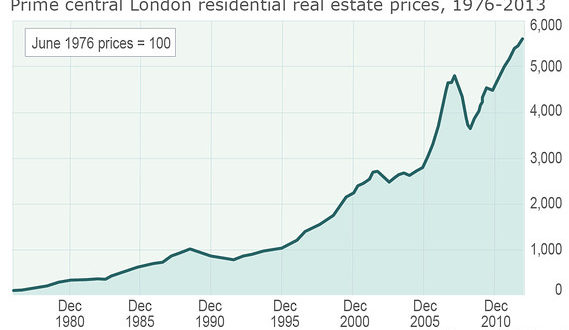
However, another interesting bubble is developing at a regional level in the financial capital of Europe – London. London has long been famous as an investment destination, a place to hide shady income, as well as perhaps the most important banking center in the whole world. Interestingly, in the last one or two years the property market in the capital of Great Britain has experienced an unprecedented boom.
As of June 2014, house prices in London had risen by 26% year-on-year, according to Nationwide. While this rate of growth may seem more reasonable in the context of a poor emerging economy, such results raise serious questions about the sustainability of London’s growth. To give a more complete picture, it is worth citing a few more figures over a longer time horizon. London property prices have risen by around 375% since 1996 and by 48% since 2009 and are currently over 15 times the average income in the capital, which is well above the levels in the US before the mortgage bubble burst, and compared to the rest of the developed world, this coefficient is only higher (around 25 times the average income) in Singapore and Hong Kong, where, in addition to also showing signs of a bubble, there is a purely territorial supply constraint while demand is constantly growing.
More important in this case is not whether there is a bubble in property prices in London, but what is the reason for such a sharp jump in prices in the last few years. On the demand side, there is both great investor interest from wealthy foreigners who have perceived London as an investment haven, and a large influx of purchases of new homes through mortgage loans. Regarding the second group, we have already published material on the loose monetary policy of the Bank of England, as well as on the various government schemes (e.g. Help-to-Buy), which help households to acquire a new home by artificially reducing interest rates. The government scheme consists of providing interest-free loans in the amount of 20% of the value of the home and guarantees when taking out a mortgage loan.
As for the group of foreign investors (which the Guardian estimates account for around a third of all property transactions in London), many of them come from emerging markets (e.g. Russia, China), where they have managed to amass their wealth through corrupt schemes and close ties to the government (crony capitalism). In addition, a large proportion of these foreign investors have amassed their wealth thanks to the bubbles inflated by central banks and the government before the Great Recession. In short, the high investment inflow into the London property market can largely be attributed to government intervention in one form or another.
As for supply, there are a bunch of heavy regulations in London that prevent construction companies from increasing supply at the rate of demand growth, and as we know from Economics 101, when demand grows faster than supply, prices rise, all other things being equal. An example of this are the so-called "green belts" around the British capital, which make expansion of the city impossible.
The Bank of England has already taken steps to cool property prices in the capital. Under one measure approved at the end of June, for example, no more than 15% of new mortgages issued by banks can be given to households with a property price-to-income ratio above 4.5. And while these measures may have some minimal cooling effect on the bubble, the low interest rate environment, foreign capital inflows and constraints on the supply of property will continue to push up property prices in London. Unfortunately, the middle class and working people who do not receive state benefits will be the hardest hit by this bubble. Both groups will find it increasingly difficult to buy a home, and perhaps even to pay their rent.
Източници:
https://ekipbg.com/balonat-na-nedvijimi-imot-v-velikobritania/
www.http://www.online.wsj.com/articles/bank-of-england-tightens-mortgage-lending-rules-1403776130"online.wsj.com/articles/bank-of-england-tightens-mortgage-lending-rules-1403776130
www.theguardian.com/housing-network/2013/nov/14/london-property-foreign-investors
http://www.standard.co.uk/news/london/london-living-through-biggest-house-price-bubble-ever-9221297.html
www.seekingalpha.com/article/2289663-londons-housing-market-has-gone-bonkers