EKIP– Expert Club for Economics and Politics A Different Opinion
Six years after the Lehman Brothers collapse, the UK is one of the few developed economies to have managed to regain its pre-crisis level of output (measured by gross domestic product) and is even expected to be the fastest growing among the G7 countries this year. In the third quarter of 2014, UK GDP increased by 0.7% quarter-on-quarter and 3.0% year-on-year, slowing slightly from the second quarter of the year, but the UK remains one of the fastest growing economies, even outpacing the growth of many emerging markets.
The UK job market continues to recover, with the unemployment rate hitting a six-year low of 6% in the third quarter of 2014, while the employment rate (a better indicator of the state of the labour market) is now higher than it was before the Great Recession. These developments have led many analysts to expect the Bank of England to be the first of the world's major central banks to tighten monetary policy by raising its key interest rate, even though consumer inflation in the UK remains below the bank's 2% target.
Графика 1: БВП на Великобритания с база 100 през първото тримесечие на 2008 г.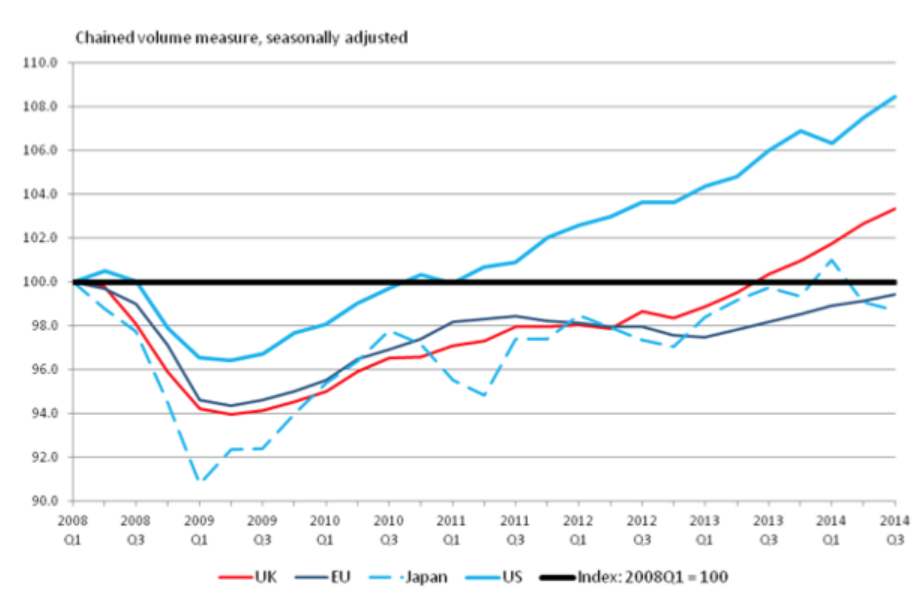
Източник: Guardian
At first glance, especially through the prism of the most commonly used economic indicators, it seems that the UK has already emerged from the crisis and is on a meteoric rise. However, the devil is in the details. With the exception of the third quarter of 2014, for the past five years, consumer price growth in the UK has outpaced nominal wage growth, meaning that, on an aggregate level, UK workers are getting poorer as real wages have been falling. Although we are not in favour of using aggregate data, as they hide what is happening at the micro level, the figures clearly show that something is wrong with the British economy. If we look closely at the GDP growth figures for the third quarter, it is clear that it was driven mainly by household consumption, which grew at its fastest pace in three years, while exports fell. The central bank has begun to question the sustainability of the consumption-led economic recovery, especially as real wages are falling and consumption growth is being driven exclusively by private debt. It is ironic that the central bank is questioning the sustainability of this growth model, given that it is precisely the institution’s loose monetary policy and credit-facilitation programs that are providing the incentives for households to borrow and consume.
As a result of the central bank’s loose monetary policy, purchases of durable goods on credit increased sharply in 2014. From January to October, for example, Britons bought 2.14 million new cars, reaching the levels of purchases since 2007, and “easy” credit managed to inflate a bubble in the real estate market again – a topic we have already written about. The annual current account deficit of Britain exceeds 5% of GDP – the highest deficit in the country’s history – and is an indication that the British are living beyond their actual economic possibilities. Moreover – such a high current account deficit is much more typical of a developing economy, due to the lack of domestic savings to finance investment in capital assets and thus ensure sustainable growth in the future. For Britain, the problem is not only the financial part of the balance of payments, but also the detailed breakdown of the current account. Even if the current account deficit were financed by debt, if the spending that inflated it were actually investment in capital goods, purchased in response to actual market signals, rather than loose monetary and credit policies that would generate income in the coming years, then the potential risks facing Britain would not be alarming. However, the current account deficit is mainly due to current consumption of consumer goods, which is a sure recipe for future problems.
Графика 2: Баланс на текущата сметка във Великобритания като % от БВП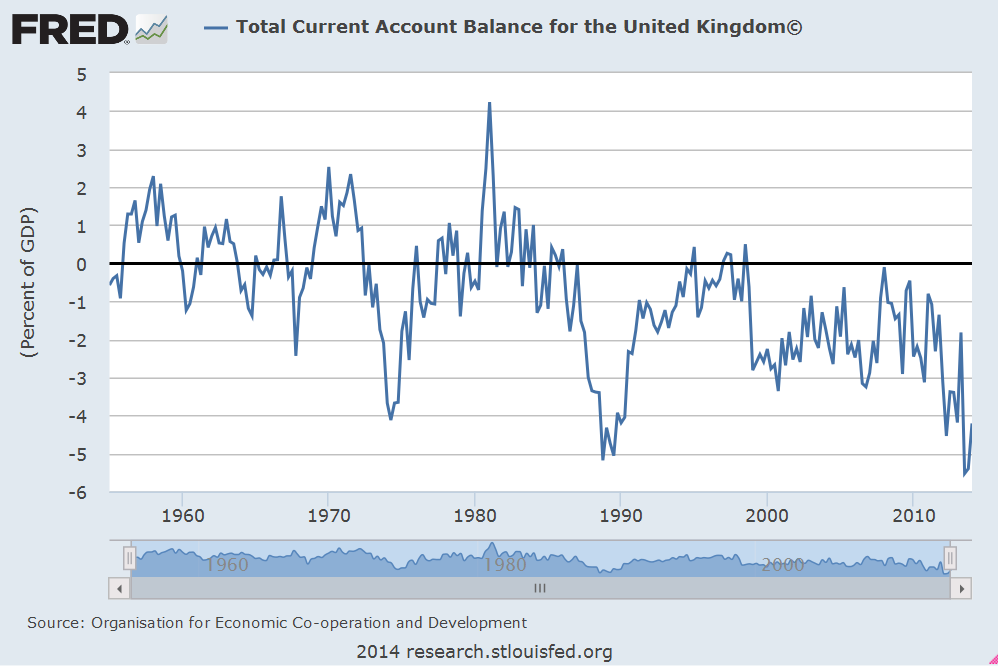
Източник: ОИСР
A few more paragraphs could be written with comments on various economic indicators for the UK, but in the end the conclusion will not change – the country’s economic recovery is not sustainable, and the structural problems of the island have not yet been adequately addressed. The Central Bank and its loose monetary policy are among the main culprits for this situation, due to the stimulation of cheap credit, which in turn distorts the market and inflates bubbles in some asset classes.