 EKIP– Expert Club for Economics and Politics A Different Opinion
 Frank Shostak
In his article "The Big Meh," Paul Krugman complains that despite all the advances in information technology, its effect on economic growth is currently insignificant.
He writes: “The entire digital era, now more than four decades old, seems like a disappointment. New technologies have led to great discoveries but modest economic results. Why? … The answer is that I don’t know; nor does anyone else.”
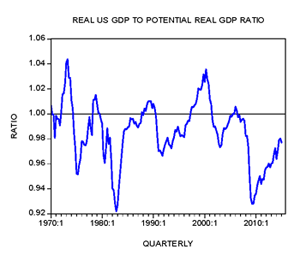
In fact, if one compares real gross domestic product growth to potential gross domestic product, the economy is running below its potential at a ratio of 0.977, recorded in the first quarter of this year.
Chart 1: US real-to-potential GDP rate
Contrary to Krugman, economists such as Ludwig von Mises and Murray Rothbard have provided a clear answer to the question of technology and economic growth. In Man , Economy , and State, Rothbard states that technology must be developed through the investment of capital in order to generate economic growth. On this point, Rothbard quotes Mises as saying:
"What is lacking (in underdeveloped countries) is not the knowledge of Western technological methods (know-how); that is relatively easy to learn. The service of acquiring knowledge – through teachers or books – can be paid for. What is lacking is the stock of the necessary saved capital with which to put modern production methods into use."
Most contemporary theories emphasizing the importance of new ideas and new technologies give the impression that these technologies and ideas have a “life of their own.” Many experts argue that due to the limited supply of capital and labor, without technological progress, opportunities for growth will eventually run out.
We need capital to implement new ideas
Ideas, unlike material resources, are inherently not scarce. Consequently, it is argued that new ideas for more efficient processes and new products can make continuous growth possible. [1]
We argue that no matter how many ideas people have, what matters is whether they can be implemented. What always limits the implementation of new technologies is the availability of funding. While ideas and new technologies can lead to better use of limited resources, ultimately, without real funding, not much can be achieved.
Therefore, no matter how smart we are and no matter how many technological ideas we have, without adequate financing we will achieve nothing. Increasing the stock of capital goods is possible through increasing real savings. It is precisely the increase in capital goods per unit of labor that allows economic growth to be created.
More financing requires more savings
It is obvious that new ideas and new technologies can be introduced during the process of producing new capital assets (i.e., new technology) and that they thereby become part of the stock of capital goods. However, the important point here is that capital goods do not appear without a prior increase in funds or real savings.
Take, for example, John the baker, who makes ten loaves of bread. He consumes two loaves of bread, while using the other two loaves—his real savings—to buy equipment that improves the baking in his oven. With a better oven, he can now increase his production to twenty loaves. If he continues to consume only two loaves of bread (he already has 18 loaves), the baker will be able to improve his baking even further by implementing new technology. Note that all of this was made possible by the real savings he made.
In our opinion, despite new technologies, the main obstacle to economic growth is the central bank, which intervenes in the financial markets.
Since 2008, this intervention has manifested itself as the Federal Reserve's highly controversial monetary policy, which has led to a massive monetary expansion of its balance sheet and a reduction in interest rates to almost zero.
These policies are responsible for the severe erosion of real savings and the weakening of the capital formation process. This in turn has undermined real economic growth, despite the development of new information technologies.
For Krugman and his followers, savings are bad news—they are seen as a decline in demand. It is therefore not surprising that Krugman is puzzled why new ideas have not led to more stable economic growth. Contrary to his views, increasing so-called aggregate demand undermines the process of capital formation, and hence the capacity to produce goods and services cannot increase and cannot increase economic growth over time. In fact, his way of thinking leads to the idea that something can be generated from nothing.
The original text in English can be found here.
[1] Regarding the relationship between capital and education, see Daniel Vassilev's article " The Causal Relationship Between Economic Growth and Education ".






The current financial system is based on false foundations and because of usury, continuous growth is needed, and this is impossible, and Prof. Jeffrey Sachs, advisor to the UN Secretary General, also says so - http://darikfinance.bg/novini/111777#comments
In comment #2 I also gave the web addresses of Mr. Hitov, a doctor of economics and a lecturer at the University of National and World Economy, who explains things beautifully, etc. It is about 3 planetary catastrophes and I have described why 6% of the world's GDP should be invested in precisely defined things.
The current financial system is based on false foundations and because of usury, continuous growth is needed, and this is impossible, and Prof. Jeffrey Sachs, advisor to the UN Secretary General, also says so - http://darikfinance.bg/novini/111777#comments
I explained everything in comment #2.