EKIP– Expert Club for Economics and Politics A Different Opinion
In recent days, we have witnessed a sharp sell-off in global equities. The negative trend in Asia, led by the stock market crash in China, has also spread to the capital markets in the US and Europe. The speculative bubble in the Chinese stock market is starting to burst, and the monetary authorities are doing everything they can to prevent this. But how long will this dangerous game continue?!
In retrospect, just a week ago, the events surrounding the depreciation of the yuan’s purchasing power largely shaped market sentiment and focused attention on a number of fundamental economic issues. In the context of tight control over the local currency and the central bank’s daily reference value [1], the so-called “one-off” correction, which lasted for three consecutive days, had a significant impact on international financial markets.
As we know, the Chinese yuan is not a freely floating currency, but is tied to the dollar. For years, the monetary authorities in China have artificially manipulated its exchange rate, maintaining a relatively “stable” exchange rate of the yuan against the dollar due to concerns that a strong depreciation of the local currency could lead to a possible outflow of capital and investment or to unwanted obstacles to exports abroad if its price rises. However, how was the lowering of the reference rate of the Chinese currency read? IMF representatives interpreted it as a kind of change in the “rules of the game” and a step towards market determination of the exchange rate. For its part, the People’s Bank of China emphasized that it uses a new method for calculating the central parity rate, based on the actions of market participants and the closing prices of trade from the previous day.
Another theory, shared by many market analysts, is that the devaluation of the yuan is being used as a tool to revive economic activity due to the belief that a weaker currency acts as a green light for increasing export trade. Official data shows that China's exports fell by 8.3% year-on-year in July, recording the largest decline in the last four months. The country's economy has slowed to its lowest growth rate in the last six years, and government debt has already exceeded 41% of GDP. With these gloomy shades of macroeconomic indicators, the Communist Party of China decided to deal with the circumstances they created (mostly thanks to their own previous interventions) with state intervention - in this case by resorting to monetary policy instruments and intervening in the foreign exchange market.
Chart 1: China's exports (year-on-year change)
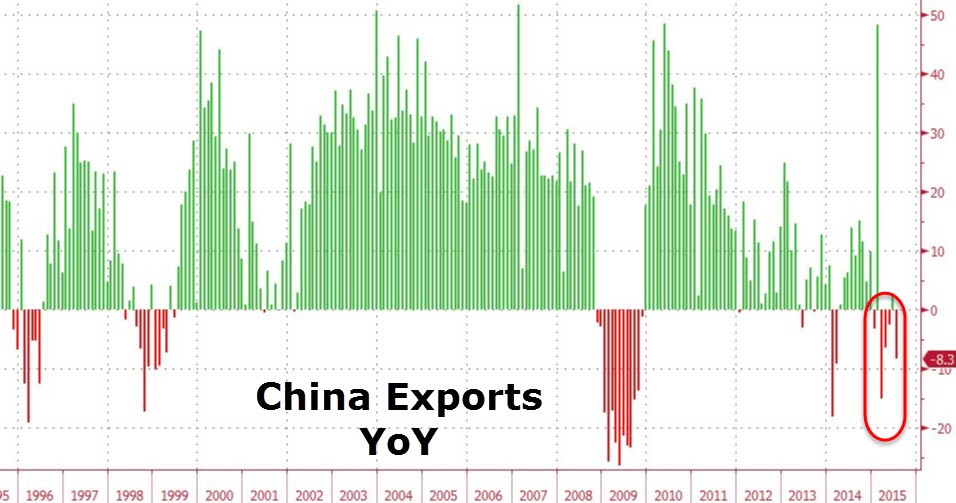
Source: Zero Hedge
Why did the People's Bank of China expand the allowable trading range?
There is a widespread misconception that the weakening of the local currency creates a prerequisite for achieving economic growth. In their efforts to stimulate exports, the Chinese authorities are trying to extract for themselves the direct positives of this policy. Its first effect is that local goods become more profitable for end consumers abroad. While the process of adapting domestic prices and wages to the conditions created by the devaluation continues, exports are stimulated (due to the relative depreciation of the currency) at the expense of imports, which become more expensive. It is believed that in this way additional demand is created, which increases the volume of exports and the profits of exporters. We must emphasize, however, that all the so-called advantages are only a temporary phenomenon. Moreover, for changes in foreign trade to occur, the remaining trading partners do not have to devalue their currencies in the same proportion.
Exports – the engine of economic growth?
When looking at only one side of the coin, one often sees distorted and misleading information about reality. A large proportion of exporters import resources, materials and components from abroad, and then export the finished product. This pattern suggests that the competitive advantage and profits of exporters cannot but be affected and serve primarily to compensate for more expensive imports. Based on such reasoning, we can hardly expect the devaluation of the yuan to contribute much to China's trade balance, although it will probably increase trade with the country's geographically close partners.
Chart 2: China's trade balance
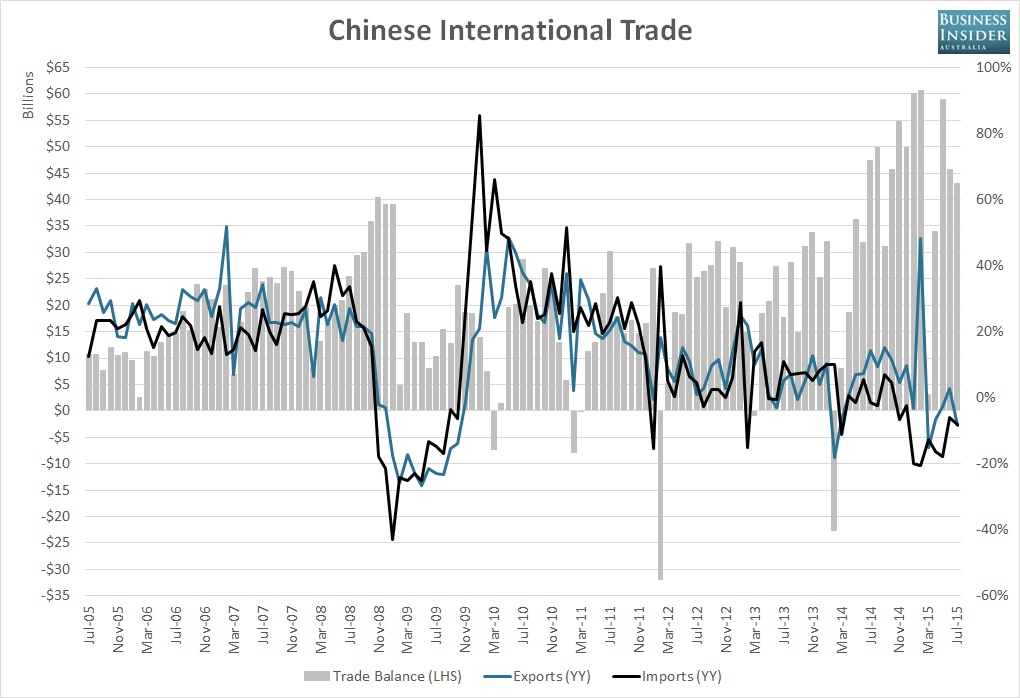
Source: Business Insider
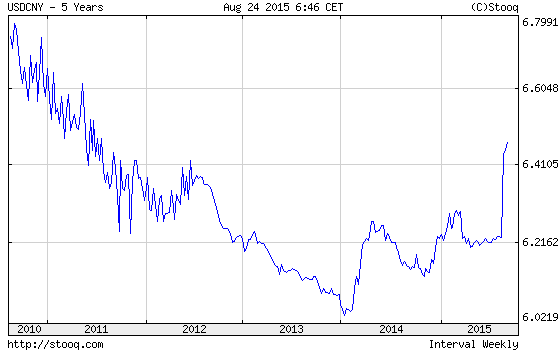
The following chart shows the yuan’s performance against the dollar over the past five years. The People’s Bank of China has maintained a rate of around 6.20 yuan per dollar in recent months, and after widening the trading band, the Chinese currency has hit its lowest level in more than three years. The question is whether the series of poor economic data and the public’s focus on the collapse in exports have provided a clear enough understanding of the objectives and reasons for the currency’s depreciation.
Chart 3: USD/CNY change as of 24.08 for the last 5 years
Source: stooq.com
One fact that could lead us to the answers we are looking for is directly related to China's foreign exchange reserves. A significant portion of China's foreign exchange reserves are in the form of US government debt. A stronger dollar against the yuan would mean that interest on the debt would bring in more yuan in China. A long-awaited increase in US interest rates would be more beneficial to Chinese holders of dollar-denominated debt, as it would increase their interest income. Whether it is because of the People's Bank of China's attempt to outpace the Federal Reserve (given the ongoing speculation about raising interest rates, which we have already written about ), by purposefully letting the yuan erase some of its value before the dollar has become the more attractive currency, or because of concerns related to the suffocating economy, which has been put on artificial respiration for so long, we are talking about the same thing - behind all this lies the unjustified and unprecedented financial planning of the country.
The Chinese regulator's actions - cause for concern or monetary acceleration?
The “hidden” move to cover up growth problems, however, failed to fool investors, as China’s stock market continued to slide sharply in recent days. [2] The Shanghai Composite Index fell below 3,000 points, its lowest level since December 2014, while major U.S. indexes fell nearly 4%. The chaos in China’s stock markets, which has sent shockwaves around the world, will not only delay the Federal Reserve’s September rate hike, but will likely lead to a fourth round of quantitative easing (QE4) sooner or later (more likely sooner).
The People's Bank of China was quick to act, cutting interest rates again and simultaneously reducing bank reserve requirements by 50 basis points to support the collapsing stock market [3] and the slowing economy. As we pointed out at the beginning, it is not surprising that another move by the state to intervene and inject additional liquidity into the financial system is being sought, but the pointless underestimation of the totally confused production structure and the fundamental role that market prices generally play will sooner or later lead to the next financial crisis.
Behind the manipulation of interest rates and the value of the yuan, China's desperate attempt to demonstrate to the world good macroeconomic indicators (gross domestic product, stock market investments and exports) is clearly visible. But, abstracting from nominal and controllable statistical data, the reality in the country is far from rosy. As a result of interventions in the financial markets and central planning in the field of monetary policy, the Communist Party inflated another economic bubble (which has already begun to burst, to the horror of the authorities in the country), and also sacrificed the purchasing power of the local population and economic stability on the altar of increasing exports. Devaluation of the currency in order to increase exports gives rise to currency wars, high levels of inflation, loss of welfare (i.e. impoverishment of the population, especially those of them who are the last to use the newly printed money) and a severe distortion of the structure of production.
Of course, these are not policies that can continue indefinitely. In a world where market signals have long been displaced by central bankers' decisions, government stimulus, artificial economic growth, and the accumulation of imbalances sooner or later lead to severe economic crises.
[1] The People's Bank of China sets a reference rate each business day, at which the yuan can fluctuate against the dollar within a certain range (up to plus or minus 2% within the day).
[2] However, by noon today, the indices had registered a slight increase.
[3] It is worth noting here that the stock market in China has been collapsing over the past 2 months largely due to the fact that the People's Bank of China cut interest rates by half in November last year, thereby inflating a huge financial bubble.