 EKIP– Expert Club for Economics and Politics A Different Opinion
On March 9, the European Central Bank (ECB) launched its expanded asset purchase program, which was officially announced at the end of January at the first meeting of the central bank’s board of directors of the year. With the expansion of the scope and volume of the program, the ECB will aim to buy €44 billion of sovereign debt of eurozone countries each month, as well as €6 billion of debt issued by supranational structures such as the European Investment Bank and the European Stability Mechanism. These amounts are added to the already existing programs for buying covered bonds (Covered bonds and ABS) worth €10 billion per month, making the entire “bazooka” worth €60 billion each month from March 2015 to September 2016. The program goes hand in hand with several restrictions, according to one of which the ECB will not buy more than 25% of the same issue of government debt of a given country, in order not to cause market distortions. Apparently, for the ECB's monetary planners, 25% is the limit beyond which intervention with artificially created money suddenly begins to influence market pricing mechanisms.
Distribution of ECB asset half-holes
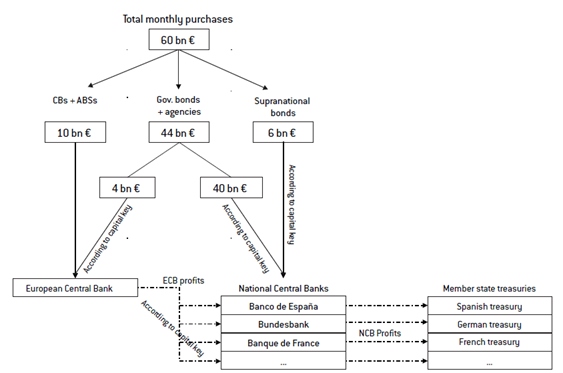
Source: ECB, Bruegel
What's happening in the debt market?
However, it is obvious otherwise when we look at what has been happening in the debt markets over the past few months. The absurdity has reached the point that a country like Portugal, with a debt of about 130% of GDP, manages to finance itself at interest rates below 2% for a 10-year period. The absurdity is even greater because the ECB buys some of the government securities at negative interest rates, which in practice means that the ECB pays certain countries (mainly those from the core of the eurozone) to keep their debt on its balance sheet. Soon, most bonds with lower maturities will most likely have negative interest rates, and since the ECB cannot buy securities with an interest rate lower than the central bank's deposit rate (currently -0.2%), a situation may arise in which the debt instruments available for purchase become a corner. In such a scenario, the ECB would most likely lower its interest rate on commercial bank deposits, further distorting the market. Each intervention leads to another intervention, until the vicious scheme finally collapses with a bang.
There are still a bunch of technical limitations to the program that may prove to be an obstacle to achieving the quantitative targets, which can be summarized in two words as - the ECB to increase its balance sheet to 3 trillion euros. For example, according to the regulations set out in the Basel 3 agreement, commercial banks have incentives to hold government bonds in their assets, which does not oblige them to set aside additional reserves as a buffer. If banks decide to sell government securities and increase lending with the proceeds, they will have to set aside money as a buffer, which certainly does not suit them given their weak balance sheets. Not to mention that the demand for loans in the euro area is still weak, which is one of the main reasons for the low credit activity. In the first two weeks, the program seems to be going "on a shoestring" when it comes to the quantitative targets for asset purchases and reducing interest rates on government securities.
Even if the ECB manages to overcome the technical difficulties of its government debt purchase program, there are still many questions about the economic effects of this program and the ethics of printing money. From an economic perspective, government bond purchases have already managed to lower the interest rates on these instruments relatively, which means a saving of resources for the government. On the other hand, the effect is also spread to the corporate sector, which means cheaper borrowing and potentially more investment. But is the artificially low cost of borrowing actually a good thing?
The consequences of the ECB's programs
Below-market interest rates create the false impression that savings are abundant in the economy, which incentivizes companies (and governments in some cases) to invest money in projects that have a negative net present value at true market financing prices. This diverts resources to bad investments that, when interest rates rise, turn out to be unprofitable. In short, a waste of scarce resources and a waste of time.
It is not that the corporate sector in the eurozone has rushed to borrow, it is already over-indebted. On the government side, low interest rates create an incentive to postpone reforms, as the educational role of the market is absent. As we saw in the case of Greece, where the ECB cannot buy government securities through its asset purchase program, the markets put the Syriza government on its feet with its creditors and European partners, and the far-left party quickly softened its tone. On the other side of Europe stands Portugal, which, thanks to low interest rates, feels no pressure to reform, and since it officially exited its bailout program last year, has reversed even the few positive changes that have been implemented so far.
The ECB’s expanded asset purchase program will buy some time for eurozone governments to take advantage of the distorted debt market and implement the necessary reforms, something that has been delayed for six years since the start of the crisis. On the other hand, the ECB’s program will significantly increase the price of government bonds, which will allow the institutions that hold these instruments (banks, investment funds, pension funds, hedge funds, etc.) to make solid profits. Last but not least, it should be noted that by making investment in government debt relatively more attractive than investment in the private sector, the ECB’s purchases will “crowd out” investment in productive activities, redirecting resources to the purchase of instruments that promise a payment in the future, which may not happen. Not to mention the effect of this program on the exchange rate of the euro against other currencies such as the pound and the dollar, which has already made the price of many imported goods and services more expensive for consumers in Europe. In short, the ECB continues to take good care of its friends in the financial sector and the governments of the eurozone, while ignoring the interests of everyone else.
Sources:
http://www.forbes.com/sites/raoulruparel/2015/03/05/ecb-ready-to-launch-qe-but-who-will-sell-to-it/





Apparently they don't understand that the "system" has failed - they got caught in their own webs
In 2011, an interesting book by Richard Heinberg, The End of Growth: Adapting to Our New Economic Reality, was published. The author makes a startling diagnosis: humanity has reached a fundamental turning point in its economic history. The trajectory of the expansion of industrial civilization is facing indisputable natural limits. Further growth will be blocked by three factors: resource depletion, environmental constraints, and the crushing volume of debt. These interacting constraints, Heinberg writes, will force us to reassess cherished economic theories and rethink money and trade. If we set goals that enhance human and environmental well-being, we must learn to save, rather than continue to pursue the impossible – endless growth in GDP.
I have explained what to do - https://www.facebook.com/atanas.shalapatov/posts/1442612112683685
In one sentence, 3 planetary catastrophes are coming and I know how to avoid them
Mr. Mitko Hitov, PhD in Economics, says it well - ''For almost 30 years, the world has been riding in a car with a damaged engine. Its replacement means a fundamental change in all institutions in the economies of the world, built over the past decades.
This is not a recession, this is a systemic crisis'' - http://www.investor.bg/blogosfera/363/a/svetyt--v-recesiia-ili-v-sistemna-kriza-92906/
Mr. Harsev also said it well - A debt revolution is coming,
A mechanism is needed to make the debt of the drowning countries bearable. The entire national debt cannot be "cut" (i.e., nullified by law or a new global treaty) indiscriminately. This will plunge the financial world into unmanageable chaos. Such a mechanism could be inflation. 10% average annual inflation for about 15 years will devalue the old debt of the bankrupt countries - as long as they do not go into debt faster than they do now. Another mechanism that central banks are already installing is the imaginary economy of negative interest rates, i.e., savers will be forced to pay a tax on money in banks, and banks will be turned into collectors of a new "liquidity tax" and will pay it through central banks into the state budget. Both methods: the inflationary typhoon and the quasi-tax, through negative interest rates, portend
end of the conventional banking system,
new rules, new institutions and new paths for global finance
Well, it won't happen exactly like that.
The so-called ''business crises'' of capitalism are theft through inflation, etc. methods
Around 1981, the US realized that the "system" was not working and wondered what to do.
First they created the "Washington Consensus" and in 1999 they repealed the 1933 Glass-Steagall Act to deregulate banking.
''The analysis of the "index of economic freedom", made in 1997 by Brett Schaefer for the Heritage Foundation, shows that during the period 1965-1995 the IMF, as the main instrument of the financial and economic policy implemented by the USA, carried out "rescue operations" in 89 countries. Today, however, 48 of them are in approximately the same situation as before receiving funds from the fund, and 32 have become even poorer, falling into economic collapse. It is no coincidence that the former chief economist of the World Bank and Nobel laureate Joseph Stiglitz claims that it was the policy of the "Washington Consensus" that provoked the Asian financial crisis of the late 90s (as well as the one in Russia). In turn, the Italian sociologist Giovanni Arrighi defines this as “accumulation by seizure”, indicating that with the help of financial crises and defaults, huge financial resources have been “seized” from developing countries, accumulating in the USA and other developed countries of the G-7. By the way, it is in this connection that the famous American preacher and civil rights fighter Jesse Jackson points out that “Empires have long stopped using bullets and the whip, and instead rely on the World Bank and the IMF” - http://venziko.blog.bg/biznes/2012/10/04/kak-i-zashto-vyznikna-ikonomicheskata-organizaciia-briks.1005985
Economics is a special science and Prof. D.Sc. (Econ.) Ivan Angelov explains it well - ''In the initial stages of its development, every country needs protection for its fledgling economy until it gets firmly on its feet. There are millions of examples around the world and they date back centuries. In his work in 2002, Ha-Joon Chang proved once again a generally known truth that all current rich countries have used economic protectionism on a massive scale in the early stages of their industrial development. And after the formation of the dictates of the Washington Consensus in the late 1980s, these same countries have not allowed us to do this in recent decades! The refusal of protectionist policies became a mandatory condition for membership in GATT, and then in the World Trade Organization. Moreover, they try to convince us that free trade was beneficial for medium- and underdeveloped economies. This is not true! Trade realities are quite different...the USA, the UK and almost all the countries of Western Europe in recent centuries and especially after the Second World War, and also in Japan and Latin America in the 1950s-1970s. Japan would hardly be what it is now without the large-scale implementation of protectionist policies after 1945, recommended and developed with the help of the economic part of the American occupation administration, then dominated by the ideas of the Keynesian school. The prominent economist and former president of Mexico (from 1994 to 2000) Ernesto Zedillo recommended the wider use of such policies in a special report to the UN Secretary-General in 2000. The then dominant conservative philosophy of the Washington Consensus ensured that this idea was stifled. A serious reassessment of the concept of world trade liberalization is needed. Especially because of the inequality between competitive highly developed countries and uncompetitive middle- and underdeveloped countries. Moreover, a similar reassessment is also needed for the conditions of the Common European Market'' - http://www.iki.bas.bg/english/CVita/angelov/No218.htm - The world is already abandoning the so-called Washington Consensus and gradually adopting modern Keynesianism. I substantiated this need in my report at a scientific conference on October 8, 1999 at the Institute of Economics of the Bulgarian Academy of Sciences....The Bulgarian public (and not only it) was deceived for many years that Adam Smith was in favor of completely removing the state from participating in the management of the economy and for giving it entirely to the market....''
1999. we know, but what is being done in our country????